

Key Takeaways
- A budget audit compares what you planned to spend against what you actually spent.
- Pulling 2-3 months of bank and credit card statements gives you reliable patterns, not flukes.
- Categories that routinely overspend are targets for adjustment, not just awareness.
- A budget audit is a reset tool - not a way to assign blame for past decisions.
- Updating your budget after the audit makes the next review faster and more useful.
What you will need
What a Budget Audit Actually Is
A budget audit is a structured comparison between the spending plan you had and the spending reality you lived. It's not about guilt - it's about data. When your bank balance keeps ending up lower than expected, or you can't explain where a paycheck went, a budget audit surfaces the specific gaps causing the problem.
This is different from simply checking your account balance. You're looking for patterns across categories - subscriptions that crept up, dining spending that drifted, or an insurance premium that increased without a matching budget adjustment. Once those gaps are visible, you can make deliberate choices rather than guessing.
If you've never set up a formal budget before, you may want to start with building a budget from scratch first, then return here to audit it.
What you will need
How to Run Your Budget Audit
Follow these steps in order. The whole process typically takes 30-90 minutes depending on how many accounts you manage and how recently you last reviewed your finances.
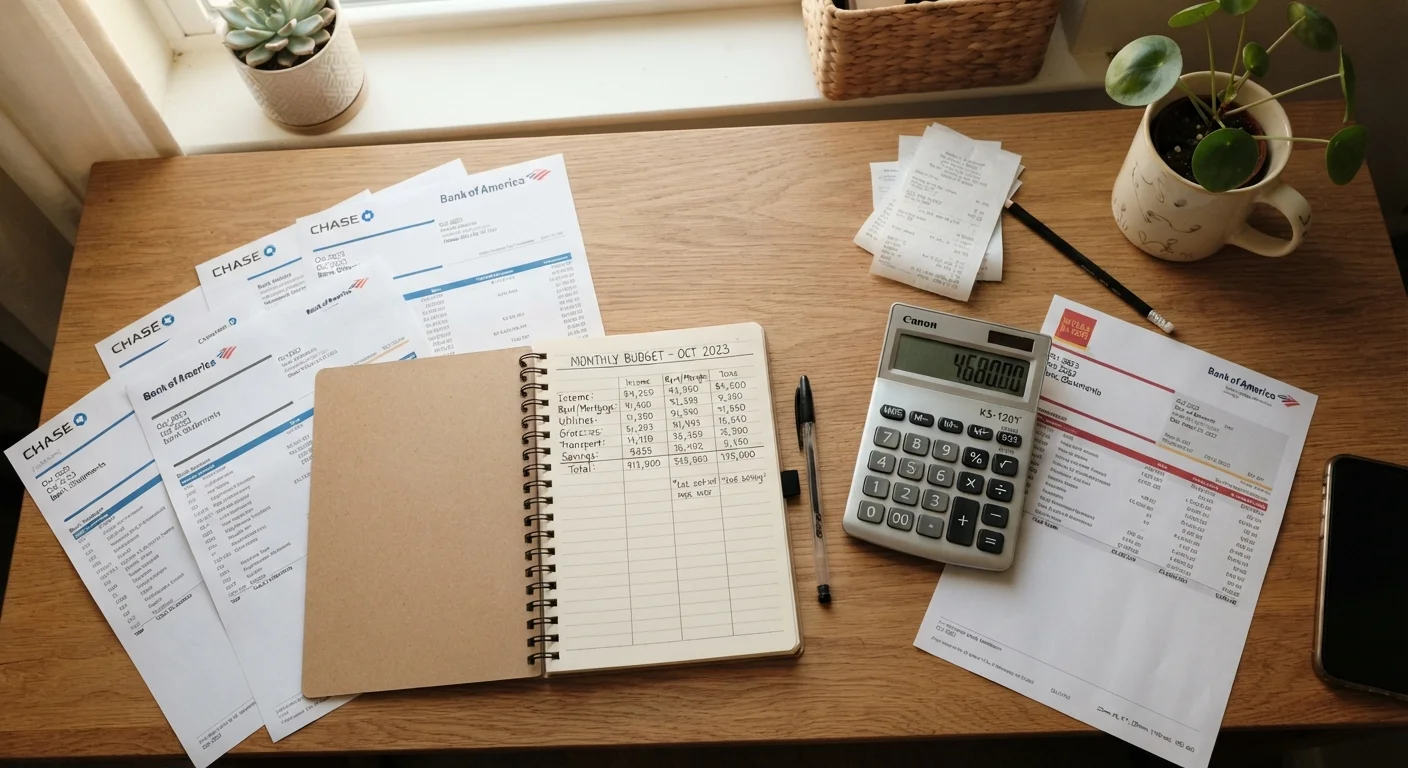
Gather your statements for the last 2-3 months
Log in to your bank and credit card portals and download or print statements covering the past two to three months. Using multiple months smooths out one-time fluctuations - a single expensive month can look like a pattern when it isn't, and a single cheap month can hide a real problem.
Include every account money flows through: checking, savings used for regular expenses, and all credit cards, even ones you pay in full each month.
List every spending category and its actual total
Go line by line through your transactions and assign each one to a category: housing, groceries, dining out, transportation, utilities, subscriptions, healthcare, personal care, clothing, entertainment, and so on. Then total each category across all three months and divide by three to get a monthly average.
Be specific enough that the numbers are useful. "Food" is too broad - split it into groceries and restaurants so you can see where spending actually lives.
Compare actuals against your budgeted amounts
Place your actual monthly averages next to your budgeted amounts for each category. Calculate the difference - positive means you came in under budget; negative means you overspent. Note which categories show a gap and how large it is.
Look especially at categories with consistent gaps across all three months. A single overage might be a genuine one-time event. Three in a row is a pattern your budget isn't capturing.
Identify fixed expenses that have changed
Fixed costs - rent, insurance premiums, loan minimums, phone plans - are supposed to stay constant, but they often shift quietly. Check whether any recurring charges have increased since you last set your budget. Insurance renewals, streaming price hikes, and annual subscription renewals are common culprits.
Update your budget immediately to reflect the current actual cost of every fixed line item, not the amount you originally budgeted.
Adjust your budget to reflect realistic numbers
With gaps and changes identified, revise your budget. There are two levers: reduce spending in overspent categories, or reduce a different category to create room. If total spending consistently exceeds income, you'll need to address that gap explicitly - either by cutting spending, increasing income, or both.
Set updated budget figures that are grounded in your actual behavior, with intentional targets where you want to change. A budget that reflects reality is far more useful than one built on hope. For guidance on different structural approaches, see how different budgeting styles compare.
Schedule Your Next Audit Before You Finish This One
One of the most effective habits in personal finance is treating the budget audit as a recurring calendar event rather than an emergency measure. Set a reminder for 90 days out before you close your spreadsheet. When the audit becomes routine, the gaps stay smaller and the fixes stay easier.
Once you've completed the audit and adjusted your numbers, consider pairing this exercise with a broader check-in on your saving habits. The personal savings audit covers emergency funds, automation, and goal alignment - all of which are affected by how well your day-to-day budget holds.
What to Do with the Results
An audit only has value if you act on what it shows. After completing the steps above, you'll likely fall into one of two situations:
- Your income and spending are misaligned: Spending consistently exceeds income in certain categories. You'll need to either reduce those categories or, if that's not possible, find offsetting reductions elsewhere.
- Your budget categories were unrealistic from the start: This is more common than most people expect. Budgets built on aspirational numbers - rather than actual past spending - fail quickly. Adjust the budget to reflect reality, then work toward improvement gradually.
If you find that your current budgeting method isn't working structurally, it may be worth exploring a different approach altogether. Comparing budgeting styles can help you find a framework that matches how you actually manage money, not just how you think you should.
Don't Adjust the Budget Without Adjusting Behavior
It's tempting to simply raise your dining budget to match what you actually spend, declare the problem solved, and move on. But if that category is crowding out savings or debt payoff, the adjustment needs to come with a deliberate trade-off elsewhere. Updating numbers without making choices just shifts the imbalance rather than resolving it.
Revisit your budget audit every 3-6 months, or immediately after any major financial change - a new job, a move, or a significant recurring expense. Budgets aren't permanent documents; they're working tools that should evolve alongside your life.
This article is for general informational purposes only and does not constitute personalized financial advice. For guidance specific to your situation, consider consulting a licensed financial professional.