

Key Takeaways
- Minimum payments are typically 1-3% of your balance, barely covering interest charges.
- Daily compounding means interest grows on interest every single day you carry a balance.
- A $3,000 balance paid at minimum could take over a decade to clear and cost thousands in interest.
- Paying even a small amount above the minimum significantly reduces total interest paid.
- Understanding how your card calculates minimums helps you make smarter payoff decisions.
How Minimum Payments Actually Work
When you carry a credit card balance, your issuer requires a minimum payment each billing cycle to keep the account in good standing. That minimum is typically calculated one of two ways: a flat dollar floor (often $25-$35) or a percentage of the outstanding balance - usually 1-3% - whichever is greater.
At first glance, a 2% minimum on a $3,000 balance sounds modest: $60 per month. But here's the problem - at a 20% APR, approximately $50 of that $60 goes directly to interest charges. Only $10 reduces the actual principal. That's why balances shrink so slowly on minimum-only payments.
To understand the full picture of how interest accumulates on a revolving balance, see how credit card debt compounds faster than most people expect.
20%+
Average credit card APR in recent years
According to Federal Reserve consumer credit data, average credit card interest rates have exceeded 20% annually in recent reporting periods.
~13 years
Estimated payoff time on $3,000 at minimum payments
Illustrative calculation assuming an 20% APR and a 2% minimum payment floor; actual results depend on your card's specific terms.
The Real Cost: A Concrete Example
Consider a $3,000 balance at 20% APR. If you pay only the minimum each month - and the minimum shrinks as the balance does - you could spend roughly 13 years paying off that debt and fork over more than $3,000 in interest alone. You'd effectively pay double the original amount borrowed.
Increase your payment to a fixed $100 per month and that timeline drops to under four years, with significantly less total interest. A fixed $150 monthly payment could clear the same debt in roughly two years. The math rewards any amount above the minimum.
Minimum Payments Are Designed to Keep You Paying Longer
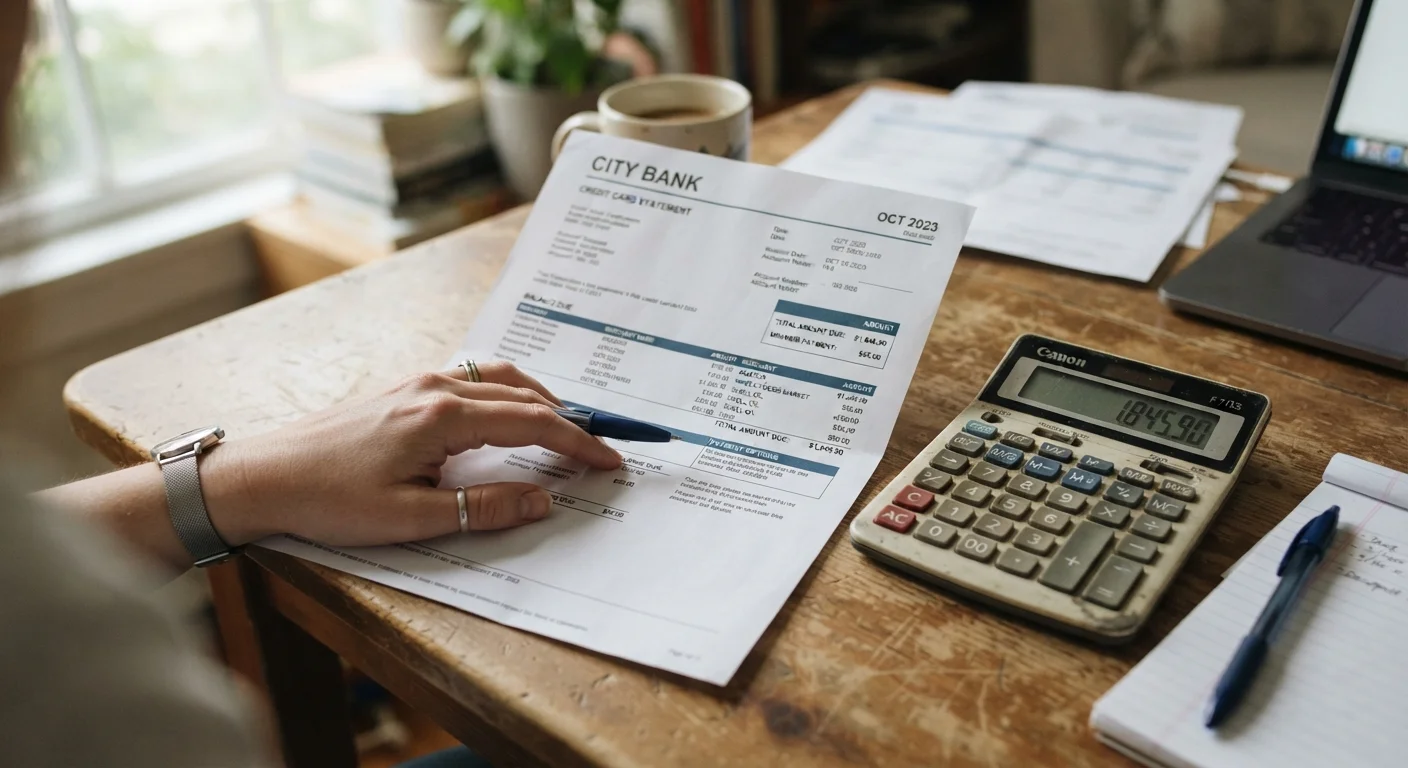
Card issuers set minimum payment formulas that satisfy regulators while extending the time you carry a balance - which means more interest collected. Always check your statement's 'Minimum Payment Warning' box, which is federally required to show how long payoff takes at the minimum rate. That number is often alarming enough to prompt action.
This same logic applies in other borrowing contexts. How loan terms affect what you actually pay on a car illustrates how stretching payments over time increases total cost - a pattern consistent across credit cards, auto loans, and beyond.
Common Mistakes That Keep You Stuck - and How to Break Free
Most people don't set out to stay in debt for a decade. They pay the minimum because it keeps things manageable month-to-month, or because they don't realize how little of each payment actually reduces their balance. The mistakes below are the most common traps - and each has a straightforward fix.
Treating the minimum payment as the 'right' amount to pay each month.
Why it happens: Credit card statements present the minimum payment prominently, making it feel like a standard, sufficient amount rather than a bare-floor figure.
Underestimating how daily compounding accelerates a growing balance.
Why it happens: Most people think of interest as a monthly charge, but most card issuers calculate interest daily using your Average Daily Balance (ADB). Small daily additions accumulate quickly.
Making new purchases while carrying a balance and paying minimums.
Why it happens: When cash flow is tight, using a card for new expenses feels manageable because the minimum payment absorbs everything. In reality, new charges add to the principal that interest is calculated on.
Ignoring the 'Minimum Payment Warning' box on monthly statements.
Why it happens: Statements are dense documents. Most readers scan for the balance and minimum due, skipping the disclosures that reveal the true cost of minimum-only payments.
Assuming a lower interest rate makes minimum payments harmless.
Why it happens: Borrowers with cards at 15% APR sometimes feel less urgency than those at 25% APR, but compounding at any rate extends repayment and inflates total cost significantly at low payment levels.
If you want a broader framework for managing debt sustainably, principles that hold up over time for keeping debt under control covers budgeting, prioritization, and working with lenders effectively.
This Is General Information, Not Financial Advice
The examples in this article use illustrative figures to explain how minimum payments and interest compounding work. Your actual balance, interest rate, and minimum payment formula will vary by card issuer. Consult a licensed financial adviser or credit counselor for guidance specific to your situation.
This article is for general informational purposes only and does not constitute personalized financial or legal advice. Credit card terms, interest calculations, and minimum payment formulas vary by issuer. Consult a licensed financial professional or nonprofit credit counselor for guidance tailored to your circumstances.