

Key Takeaways
- Comprehensive covers non-collision events like theft, hail, floods, and animal strikes.
- Collision covers damage from hitting another vehicle, object, or rolling over - regardless of fault.
- Lenders typically require both coverages on financed or leased vehicles.
- On older, lower-value vehicles, dropping one or both coverages may make financial sense.
- Both coverages involve a deductible you pay before the insurer covers the remainder.
Option A
Comprehensive Coverage
Protection against events outside your control.
Best for: Drivers concerned about theft, weather damage, falling objects, or animal strikes.
Option B
Collision Coverage
Protection when your vehicle makes contact with something.
Best for: Drivers who want their insurer to cover repair costs after an at-fault or single-car accident.
If your vehicle is financed or leased
Both Comprehensive and Collision Coverage
Most lenders and leasing companies contractually require both coverages for the duration of the loan or lease.
If your car's market value is low relative to your annual premiums
Neither - liability-only may suffice
When the combined cost of both coverages approaches the vehicle's actual cash value, the financial case for keeping them weakens significantly.
If you live in an area prone to severe weather, flooding, or high vehicle theft
Comprehensive Coverage
Comprehensive directly addresses the non-collision risks most elevated in those environments, making it particularly valuable there.
If you commute frequently or drive in high-traffic urban areas
Collision Coverage
Higher daily driving exposure increases the statistical likelihood of a collision, making this coverage worth its cost for frequent drivers.
If you own a newer or higher-value vehicle outright
Both Comprehensive and Collision Coverage
The cost to repair or replace a valuable vehicle is high enough that carrying both coverages is typically a sound financial decision.
What Each Coverage Actually Covers
At a high level, both comprehensive and collision coverage pay to repair or replace your vehicle - but the trigger for each is entirely different. Understanding that distinction is the key to knowing which one you need. For a broader look at how these fit within a full policy, see how liability, collision, and comprehensive differ.
Comprehensive Coverage
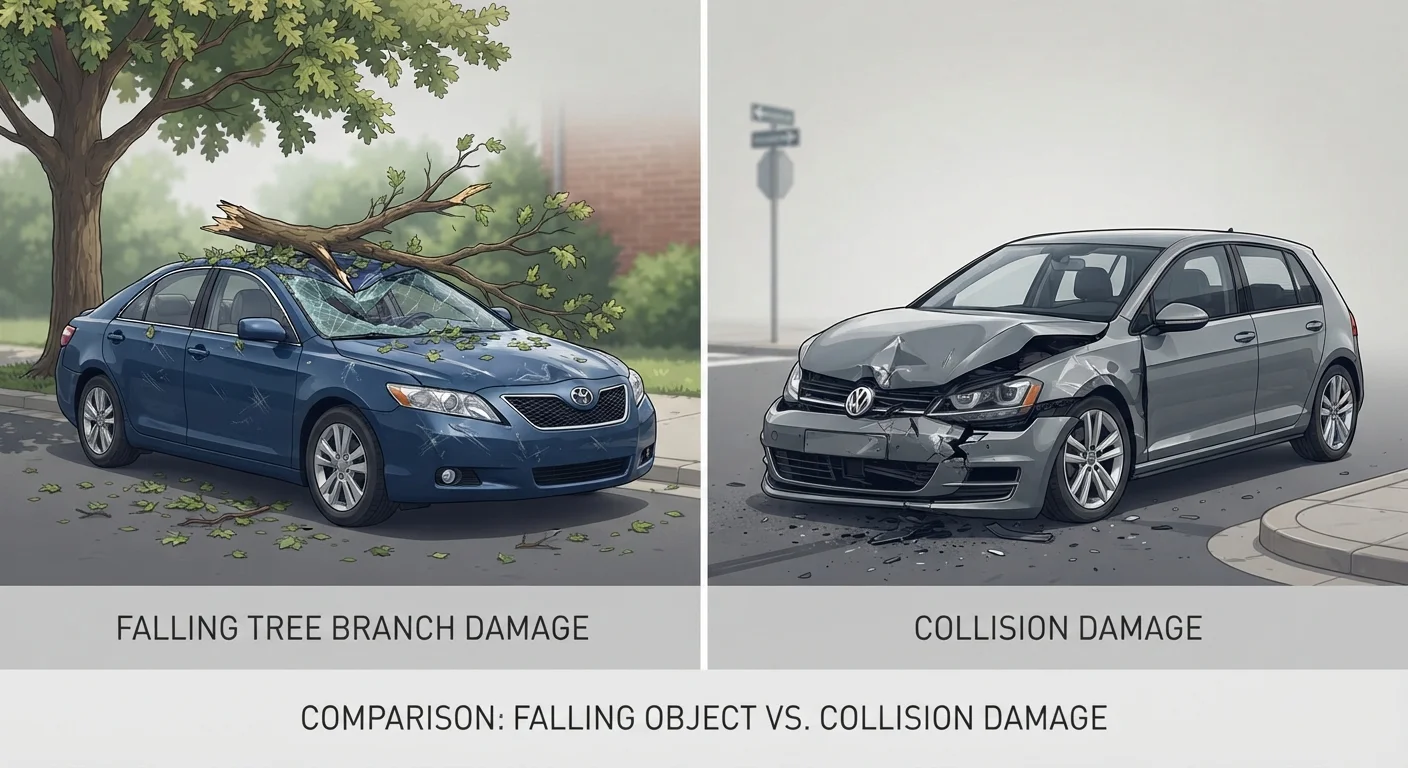
Despite its name, comprehensive does not cover everything. It specifically covers damage to your vehicle caused by events that are generally outside your control and do not involve a collision with another vehicle or object you drove into. Common covered events include:
- Theft or vandalism
- Fire
- Hail, flooding, or other weather-related damage
- Falling objects (trees, debris)
- Striking an animal, such as a deer
Collision Coverage
Collision coverage applies when your vehicle physically contacts something - another car, a guardrail, a fence, or a stationary object - or if your vehicle rolls over. Critically, collision coverage applies regardless of who is at fault. Even if you caused the accident, collision coverage steps in to pay for your vehicle's repairs, minus your deductible.
| Criterion | Comprehensive | Collision |
|---|---|---|
| What triggers a claim | Non-collision events (theft, weather, animals) | Contact with vehicle, object, or rollover |
| Fault required | Not applicable - event-based | No - covers regardless of fault |
| Typical relative cost | Generally lower premium | Generally higher premium |
| Deductible applies | Yes | Yes |
| Required by lenders | Yes, on financed/leased vehicles | Yes, on financed/leased vehicles |
| Covers theft | Yes | No |
| Covers hitting a deer | Yes | No |
| Covers hitting a guardrail | No | Yes |
Deductibles, Premiums, and Real Costs
Both coverage types require you to choose a deductible - the amount you pay out of pocket before your insurer covers the rest. Typical deductibles range from $250 to $1,500. A higher deductible lowers your monthly premium but means more out-of-pocket expense after a claim.
~$134/yr
Average annual comprehensive premium (US)
According to the National Association of Insurance Commissioners (NAIC), the average expenditure for comprehensive coverage has historically hovered around this range, though it varies significantly by state and driver profile.
~$363/yr
Average annual collision premium (US)
NAIC data consistently shows collision as the more expensive of the two physical damage coverages, reflecting its higher claim frequency compared to comprehensive.
Collision coverage generally costs more than comprehensive because collision claims are more frequent. Comprehensive claims - particularly for hail or theft - vary significantly by region. To think carefully about whether you're getting value from these coverages, consider the vehicle's actual cash value (ACV), which is what your insurer would pay if your car were totaled. If your ACV is $4,000 and you're paying $900 per year combined for both coverages with a $500 deductible, the math may not favor keeping both. General financial education on managing these kinds of tradeoffs is available through resources like budgeting guidance.
When Lenders and Leases Decide for You
If you financed your vehicle with an auto loan or are currently leasing, the choice between comprehensive and collision may not be fully yours to make. Most lenders and leasing companies require both coverages as a condition of the agreement. This protects their financial interest in the vehicle for the duration of the loan or lease.
What Happens If You Drop Coverage on a Financed Car
If you remove required comprehensive or collision coverage from a financed vehicle without the lender's knowledge, the lender may purchase what is called 'force-placed insurance' on your behalf - and charge you for it. Force-placed policies typically cost significantly more than standard market rates and protect only the lender's interest, not yours. Always check your loan agreement before modifying coverage on a vehicle you don't own outright.
Once a loan is paid off, the requirement disappears - but that doesn't automatically mean dropping the coverage is the right call. Evaluate your vehicle's current value and your personal financial cushion before making changes. If your car were totaled tomorrow with no coverage, could you comfortably replace it? That answer should guide your decision.
For drivers who owe more than their car is worth, it's also worth understanding how gap insurance works and when it matters in a total-loss scenario.
How to Think About Your Own Situation
There is no universally correct answer to how much physical damage coverage you need. Your decision should weigh several personal factors:
- Vehicle age and value: Older, lower-value vehicles may not justify the combined cost of both coverages.
- Where you live and park: High-theft ZIP codes, flood-prone regions, or areas with frequent severe weather increase the value of comprehensive coverage specifically.
- How much you drive: Higher mileage in dense traffic increases accident risk, strengthening the case for collision.
- Your financial reserves: If paying for unexpected repairs or a replacement vehicle out of pocket would be a serious hardship, maintaining coverage provides important financial protection.
For a fuller picture of how all the layers of a policy fit together, this end-to-end guide to auto insurance coverage walks through each component in depth. And if you want to understand what you're paying for more broadly, auto insurance explained is a useful starting point.
This article is for general informational purposes only and does not constitute personalized insurance or financial advice. Coverage terms, premiums, deductibles, and eligibility vary by insurer, policy, and state. Consult a licensed insurance agent or adviser to evaluate your specific situation.