

Key Takeaways
- Credit utilization accounts for roughly 30% of your FICO score - the second-largest factor after payment history.
- Keeping your utilization below 30% is widely recommended; below 10% is associated with higher scores.
- Utilization is calculated monthly based on your statement balance, so it can change quickly.
- Paying down balances or requesting a credit limit increase are two practical ways to lower your ratio.
- Utilization only applies to revolving credit - installment loans like mortgages don't factor in.
Credit Utilization
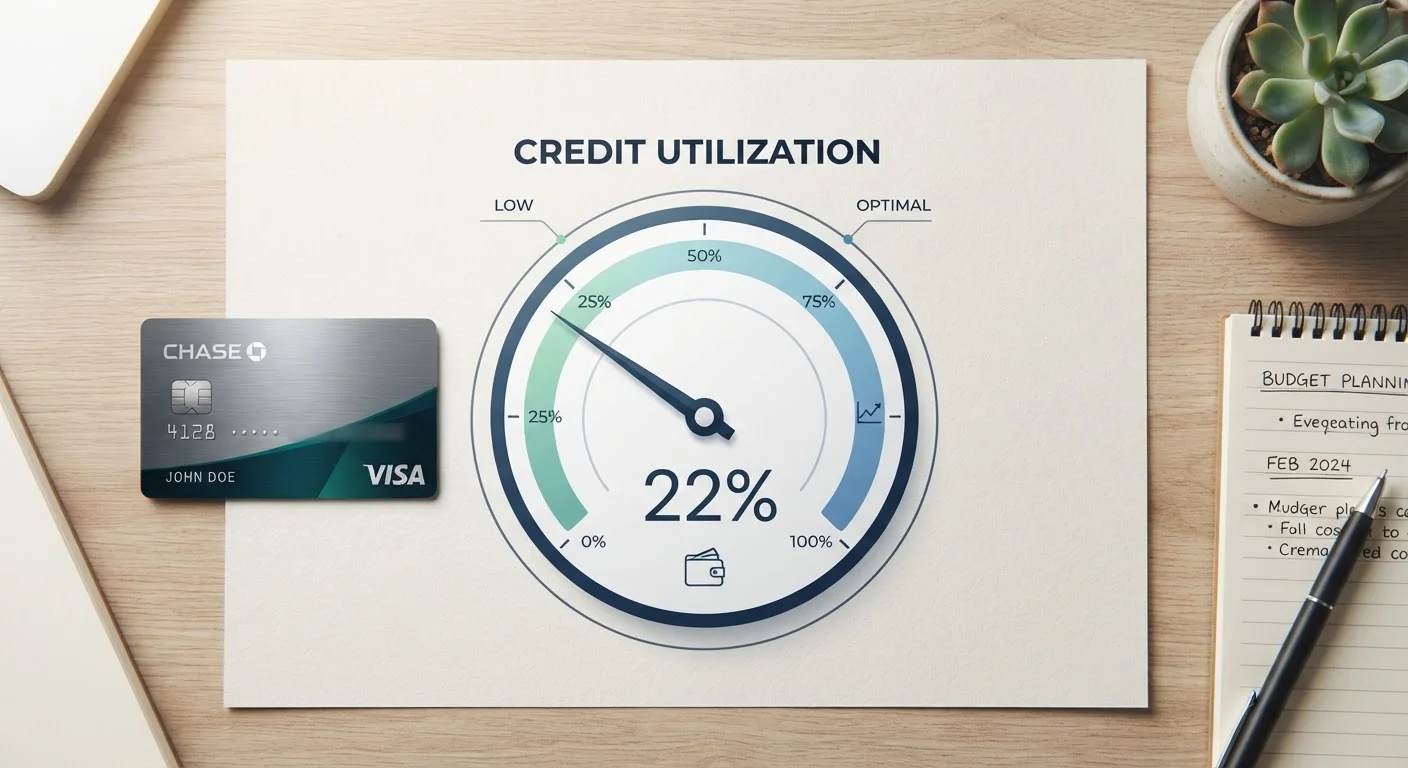
Credit utilization is the percentage of your total available revolving credit that you're currently using. It's calculated by dividing your total credit card balances by your total credit limits. For example, if you have $2,000 in balances across cards with a combined $10,000 limit, your utilization rate is 20%.
Scoring models like FICO and VantageScore evaluate utilization both in aggregate (across all revolving accounts) and per individual card, so a single maxed-out card can drag your score even if your overall rate is low.
How the Ratio Is Calculated
Credit utilization is straightforward math: divide your current revolving balances by your total revolving credit limits, then multiply by 100 to get a percentage. If you carry $1,500 across two credit cards with a combined limit of $7,500, your ratio is 20%.
The calculation works at two levels. Your aggregate utilization looks at all your revolving accounts combined. Your per-card utilization examines each account individually. Both matter. A card sitting at 80% utilization can hurt your score even if your overall ratio looks reasonable.
This is a revolving credit concept. Installment loans - auto loans, student loans, mortgages - are not included in the utilization calculation. Only credit cards and lines of credit count.
~30%
Portion of FICO score tied to utilization
According to FICO's publicly documented score breakdown, amounts owed - primarily utilization - is the second-largest scoring category.
<10%
Utilization rate common among high scorers
Consumers with FICO scores above 800 tend to use a very small fraction of their available credit, based on FICO's analysis of high-achieving score profiles.
30%
Widely cited upper threshold for healthy utilization
Consumer financial guidance from credit bureaus and nonprofit credit counselors generally points to 30% as a reasonable ceiling, though lower rates produce better results.
Why It Weighs So Heavily on Your Score
Under the FICO scoring model, credit utilization makes up approximately 30% of your score - second only to payment history. That makes it one of the most powerful levers you can actually move in the short term. Payment history takes years to build; utilization can shift within a single billing cycle.
Lenders view high utilization as a risk signal. Someone using 80% of their available credit may be financially stretched and more likely to miss payments. Someone using 15% looks more in control. The ratio gives lenders a quick read on how dependent you are on borrowed money right now.
For a deeper look at how utilization fits alongside other scoring factors, see the five factors that shape your credit score.
“Utilization is one of the most actionable parts of your credit score because it responds quickly to behavior changes. Unlike payment history, which takes time to rebuild, you can lower your utilization within a single billing cycle.”
— Consumer Financial Protection Bureau, U.S. government agency responsible for consumer financial protection
Practical Ways to Lower Your Utilization
There are two sides to the utilization ratio: the balance (numerator) and the limit (denominator). You can improve the ratio by reducing one, increasing the other, or both.
- Pay down balances strategically. If you can't clear all cards at once, prioritize the one closest to its limit - that card's individual utilization is likely doing the most damage.
- Pay before your statement closing date. Issuers report balances on the statement date, not the due date. Paying early means a lower balance gets reported, even if you pay in full every month.
- Request a credit limit increase. If your spending stays flat and your limit rises, your ratio falls automatically. Be aware that some issuers run a hard inquiry for this request.
- Avoid closing unused cards. A card with no balance still contributes available credit to your denominator. Closing it removes that buffer. Common credit score myths often trip people up on exactly this point.
Time Your Payments for Maximum Impact
Find out when your card issuer reports to the credit bureaus - this is usually your statement closing date, not your payment due date. If you pay down your balance before that date, the lower amount is what gets reported and counted in your utilization ratio. A quick call to your card issuer or a check of your online account can tell you the exact date.
What to Watch Out For
A few situations catch people off guard when it comes to utilization:
Business credit cards. Some business cards report to personal credit bureaus. If you run up charges on a business card tied to your personal credit, your utilization can spike without warning.
If you're working toward better credit overall - whether to qualify for a loan or improve your financial position - pairing utilization management with solid budgeting habits and a savings strategy creates a more stable foundation. A lower utilization ratio helps your score, but reducing reliance on revolving credit altogether is the stronger long-term goal.
Before applying for new credit, it's worth reviewing where your utilization stands. Our credit application readiness checklist covers the steps to take before submitting any application.
This article is for general informational purposes only and does not constitute personalized financial or credit advice. For guidance specific to your situation, consider consulting a licensed financial professional.