

Key Takeaways
- High-yield savings accounts typically offer significantly higher APYs than traditional savings accounts at brick-and-mortar banks.
- Both account types are usually FDIC-insured up to $250,000 per depositor, per institution.
- Traditional savings accounts offer easier in-person access but often pay near-zero interest.
- High-yield accounts are frequently offered by online banks, which keep overhead low to pass savings to depositors.
- Neither account is ideal for long-term wealth building - they serve as safe, accessible cash reserves.
- Your choice should reflect your banking habits, how often you need branch access, and your savings goals.
Option A
High-Yield Savings Account (HYSA)
The higher-rate option for growth-focused savers.
Best for: Savers who want their cash to earn meaningfully more interest while staying liquid and federally insured.
Option B
Traditional Savings Account
The familiar, accessible staple of everyday banking.
Best for: People who prioritize convenience, in-person banking access, and keeping savings alongside a checking account at their primary bank.
If you want your emergency fund to earn as much as possible
High-Yield Savings Account (HYSA)
HYSAs consistently offer higher APYs, meaning idle cash earns more without taking on any additional risk.
If you value in-person banking and branch access
Traditional Savings Account
Traditional banks maintain physical locations, making it easier to handle transactions and get face-to-face help.
If you're comfortable banking entirely online
High-Yield Savings Account (HYSA)
Online-only banks offering HYSAs typically have strong mobile apps and customer support, with fewer physical-branch limitations.
If you want savings linked directly to your primary checking account
Traditional Savings Account
Keeping savings at your existing bank simplifies transfers and may help you avoid minimum balance fees.
What Makes These Two Account Types Different
At their core, both account types do the same job: hold your cash safely and pay you interest while you're not using it. The difference lies primarily in how much interest they pay and where the account is held.
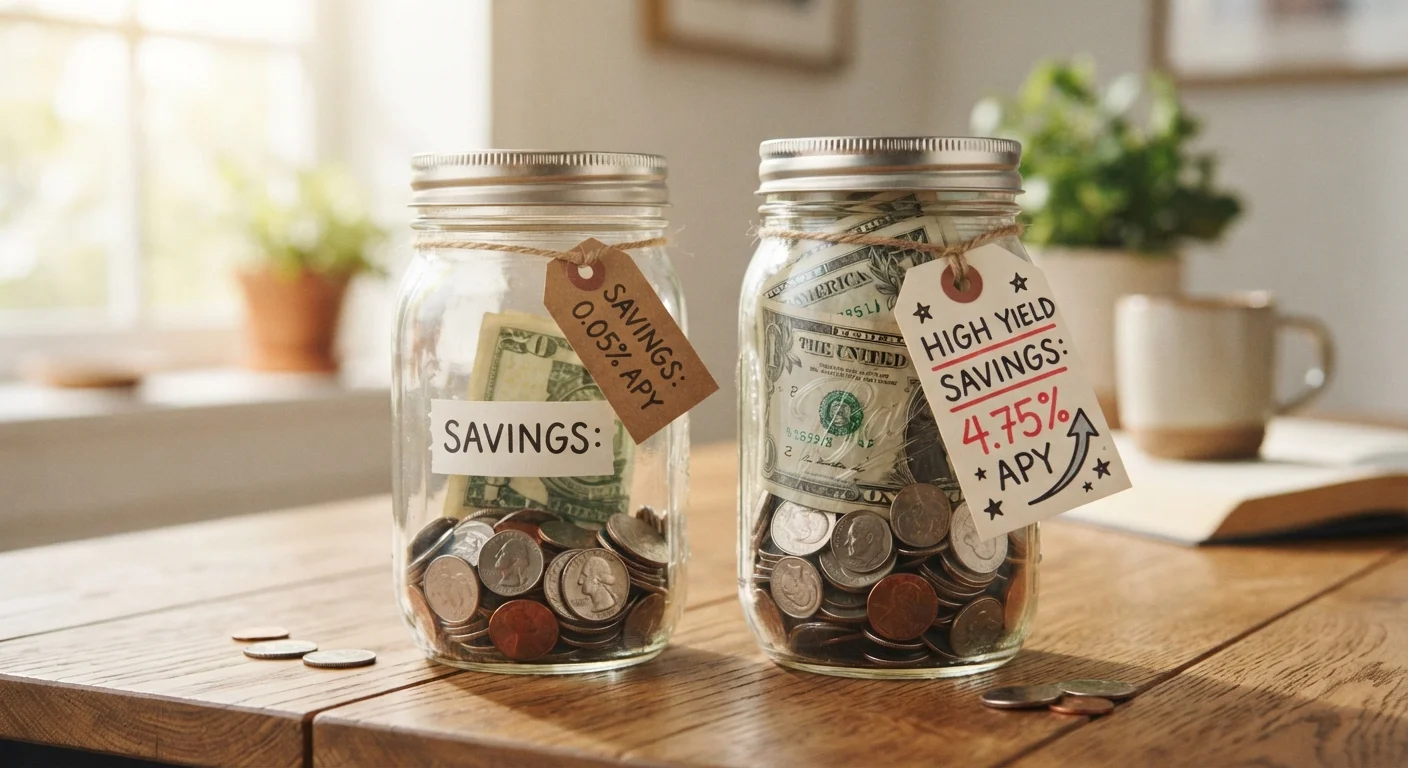
Annual Percentage Yield (APY) is the standardized way banks express how much you'll earn in a year, factoring in compound interest. Traditional savings accounts at large, established banks have historically offered APYs well below 1% - often closer to 0.01%-0.10%. High-yield savings accounts, by contrast, are commonly offered by online banks and credit unions that carry lower overhead costs, allowing them to pass more earnings to depositors in the form of higher APYs.
Both account types are typically insured by the Federal Deposit Insurance Corporation (FDIC) for banks, or the National Credit Union Administration (NCUA) for credit unions, up to $250,000 per depositor, per institution. That protection is identical regardless of which account type you choose.
| Criterion | High-Yield Savings Account | Traditional Savings Account |
|---|---|---|
| Typical APY range | Substantially above national average | Often near national average or below |
| Federal deposit insurance | Yes (FDIC/NCUA, up to $250K) | Yes (FDIC/NCUA, up to $250K) |
| Account access | Primarily online and mobile | Online, mobile, and in-person branches |
| Transfer speed to external accounts | 1-3 business days (typically) | Often instant within same bank |
| Minimum balance requirements | Varies; some have none | Varies; some have none |
| Rate variability | Variable; tracks federal rate changes | Variable; often slow to reflect rate changes |
How Interest Works - and Why the Gap Matters
Interest on savings accounts compounds - meaning you earn interest not just on your original deposit, but also on previously earned interest. Most savings accounts compound daily or monthly. The higher the APY, the faster compounding works in your favor.
To illustrate the gap without speculating on current rates: a $10,000 balance in an account earning 0.05% APY generates roughly $5 in interest over a year. The same balance at 4.50% APY generates roughly $450. That difference is not trivial when you're building an emergency fund or saving toward a specific goal.
0.01%-0.10%
Typical APY at large traditional banks
The FDIC publishes national deposit rate averages, which historically show traditional savings rates far below broader market rates.
$250,000
FDIC insurance limit per depositor
Both account types share the same federal insurance ceiling, protecting depositors at member banks in case of bank failure.
It's worth noting that APYs on high-yield accounts are variable - they move with the federal funds rate set by the Federal Reserve. When rates rise, HYSAs tend to pay more; when rates fall, yields drop. Traditional accounts also technically have variable rates, but they tend to move far less and often lag rate increases considerably. For context on how savings strategy interacts with timeframe, see our guide on short-term vs. long-term saving.
Trade-offs to Weigh Before You Choose
High-yield savings accounts aren't without limitations. Because most are offered by online-only institutions, you typically won't have a physical branch to visit. Transfers between your HYSA and an external checking account can take one to three business days, which matters if you need funds quickly. Some HYSAs also have minimum balance requirements or limit the number of withdrawals per month.
Traditional savings accounts shine in convenience: they're often at the same bank as your checking account, transfers are instant, and you can walk in to speak with someone in person. The trade-off is accepting a much lower return on your cash.
Savings Accounts Are Not Investment Accounts
It's a common misconception that a high-yield savings account is a form of investing. It is not - your principal is protected and your return is predictable, but it is unlikely to outpace inflation over long periods. Savings accounts are best used for liquidity and short-term goals, not long-term wealth accumulation. For longer-term goals, a qualified financial adviser can help identify appropriate options.
Neither account is designed to grow wealth over decades - for that, you'd look to investment accounts. Both are best used as liquid reserves: emergency funds, short-term savings goals, or cash you may need within the next one to three years. If you're worried about spending down savings you've built, common reasons people drain their savings is worth reading before you decide on an account structure.
Some savers use both account types together - keeping a small traditional savings buffer linked to their checking account for immediate needs, and a high-yield account for longer-term reserves. Consolidating savings into one account has real pros and cons worth understanding before committing to a single approach.
This article is for general informational purposes only and does not constitute personalized financial advice. Consult a licensed financial professional for guidance tailored to your specific situation.