

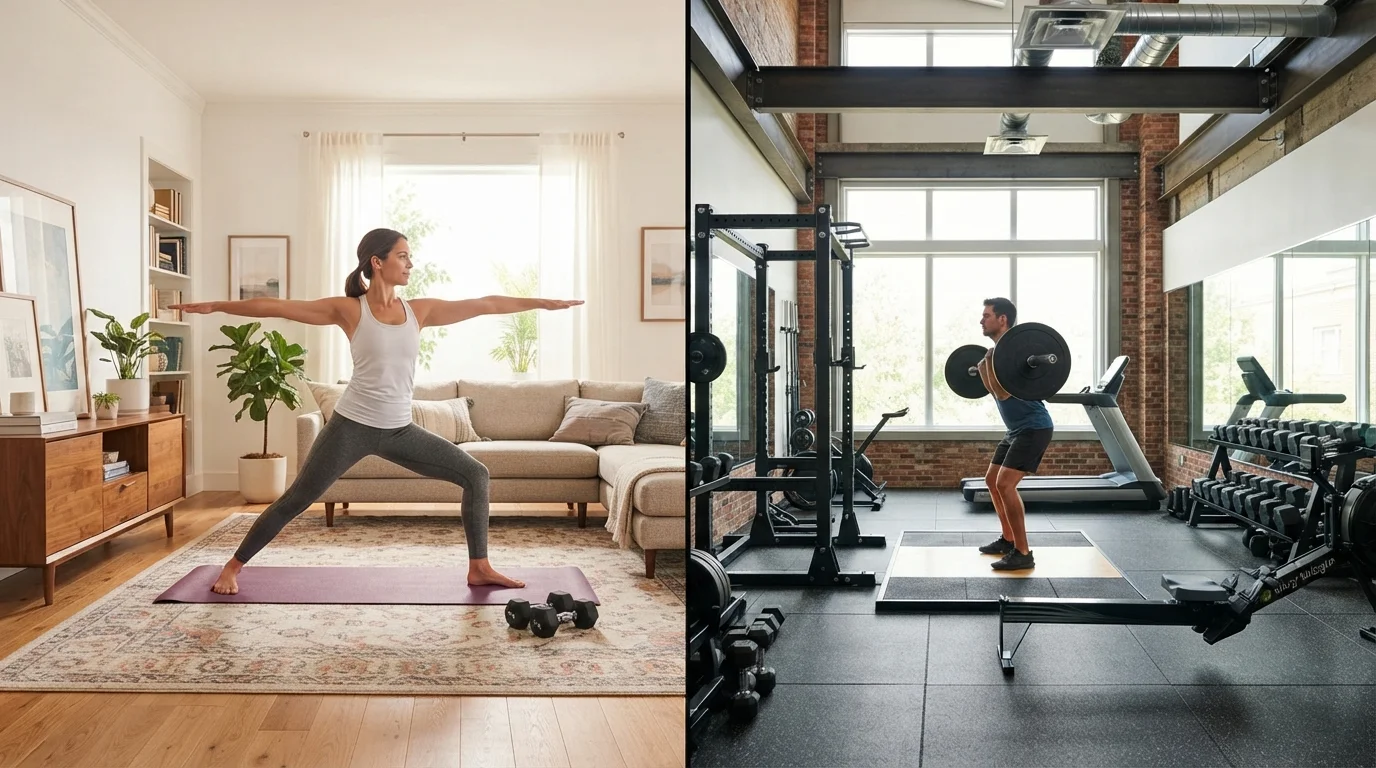
Key Takeaways
- Home workouts cost less long-term and remove commute as a barrier to consistency.
- Gyms provide equipment variety, professional guidance, and social motivation that home setups rarely match.
- Neither option is universally superior - your schedule, budget, and goals should drive the decision.
- Many people find a hybrid approach - some sessions at home, some at a gym - works best.
No commute - train whenever a window opens
Removing travel time eliminates one of the most common reasons people skip workouts. A 20-minute session at home beats a skipped session due to a 30-minute drive.
Lower ongoing cost after initial setup
A basic set of resistance bands, a mat, and adjustable dumbbells can cover years of training with no monthly fees.
Complete privacy and personal comfort
For beginners or those who feel self-conscious, the absence of an audience removes a real psychological barrier to getting started.
Total schedule flexibility
Early morning, late night, during a lunch break - home training can fit into gaps that a gym's hours or travel time can't accommodate.
Limited equipment restricts progressive overload
Significant strength gains - especially for the lower body - eventually require heavier resistance than most home setups can provide without major investment.
Distractions and lack of dedicated space
Household chores, family interruptions, and the pull of screens can fragment focus in ways that a gym environment simply doesn't allow.
No professional guidance on technique
Poor form developed in isolation can lead to injury over time. Without a trainer or qualified eye nearby, errors can go uncorrected for months.
Harder to sustain motivation alone
The social energy of a gym - other people working out, instructor encouragement, group class energy - is a genuine motivational resource that home training can't replicate easily.
Our Verdict
Home exercise wins on convenience and cost, while the gym wins on equipment access and structured environment. Neither is objectively better - the right choice is whichever one you'll actually stick with week after week. If budget and time are your main constraints, a well-planned home routine can deliver real fitness gains; if variety, accountability, or heavier resistance training are priorities, a gym membership is likely worth the investment.
Home workouts suit people with tight schedules or budgets; gyms suit those who need equipment variety, external motivation, or professional coaching.
Why This Decision Matters More Than You Might Think
The most effective exercise routine is the one you follow consistently. Research consistently shows that adherence - not the exact modality - is the strongest predictor of long-term fitness outcomes. That means the home-vs-gym question is really a question about what your life will actually support.
Before weighing the pros and cons, it helps to be honest about a few things: How much time do you have on weekdays? Do you have space and budget for equipment? Do you need external accountability to stay on track? Answering those questions honestly will make the trade-offs below much easier to apply to your own situation.
If you're just starting out, see our guide to building a fitness routine from scratch for practical first steps regardless of where you train.
The Case for Exercising at Home
Home workouts have genuine strengths that go beyond mere convenience.
No commute - train whenever a window opens
Removing travel time eliminates one of the most common reasons people skip workouts. A 20-minute session at home beats a skipped session due to a 30-minute drive.
Lower ongoing cost after initial setup
A basic set of resistance bands, a mat, and adjustable dumbbells can cover years of training with no monthly fees.
Complete privacy and personal comfort
For beginners or those who feel self-conscious, the absence of an audience removes a real psychological barrier to getting started.
Total schedule flexibility
Early morning, late night, during a lunch break - home training can fit into gaps that a gym's hours or travel time can't accommodate.
The most significant advantage is removing friction. Every barrier eliminated between you and a workout - no commute, no packing a bag, no waiting for equipment - increases the likelihood you'll actually do it. For people with demanding schedules or young children, this alone can be decisive.
Cost is also a real factor. While a solid home setup requires some upfront investment in basics like resistance bands, a mat, or adjustable dumbbells, the ongoing cost is near zero. Over several years, this typically undercuts gym membership fees substantially. For a broader look at how fitness spending fits into everyday budgeting, the budgeting hub offers useful context.
The Limitations of Home Training
Home exercise isn't without real drawbacks, and being realistic about them prevents frustration.
Limited equipment restricts progressive overload
Significant strength gains - especially for the lower body - eventually require heavier resistance than most home setups can provide without major investment.
Distractions and lack of dedicated space
Household chores, family interruptions, and the pull of screens can fragment focus in ways that a gym environment simply doesn't allow.
No professional guidance on technique
Poor form developed in isolation can lead to injury over time. Without a trainer or qualified eye nearby, errors can go uncorrected for months.
Harder to sustain motivation alone
The social energy of a gym - other people working out, instructor encouragement, group class energy - is a genuine motivational resource that home training can't replicate easily.
The biggest limitation is equipment ceiling. Bodyweight and light resistance work can take you far, but if your goals include significant strength development - particularly for lower body - you'll eventually need heavier load than most home setups provide. Our article on free weights vs. resistance machines explains why load variety matters for progressive strength training.
Motivation is another honest challenge. Without a designated workout environment or the social pull of other exercisers, some people find it harder to sustain intensity or consistency at home. Distractions - household tasks, family members, screens - are always nearby.
What the Gym Offers That Home Usually Can't
Commercial gyms exist for good reason. They consolidate equipment, expertise, and community in ways that are genuinely difficult to replicate at home.
~$50/mo
Average US gym membership cost
Industry data from the International Health, Racquet & Sportsclub Association (IHRSA) estimates average monthly gym membership fees in the US typically range from $40-$70.
150 min
Weekly moderate aerobic activity recommended
The U.S. Department of Health and Human Services Physical Activity Guidelines recommend at least 150 minutes of moderate-intensity aerobic activity per week for adults - achievable in either setting.
Equipment breadth is the clearest advantage. A well-equipped gym gives you access to cable machines, barbells, squat racks, cardio machines, and group class studios - a range that would cost thousands of dollars and significant floor space to replicate at home. This variety is particularly important if you want to train different muscle groups effectively or explore different exercise types like cardio, strength, flexibility, and balance.
Professional staff is another differentiator. Personal trainers, group fitness instructors, and even knowledgeable staff on the floor can help you learn proper form and reduce injury risk - something a YouTube video can approximate but not fully replace.
A Note on Injury Risk and Supervision
Gyms don't automatically make exercise safer, but access to trained staff does lower the risk that poor form goes unaddressed. If you train at home, particularly with free weights, investing in even a few sessions with a certified personal trainer to learn proper technique can pay dividends in safety. This is especially important for compound movements like squats and deadlifts. Always consult a healthcare provider if you're managing an injury or chronic condition.
Making the Decision for Your Life
The honest answer for most people is that both options can work - and both can fail if they don't fit your lifestyle. A few practical considerations to guide your choice:
- If consistency is your main challenge, choose the option with the fewest steps between you and starting a session.
- If your goals include progressive strength training, a gym or at minimum a barbell home setup will serve you better than bodyweight alone.
- If cost is a constraint, a thoughtful home routine built around resistance bands, dumbbells, and bodyweight movements can meet most general fitness goals.
- If you thrive on social energy or need accountability, a gym environment - especially group classes - provides that structure.
Many people ultimately land on a hybrid: a few gym sessions per week for heavier work, supplemented by home workouts on busy days. It's also worth remembering that even simple activities like walking carry measurable health benefits. Our article on what walking can and can't do for your health puts that in useful perspective.
And regardless of where you train, the fuel you provide your body matters just as much. The nutrition hub is a good complement to any new or evolving fitness routine.
This article is for general informational purposes only and is not a substitute for professional medical or fitness advice. Consult a qualified healthcare provider before starting a new exercise program, especially if you have existing health conditions.