

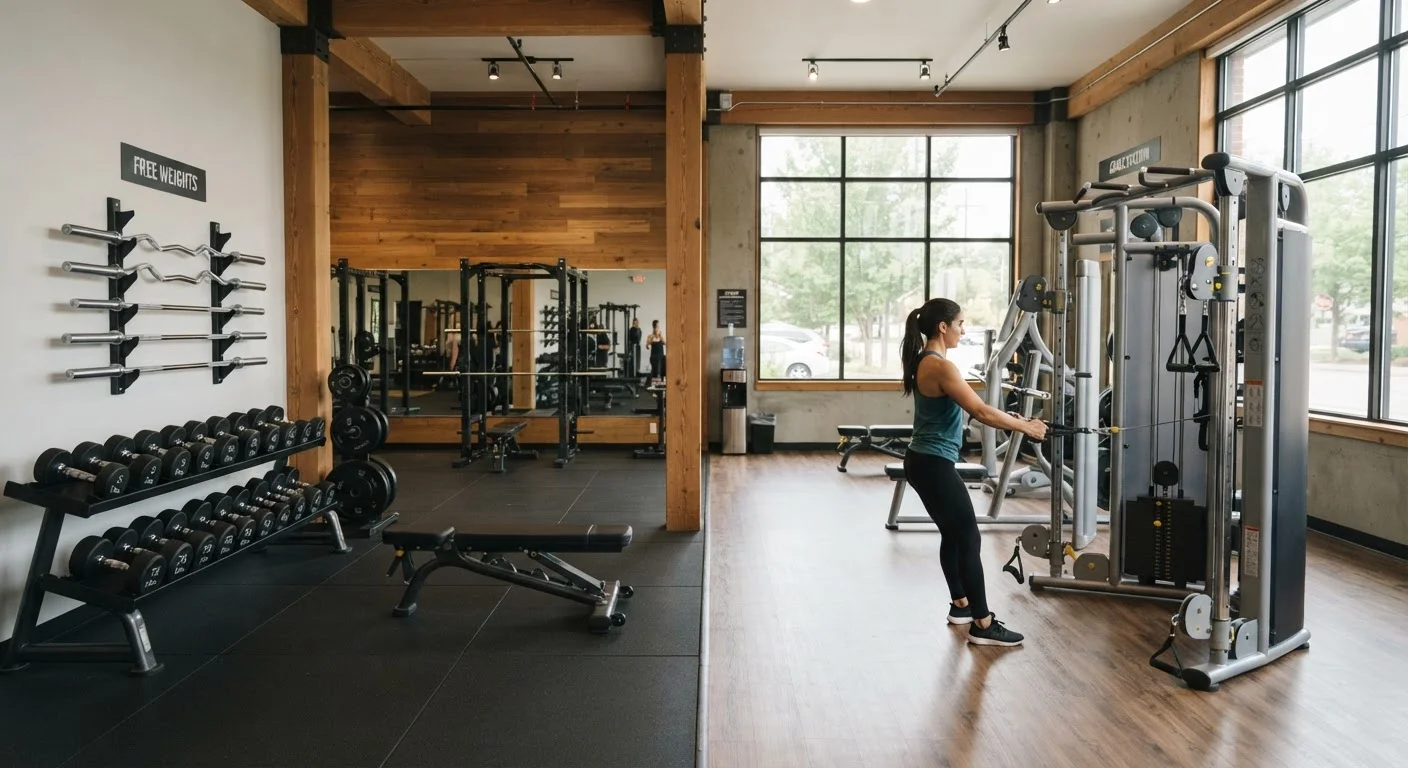
Key Takeaways
- Free weights recruit more stabilizer muscles, training functional strength and coordination simultaneously.
- Resistance machines guide movement along a fixed path, reducing injury risk for beginners and people in rehab.
- Neither tool is universally superior - most strength programs benefit from including both.
- Free weights generally require more technique and body awareness to use safely.
- Machines allow easier progressive overload with precise, repeatable weight increments.
- Your training goals, experience level, and any existing injuries should guide which you prioritize.
Option A
Free Weights
The versatile, functional choice for multi-muscle movement.
Best for: Best for athletes, experienced lifters, and anyone focused on functional strength and whole-body coordination.
Option B
Resistance Machines
The guided, beginner-friendly alternative for targeted training.
Best for: Best for beginners learning movement patterns, people in rehabilitation, or those isolating specific muscle groups safely.
If you are new to strength training
Resistance Machines
Machines guide your movement along a controlled path, helping you build foundational strength and learn basic patterns with a lower risk of poor form or injury.
If you want to build functional, real-world strength
Free Weights
Free weights require your body to balance and stabilize the load, mirroring everyday movements and building strength that transfers beyond the gym.
If you are recovering from an injury
Resistance Machines
The fixed range of motion on machines can allow targeted muscle rehabilitation while protecting vulnerable joints - always consult a healthcare provider or physical therapist first.
If you train at home with limited space
Free Weights
A set of dumbbells or a barbell takes far less space and cost than resistance machines, while still enabling a wide variety of effective exercises.
If you want a balanced, well-rounded program
Free Weights
Evidence suggests combining both tools is optimal, but if you must choose one, free weights offer greater exercise variety and adaptability across fitness goals.
How Each Approach Works
Understanding the core mechanics of each tool helps you make smarter training decisions. For a broader overview of where strength training fits alongside cardio and flexibility work, see our guide to exercise types.
Free weights - including dumbbells, barbells, kettlebells, and weight plates - require you to control the load through three-dimensional space. Because there is no fixed track guiding your movement, your stabilizer muscles (the smaller muscles surrounding joints) must work constantly to keep the weight balanced and your body aligned. This recruits more total muscle tissue per movement and challenges your neuromuscular system to coordinate across multiple joints.
Resistance machines operate on cables, pulleys, or lever arms that move along a predetermined path. This mechanical guidance takes stabilization largely out of the equation, allowing you to focus effort on the primary muscle being trained. The tradeoff is that the movement is more isolated and less representative of how your body moves in everyday life.
| Criterion | Free Weights | Resistance Machines |
|---|---|---|
| Muscle recruitment | High - includes stabilizers | Moderate - primarily target muscle |
| Beginner safety | Requires coaching and technique | Guided path reduces form errors |
| Functional carryover | High - mimics real-world movement | Lower - isolated, fixed-plane motion |
| Exercise variety | Very wide - hundreds of exercises | Limited by machine design |
| Space and cost | Compact and affordable | Large footprint, higher cost |
| Rehab suitability | Variable - depends on movement | Often preferred for controlled rehab |
| Progressive overload | Flexible but less precise | Easy with pin-weight increments |
Safety, Technique, and Learning Curve
One of the most meaningful differences between these two tools is how quickly a beginner can use each one safely. Resistance machines are designed so that even a first-time gym-goer can sit down, adjust the seat, set the weight pin, and perform a movement with relatively low technical risk. The fixed path limits the chance of the load drifting out of alignment.
Free weights demand significantly more technique. A barbell squat or overhead press requires proper joint positioning, bracing, and body awareness - skills that take time and practice to develop. Performing free-weight exercises with poor form under heavy load carries a genuine injury risk. This does not mean beginners should avoid free weights entirely, but it does mean starting with lighter loads and, ideally, guidance from a qualified trainer.
A Note on Injury and Rehabilitation
If you have an existing injury or a chronic condition affecting your joints or muscles, neither free weights nor resistance machines should be used without professional clearance. A physical therapist or sports medicine physician can recommend which equipment and movement patterns are appropriate for your specific situation. General fitness guidance does not substitute for individualized clinical assessment.
If you are unfamiliar with common strength training terminology - terms like progressive overload, compound movements, or rep ranges - our fitness terms reference is a helpful starting point before choosing equipment.
Muscle Recruitment and Long-Term Progress
Research in exercise science consistently shows that free weights activate a broader network of muscles per movement compared to machine equivalents. A dumbbell bench press, for example, engages the chest, shoulders, triceps, and the stabilizing muscles of the rotator cuff and core - whereas a chest press machine primarily loads the chest and triceps along a fixed arc.
For long-term strength development, progressive overload - gradually increasing the challenge placed on muscles over time - is the key driver of adaptation. Both tools support this principle well. Machines make it easy to add small, precise weight increments, which can be helpful in the early stages of training. Free weights offer broader flexibility: you can adjust load, angle, grip, and range of motion to keep progressing in varied ways.
~20%
Greater core activation with free weights
Studies published in the Journal of Human Kinetics have found meaningfully higher core muscle activation during free-weight exercises compared to matched machine movements.
2-3x
More stabilizer muscles engaged
Exercise science research suggests free-weight compound lifts recruit significantly more stabilizing musculature than machine-based equivalents targeting the same primary muscle group.
Most fitness professionals and exercise scientists suggest that a program incorporating both free weights and machines tends to outperform one relying exclusively on either. See our home vs. gym training comparison for context on how your training environment may influence which tools are accessible to you.
This article provides general fitness information for educational purposes and is not a substitute for personalized advice from a qualified fitness professional or healthcare provider.