

Key Takeaways
- Raw diets are minimally processed but require careful balancing to avoid nutritional deficiencies.
- Commercial kibble is formulated to meet established nutritional standards, making label-reading a reliable guide.
- Raw feeding carries documented food-safety risks, including bacterial contamination, for both pets and humans.
- Cost and time commitment differ significantly between the two feeding styles.
- Neither approach is universally superior - the right choice depends on your pet's health, your lifestyle, and veterinary input.
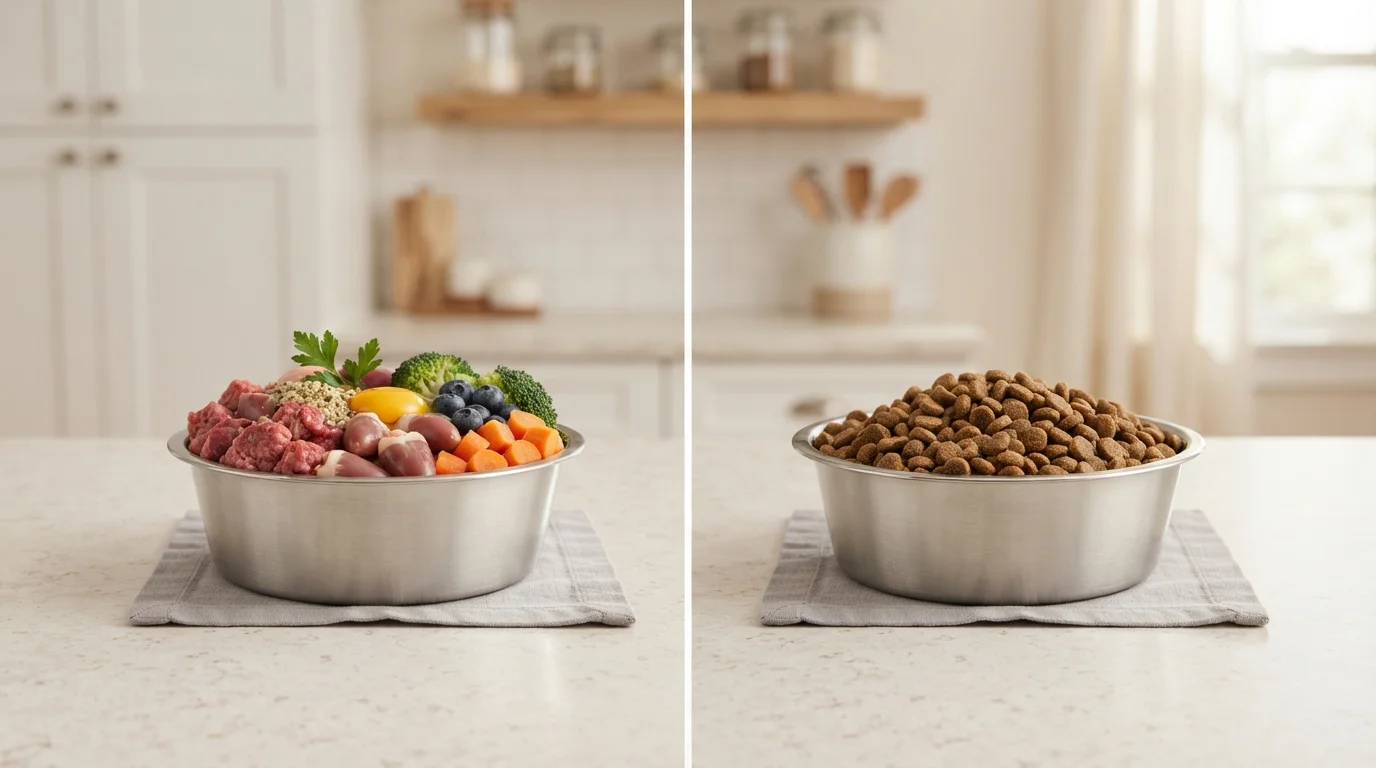
Option A
Raw Diet (BARF / Whole Prey)
The minimally processed, whole-ingredient approach.
Best for: Experienced pet owners who have time to source, prepare, and safely handle raw ingredients under veterinary guidance.
Option B
Commercial Kibble
The convenient, widely available, nutritionally standardised option.
Best for: Most pet owners seeking a consistent, vet-approved, low-effort daily feeding routine.
If you want a nutritionally standardised diet with minimal preparation
Commercial Kibble
AAFCO-compliant kibble is formulated to meet established nutritional profiles, making it straightforward to feed a complete and balanced diet daily.
If your pet has specific sensitivities and your vet recommends a whole-food approach
Raw Diet (BARF / Whole Prey)
Under proper veterinary and nutritionist oversight, a carefully balanced raw diet can address certain dietary concerns using whole ingredients.
If you have young children, immunocompromised family members, or limited time
Commercial Kibble
Raw meat handling poses bacterial risks to household members; kibble eliminates this concern entirely and requires far less daily effort.
If you want to understand processing levels in your pet's food
Raw Diet (BARF / Whole Prey)
Raw diets involve little to no industrial processing, keeping ingredients closer to their whole-food state - though this alone does not guarantee nutritional adequacy.
What Each Feeding Style Actually Means
When pet owners talk about a raw diet, they generally mean feeding uncooked animal muscle meat, organ meat, raw meaty bones, and sometimes vegetables or fruit. Two popular frameworks are BARF (Biologically Appropriate Raw Food) and whole-prey feeding. Both aim to replicate something closer to what a dog or cat might eat before domestication.
Commercial kibble, by contrast, is a dry extruded or baked pet food manufactured to meet nutritional guidelines set by bodies such as the Association of American Feed Control Officials (AAFCO). Ingredients are cooked at high temperatures, which extends shelf life and eliminates most pathogens. Most mainstream kibble carries an AAFCO statement confirming it is "complete and balanced" for a specific life stage.
Understanding what separates these two approaches at a foundational level is essential before weighing the pros and cons. For a broader primer on what nutrients dogs and cats actually need, see our Pet Nutrition 101 guide.
Nutrition, Safety, Cost, and Convenience Compared
The four dimensions that most pet owners care about - nutrition, safety, cost, and convenience - play out very differently across these two diets. Here is a direct comparison:
| Criterion | Raw Diet | Commercial Kibble |
|---|---|---|
| Nutritional completeness | Variable; depends on formulation | Standardised; AAFCO-verified |
| Processing level | Minimal to none | High-heat extrusion or baking |
| Pathogen risk | Higher; raw meat harbours bacteria | Lower; cooking reduces pathogens |
| Typical monthly cost | Generally higher | Wide range; often lower |
| Preparation time | Significant daily handling required | Minimal; scoop and serve |
| Shelf life / storage | Refrigeration or freezing needed | Long shelf life; room temperature |
| Veterinary consensus | Caution advised; risks documented | Broadly recommended when complete |
A key nuance: nutritional adequacy in a raw diet depends almost entirely on how well the meals are balanced. Homemade raw diets that are not formulated by a board-certified veterinary nutritionist frequently fall short in critical micronutrients such as calcium, phosphorus, zinc, and vitamins D and E. Kibble's standardisation removes much of that guesswork for most households.
60%+
Raw diets found nutritionally inadequate in studies
Multiple peer-reviewed analyses of homemade raw diets have found the majority did not meet established nutritional guidelines without professional formulation.
~70%
Of raw pet food samples positive for Salmonella in FDA testing
FDA sampling studies of commercially available raw pet foods have repeatedly identified high rates of pathogen contamination compared with other pet food categories.
Food Safety: An Honest Look at the Risks
Food safety is where the raw vs. kibble debate gets most serious. Raw meat - including poultry, beef, and fish - can carry Salmonella, Listeria, E. coli, and other pathogens. The US Centers for Disease Control and Prevention (CDC) and the US Food and Drug Administration (FDA) have both issued guidance noting that raw pet food poses contamination risks not only to animals but also to the people who handle it and the surfaces it touches.
Pets fed raw diets can shed these bacteria in their stool even when they appear healthy, which creates additional household exposure. This concern is especially relevant in homes with infants, elderly individuals, or anyone who is immunocompromised.
Commercial kibble is not risk-free - recalls do occur - but the high-heat manufacturing process significantly reduces pathogen load. For a deeper look at what veterinary bodies advise on this topic, our article on what the research actually says about raw feeding covers the evidence honestly.
Commercially Prepared Raw Food Is Different
Commercially prepared raw pet foods - including freeze-dried and frozen raw products - are distinct from homemade raw diets. Some are formulated to be nutritionally complete, though pathogen risks still apply during handling. If you are considering a commercial raw product, check whether it carries an AAFCO nutritional adequacy statement and discuss it with your veterinarian before switching.
Making the Decision That Fits Your Pet and Your Life
There is no universally correct answer here. A pet's age, health status, activity level, and any existing medical conditions all influence which feeding style is more appropriate. Your veterinarian is the right starting point - they can assess your individual animal and, if needed, refer you to a board-certified veterinary nutritionist for a properly balanced raw diet plan.
If you do choose kibble, label literacy matters more than most owners realise. The ingredient list, guaranteed analysis, and AAFCO nutritional adequacy statement each tell you something specific. Our guide on reading a pet food label without getting lost in the fine print walks you through each section. And if you are new to pet ownership, it is also worth checking common nutrition mistakes new pet owners make - many feeding missteps are easy to avoid once you know what to look for.
This article is for general informational purposes only and does not constitute veterinary or medical advice. Always consult a qualified veterinarian before making significant changes to your pet's diet.