
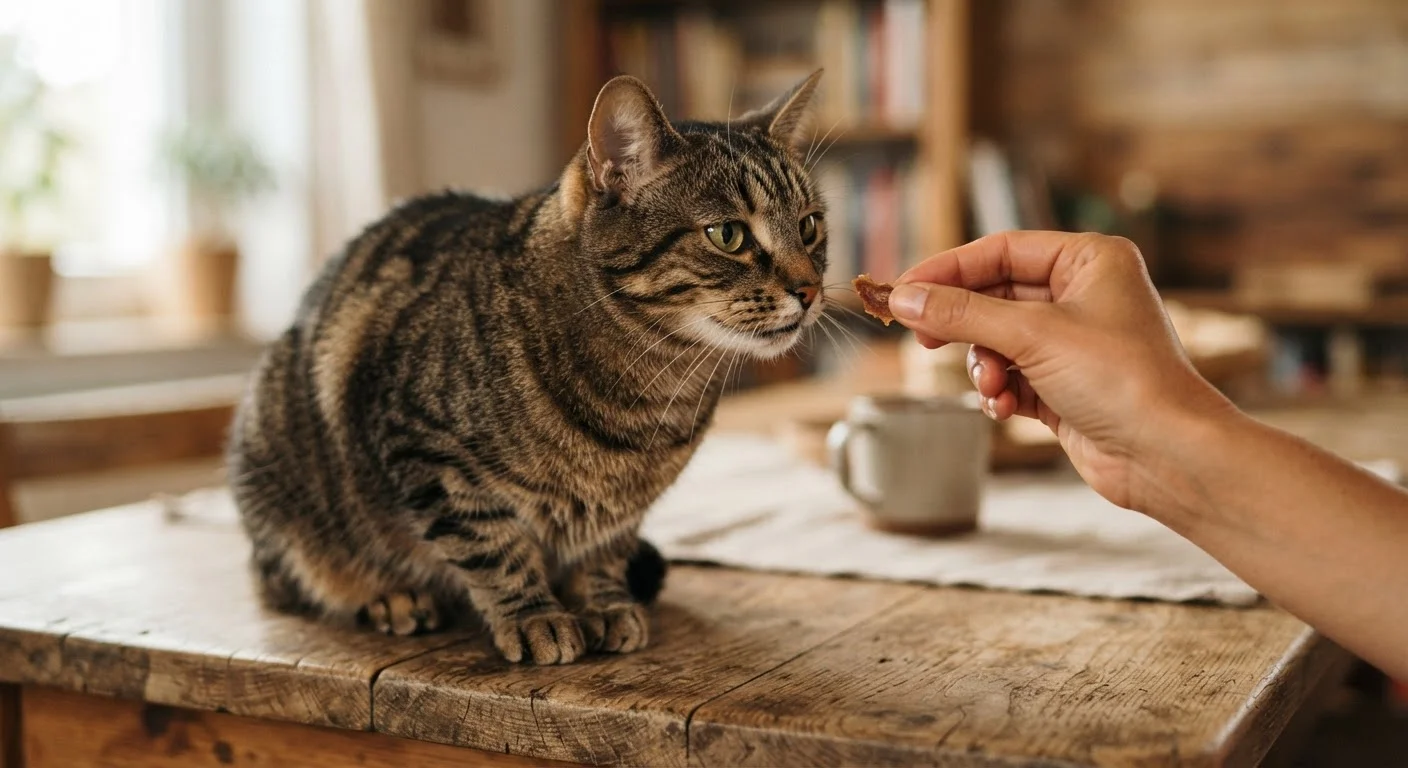
Key Takeaways
- Cats are trainable, but they respond best to short, reward-based sessions rather than repetitive drilling.
- Motivation is the critical variable - food, play, and timing all matter more than repetition alone.
- Most cats can learn useful behaviors like sitting, coming when called, and using a scratching post.
- Unrealistic expectations - not feline stubbornness - are the most common reason cat training fails.
- Positive reinforcement is the only approach supported by behavioral science for cats.
Strengthens the human-cat bond meaningfully
Training sessions create structured, positive interactions that build mutual trust. Cats that engage in regular reward-based training with their owners tend to show greater comfort around handling and novel situations.
Reduces common problem behaviors
Teaching a cat where to scratch, when to expect meals, and how to enter a carrier voluntarily can eliminate many of the friction points that frustrate owners - without force or punishment.
Provides essential mental stimulation
Cats, particularly those living exclusively indoors, benefit significantly from cognitive challenges. Training exercises the brain in ways that play alone doesn't fully replicate.
Makes veterinary care significantly easier
A cat trained to accept handling, carrier entry, and brief restraint is far less stressed during vet visits - and easier for veterinary staff to examine safely.
Cats of any age can learn new behaviors
Adult and senior cats are fully capable of learning, contrary to popular assumption. The pace may differ, but neuroplasticity in cats is not age-limited in the way many owners believe.
Cats disengage quickly if unrewarded
Unlike dogs, cats are unlikely to continue participating in training out of desire to please. The moment the reward stops feeling worth the effort, most cats simply walk away.
Progress is slower than with dogs
The timeline to a reliable behavior is generally longer with cats, and owners who expect dog-like compliance within days are typically disappointed. Patience is essential, not optional.
Individual variation is enormous
Some cats are highly food-motivated and pick up cues quickly; others are easily distracted, anxious, or simply less interested in interaction. Breed, early socialization, and personality all play significant roles.
Environment dramatically affects performance
A behavior a cat performs reliably in a quiet room may vanish entirely in a new location or with distractions present. Generalizing trained behaviors across contexts takes deliberate, gradual effort.
Our Verdict
Cat training is genuinely possible and often more rewarding than owners expect - but it requires adjusting your mindset away from dog-training norms. Cats learn through positive reinforcement, short sessions, and high-value rewards, and they will disengage the moment training stops feeling worthwhile to them. Set realistic goals, be patient with the pace, and the results can genuinely improve both your cat's wellbeing and your relationship.
Best for cat owners who are willing to work with their cat's natural motivations rather than against them, and who find satisfaction in gradual, relationship-building progress.
Why the 'Cats Can't Be Trained' Myth Persists
The idea that cats are untrainable is one of the most stubborn misconceptions in pet ownership. It likely stems from comparing cats directly to dogs - animals selectively bred over thousands of years to follow human direction. Cats were domesticated under very different pressures, and their relationship with humans has always been more collaborative than hierarchical.
That doesn't mean untrainable. It means differently motivated. Research in animal behavior consistently shows that cats can associate cues with behaviors and learn through reinforcement - they simply require owners to meet them on their own terms. If you're curious how this stacks up against other common assumptions, the behavioral science behind pet training myths is worth exploring.
Strengthens the human-cat bond meaningfully
Training sessions create structured, positive interactions that build mutual trust. Cats that engage in regular reward-based training with their owners tend to show greater comfort around handling and novel situations.
Reduces common problem behaviors
Teaching a cat where to scratch, when to expect meals, and how to enter a carrier voluntarily can eliminate many of the friction points that frustrate owners - without force or punishment.
Provides essential mental stimulation
Cats, particularly those living exclusively indoors, benefit significantly from cognitive challenges. Training exercises the brain in ways that play alone doesn't fully replicate.
Makes veterinary care significantly easier
A cat trained to accept handling, carrier entry, and brief restraint is far less stressed during vet visits - and easier for veterinary staff to examine safely.
Cats of any age can learn new behaviors
Adult and senior cats are fully capable of learning, contrary to popular assumption. The pace may differ, but neuroplasticity in cats is not age-limited in the way many owners believe.
What Cats Can Realistically Learn
Cats are capable of learning a wider range of behaviors than most owners attempt to teach. With consistent positive reinforcement - typically small, high-value food treats delivered at exactly the right moment - most cats can learn to:
- Sit on cue
- Come when called by name
- Use a designated scratching post instead of furniture
- Enter a carrier voluntarily
- Tolerate handling for grooming and veterinary exams
- Target a hand or stick (useful for guiding movement)
More complex behaviors, like walking on a leash or performing agility tasks, are achievable for many cats with enough time and the right individual temperament. The principles that make training effective across species apply directly here - short sessions, clear cues, and precise timing are non-negotiable.
Cats disengage quickly if unrewarded
Unlike dogs, cats are unlikely to continue participating in training out of desire to please. The moment the reward stops feeling worth the effort, most cats simply walk away.
Progress is slower than with dogs
The timeline to a reliable behavior is generally longer with cats, and owners who expect dog-like compliance within days are typically disappointed. Patience is essential, not optional.
Individual variation is enormous
Some cats are highly food-motivated and pick up cues quickly; others are easily distracted, anxious, or simply less interested in interaction. Breed, early socialization, and personality all play significant roles.
Environment dramatically affects performance
A behavior a cat performs reliably in a quiet room may vanish entirely in a new location or with distractions present. Generalizing trained behaviors across contexts takes deliberate, gradual effort.
The Honest Challenges of Training Cats
Understanding the real obstacles helps you prepare rather than give up prematurely.
A Note on Timing and Rewards
In cat training, the reward must arrive within one to two seconds of the desired behavior to create a clear association. Delayed reinforcement teaches the wrong lesson - the cat learns to associate the reward with whatever it happened to be doing when the treat arrived. A clicker or a consistent marker word (like 'yes') can bridge the gap between the behavior and the reward, making timing far more precise.
One of the most common missteps is treating disengagement as defiance. When a cat walks away mid-session, it's almost always a signal that the reward isn't compelling enough, the session has gone too long, or the environment is too distracting - not a character flaw. Diagnosing why a pet keeps ignoring commands walks through exactly this kind of troubleshooting.
It's also worth understanding that punishment-based methods don't work with cats and can actively damage trust. Behavioral science is clear on this: aversive techniques increase stress and anxiety in cats without producing reliable learning. Positive reinforcement isn't just kinder - it's more effective.
Building a Training Approach That Actually Works
Successful cat training shares a few non-negotiable foundations:
- Identify your cat's currency. Not all cats are food-motivated. Some respond better to play with a toy, a brief petting session, or verbal praise. Experiment to find what your cat genuinely wants in the moment.
- Keep sessions short. Two to five minutes, once or twice a day, produces better results than longer, infrequent sessions. Cats have a sharp threshold for disengagement.
- End on success. Always finish while your cat is still engaged and has just performed a behavior correctly. This keeps the association positive.
- Be consistent with cues. Use the same word and hand signal every time. Inconsistency slows learning significantly. If you're new to training concepts, a plain-language guide to reinforcement and shaping can help you build a solid foundation.
~2-5 min
Optimal cat training session length
Animal behaviorists generally recommend sessions of two to five minutes to maintain engagement and prevent mental fatigue in cats.
1-2 sec
Maximum delay for effective reinforcement
Research in operant conditioning shows reinforcement delivered within one to two seconds of a behavior produces the strongest and fastest learning in cats.
For indoor cats especially, training sessions also serve as meaningful mental enrichment. Research on indoor cat wellbeing highlights how cognitive stimulation directly supports behavioral health.
This article is for general informational purposes only and is not a substitute for advice from a certified animal behaviorist or veterinarian.