
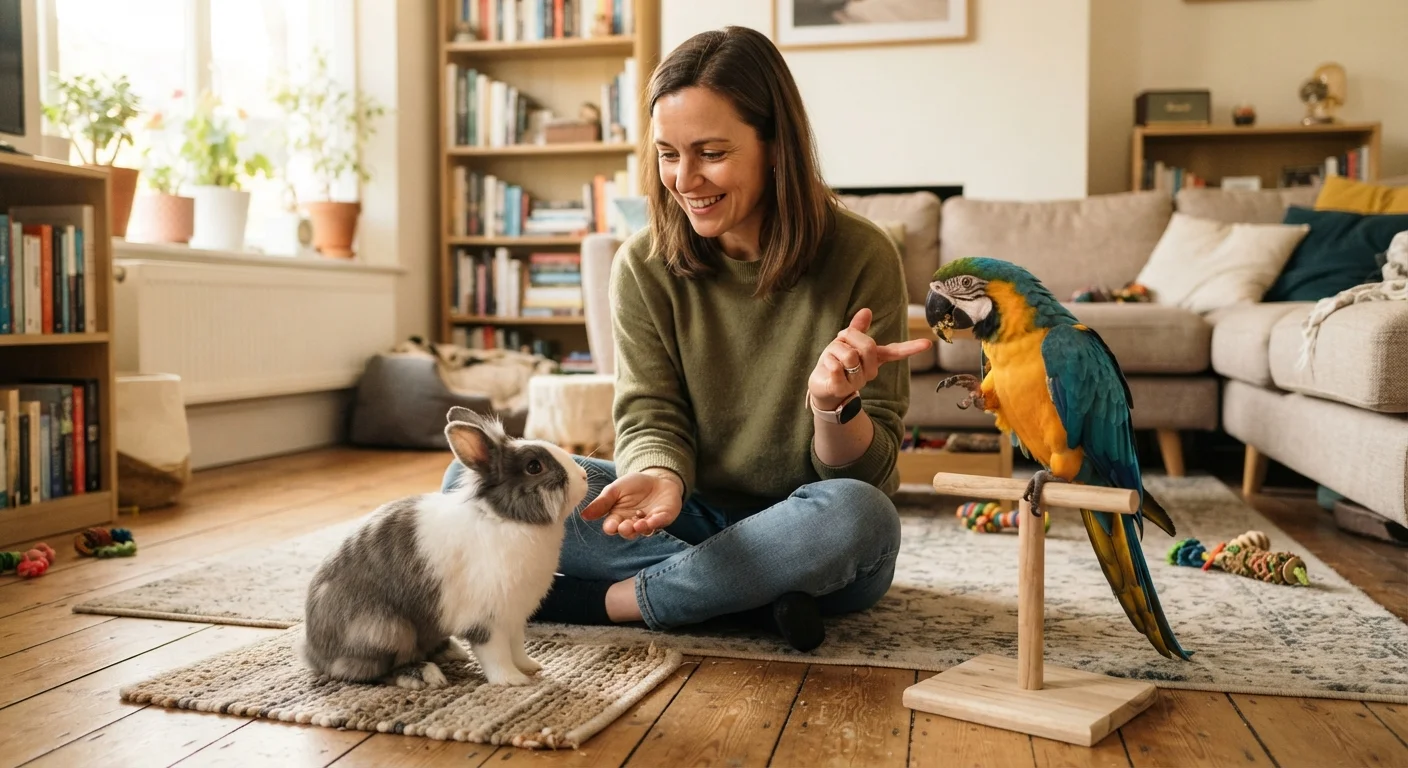
Key Takeaways
- Short, frequent sessions outperform long, exhausting ones for nearly every species.
- Timing your reinforcement within one to two seconds of the desired behavior is critical.
- Consistency in cues and criteria prevents confusion and speeds up learning.
- Ending each session on a success helps maintain your pet's motivation over time.
- Reading your pet's body language lets you adjust difficulty before frustration sets in.
Why Training Principles Transcend Species
Whether you share your home with a dog, cat, parrot, rabbit, or goldfish, the underlying mechanics of learning are surprisingly consistent. All vertebrates - and many invertebrates - learn through the same basic processes: association, consequence, and repetition. What differs is the species-specific motivation (what counts as a reward), the sensory channel that works best (visual, auditory, tactile), and the pace at which the animal can process and respond.
This means that the principles refined through decades of research in animal behavior aren't just dog-training tips. They're a shared grammar for communicating with almost any creature. Before diving into specific practices, it helps to have a solid foundation - the key terms and concepts behind reinforcement and conditioning will make everything else click faster.
Core Practices That Consistently Improve Results
These proven approaches apply whether you're teaching a recall cue to a rescue dog or introducing a harness to a skeptical cat.
Keep sessions short - aim for 3 to 5 minutes, repeated several times a day.
Cognitive fatigue sets in quickly for most animals, and long sessions often end in frustration rather than progress. Shorter, more frequent sessions take advantage of how memory consolidates between practice bouts, leading to faster, more durable learning.
Deliver reinforcement within one to two seconds of the target behavior.
Animals associate consequences with whatever they were doing at the precise moment reinforcement arrives. A delayed reward accidentally reinforces whatever happened in that gap - sitting down, looking away, or sniffing the floor.
Use one consistent cue per behavior and never change it mid-training.
Mixing verbal cues, hand signals, or body positions for the same behavior creates confusion that mimics non-compliance. Animals aren't being stubborn - they genuinely don't recognize an altered signal as the same request.
Raise criteria gradually using a process called shaping.
Jumping to the full, finished behavior too quickly leads to failure and disengagement. Breaking a complex behavior into small, achievable steps keeps your pet succeeding often enough to stay motivated.
Always end each session with a behavior your pet can do successfully.
How a session ends affects how your pet approaches the next one. Finishing on a failure or struggle can reduce motivation and create avoidance around training time.
It's also worth understanding what doesn't work. Punishment-based techniques often backfire not because animals are stubborn, but because aversive methods interfere with the trust and emotional safety that learning requires.
Reading the Room: Adjusting in Real Time
Even the best-designed session can go sideways if you're not paying attention to your pet's signals. Yawning, turning away, slow responses, or repeated mistakes are all signs that the task may be too hard, the session too long, or your pet simply not in the right headspace that day.
“The animal is always right. If the behavior isn't happening, the training plan needs to change - not the animal.”
— Karen Pryor, Pioneer of clicker training and author of 'Don't Shoot the Dog'
Learning to read these signals in the moment is a skill in itself. Our guide to reading body signals during a training session breaks down what to look for across different species. When you notice signs of fatigue or frustration, lower the difficulty, ask for something your pet already knows well, reward that, and stop. That counts as a win.
Training needs also shift across your pet's lifetime - a young animal learning foundations needs different session structures than a senior pet maintaining familiar skills. The life-stage training guide explores how to adapt your approach as your animal companion ages.
Adjust Difficulty, Not Expectations
If your pet misses the same step three times in a row, that's a signal to go back one step - not to repeat the failing criterion. Lowering difficulty temporarily isn't giving up; it's smart training. Animals learn fastest when they're succeeding about 80% of the time in any given session.
Quick Wins to Implement Today
You don't need to overhaul your entire routine to see improvement. A few targeted adjustments can meaningfully raise the quality of your next session.
If you're still deciding how to structure your training overall - solo at home, in a group class, or with a private trainer - an honest comparison of formats can help. See weighing your training options for a balanced breakdown. And if your pet happens to be a cat, what's actually achievable with feline training might pleasantly surprise you.