

Key Takeaways
- Bulk buying reliably saves money on non-perishables, household staples, and items with long shelf lives.
- Perishables, trend-driven items, and products you haven't tried before are poor candidates for bulk purchasing.
- Annual membership fees must factor into your savings calculation to know whether you're actually ahead.
- Unit price comparison is the single most reliable tool for evaluating any bulk purchase.
Lower cost per unit on stable household staples
Non-perishables like paper goods, cleaning supplies, and pantry staples consistently show meaningful per-unit savings at warehouse clubs compared to standard retail.
Fewer shopping trips for high-consumption items
Buying in bulk reduces how often you need to restock predictable items, saving both time and the incremental spending that comes with frequent store visits.
Frozen proteins offer real savings without spoilage risk
Large packs of meat and fish can be divided and frozen at home, preserving the per-pound savings while eliminating the waste concern common with other perishables.
Store-brand options add a second layer of savings
Warehouse club private-label products often combine bulk pricing with lower brand premiums, delivering the strongest unit-cost reductions in the store.
Perishables frequently go to waste before use
Fresh produce, dairy, and bread have short windows that rarely align with how quickly a typical household can consume warehouse-sized quantities.
Annual membership fee must be earned back
Membership costs between $65 and $130 per year; households that don't shop frequently enough or in the right categories may not recover that fee through savings.
Bulk commitment risky for untested products
Buying large quantities of an unfamiliar item locks you into a product you may not like, turning an apparent deal into a sunk cost.
Storage space requirements are often underestimated
Bulk quantities of household goods require dedicated storage; limited space can force inconvenient placement that leads to items being forgotten or expiring.
Not always cheaper than sale prices at regular retailers
For some categories, standard grocery stores running promotional pricing can undercut warehouse club unit prices, making bulk purchasing the less efficient option.
Our Verdict
Warehouse clubs can deliver real savings for households that consume staples consistently and have the storage space to back it up. The math breaks down when you overbuy perishables, pay for things you don't finish, or forget to factor in the membership cost. Treated as a strategic tool rather than a default shopping habit, bulk buying is genuinely worthwhile for a defined set of product categories.
Best for households with predictable consumption patterns, adequate storage space, and the discipline to compare unit prices before loading up the cart.
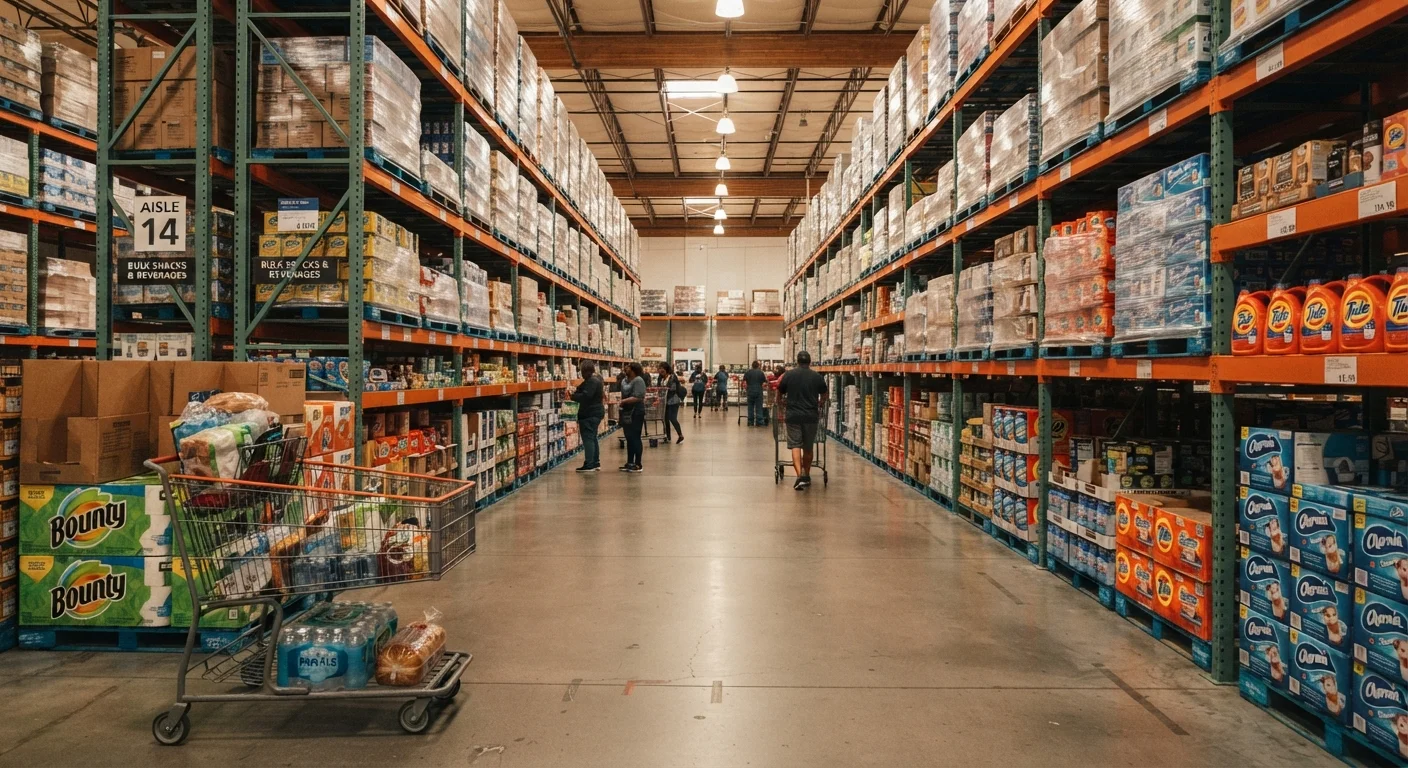
The Core Promise - and the Hidden Catch
The pitch from warehouse clubs is straightforward: buy more, pay less per unit. For certain product categories, that math holds up solidly. For others, the bulk package becomes a slow drain on your budget - not through the sticker price, but through waste, spoilage, and opportunity cost tied up in storage space.
Before any individual purchase decision, there's a fixed cost to acknowledge: annual membership fees typically run between $65 and $130 depending on the tier and club. That cost needs to be recovered through actual savings before you come out ahead. Households that shop at warehouse clubs infrequently or for only a narrow set of items may find the membership pays for itself; those buying broadly across categories generally find it does - but only when they're buying the right things.
For a deeper look at how unit pricing works across any retail format, see how to read unit price labels. That skill is foundational here.
Where Bulk Buying Genuinely Delivers
Lower cost per unit on stable household staples
Non-perishables like paper goods, cleaning supplies, and pantry staples consistently show meaningful per-unit savings at warehouse clubs compared to standard retail.
Fewer shopping trips for high-consumption items
Buying in bulk reduces how often you need to restock predictable items, saving both time and the incremental spending that comes with frequent store visits.
Frozen proteins offer real savings without spoilage risk
Large packs of meat and fish can be divided and frozen at home, preserving the per-pound savings while eliminating the waste concern common with other perishables.
Store-brand options add a second layer of savings
Warehouse club private-label products often combine bulk pricing with lower brand premiums, delivering the strongest unit-cost reductions in the store.
The categories where bulk purchasing consistently earns its keep share a few characteristics: long shelf life, stable household demand, and no meaningful quality difference between a large package and a small one.
- Non-perishable pantry staples - rice, dried pasta, canned goods, cooking oils, and dried beans hold well and are consumed steadily in most households.
- Paper and cleaning products - toilet paper, paper towels, laundry detergent, and dish soap don't expire, store compactly relative to their volume savings, and see consistent use.
- Personal care basics - items like shampoo, body wash, and toothpaste work well in bulk as long as you've already confirmed you like the specific product.
- Frozen proteins - bulk packages of chicken, ground beef, or fish can be portioned and frozen at home, making the per-pound savings real without the spoilage risk.
The case for generic household staples is relevant here too - warehouse club store brands often represent additional savings layered on top of bulk pricing.
When the Math Stops Working
Perishables frequently go to waste before use
Fresh produce, dairy, and bread have short windows that rarely align with how quickly a typical household can consume warehouse-sized quantities.
Annual membership fee must be earned back
Membership costs between $65 and $130 per year; households that don't shop frequently enough or in the right categories may not recover that fee through savings.
Bulk commitment risky for untested products
Buying large quantities of an unfamiliar item locks you into a product you may not like, turning an apparent deal into a sunk cost.
Storage space requirements are often underestimated
Bulk quantities of household goods require dedicated storage; limited space can force inconvenient placement that leads to items being forgotten or expiring.
Not always cheaper than sale prices at regular retailers
For some categories, standard grocery stores running promotional pricing can undercut warehouse club unit prices, making bulk purchasing the less efficient option.
The failure modes in bulk buying are predictable once you know what to watch for. Perishables with short windows - fresh bread, soft produce, most dairy - are the most common source of waste. Buying a three-pound container of spinach sounds efficient until half of it goes bad before you can use it.
Beyond perishables, there are subtler traps:
- Products you haven't tested - committing to a 96-count supply of something you've never used is a significant gamble on personal preference.
- Trend or seasonal items - warehouse clubs sometimes stock items that appear to be good deals but reflect short-term demand rather than products you'll reliably consume.
- Items where variety matters - buying bulk coffee, for example, only works if one roast satisfies your household for months.
It's also worth knowing that some categories are actually priced more competitively at standard grocery stores during sales. Shopping with a clear list and comparing against regular retail prices before warehouse trips prevents overpaying on items where bulk isn't the advantage it appears.
~$65-$130
Typical annual warehouse club membership cost
Membership tiers vary by club and benefits level; the fee must be factored into any savings calculation.
~30-40%
Estimated unit-cost savings on paper products
Consumer surveys and retail analyses commonly find paper goods among the highest-savings categories when bought in bulk versus standard retail.
Making the Membership Pay for Itself
The practical approach is to treat your warehouse club membership like any subscription: track whether it's earning its keep annually. A reasonable method is to note your estimated per-unit savings on items you buy regularly and compare that total to the membership cost. Most active users find they recover the fee quickly on paper products and pantry staples alone - everything else is incremental gain.
Storage capacity is a real constraint that shapes which bulk purchases are rational. Large quantities of laundry detergent require dedicated shelf space. Bulk cooking oil takes up pantry room. If storage space forces you to keep bulk items in inconvenient places, the behavioral reality is that you'll use them inconsistently and some will expire.
For households managing household spending intentionally, bulk purchasing fits naturally into a household budgeting approach - but only when the categories are chosen deliberately rather than because the package size seems impressive. And if you're weighing whether to shop warehouse clubs versus online bulk retailers, comparing online and in-store channels helps clarify which format offers genuine value by category.
A Note on Household Size and Consumption
The economics of bulk buying shift significantly with household size. A two-person household may struggle to finish a bulk package of produce or bakery items before spoilage, while the same purchase is routine for a family of five. Before joining or renewing a warehouse membership, it's worth estimating how quickly your household realistically moves through your most-purchased categories - not how quickly you'd like to.