

Key Takeaways
- Unit price tells you the cost per standard measurement, not just the sticker price.
- Larger packages don't always have a lower unit price - you need to check.
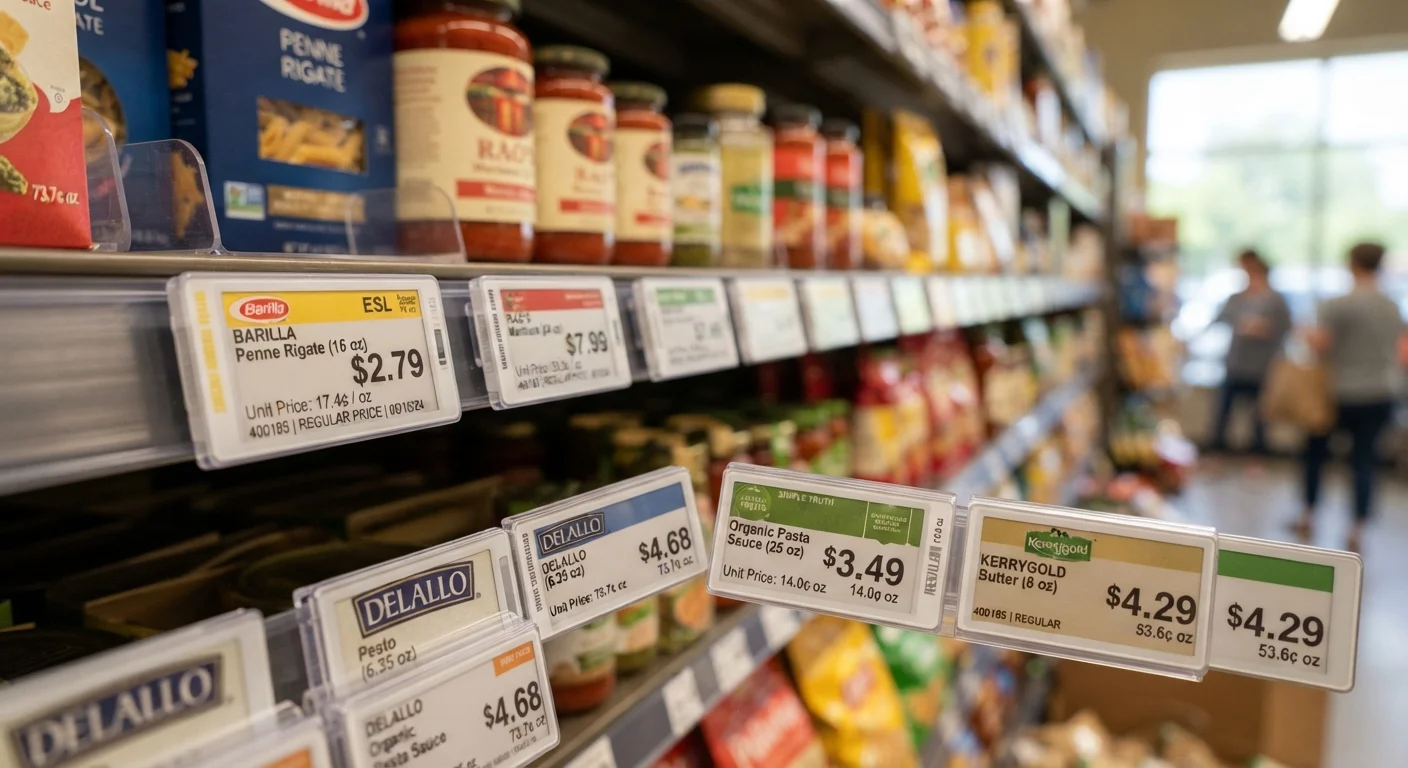
- Store shelf tags typically display unit price in small print near the total price.
- Unit pricing is most valuable when comparing the same product across sizes or brands.
- Buying more than you'll use before it expires erases any unit price savings.
Unit Price
A unit price is the cost of a product broken down to a standard measurement - such as per ounce, per count, or per pound. It lets you compare the true cost of different package sizes or brands side by side, regardless of how the product is packaged or marketed. Instead of comparing a $3.49 bottle to a $4.99 bottle, you compare $0.22 per ounce to $0.18 per ounce.
Many U.S. states require retailers to display unit prices on shelf tags under consumer protection regulations, though the specific unit of measurement used can vary by store and product category.
What the Shelf Tag Is Actually Telling You
Every grocery shelf tag carries two prices: the total you'll hand over at checkout, and the unit price - the one most shoppers overlook. That second number, usually printed small near the bottom of the label, is where the real comparison happens.
Unit price strips away packaging differences and marketing. A 12-oz jar and a 28-oz jar of the same pasta sauce can sit next to each other with prices that seem close. But the unit price - expressed as cost per ounce - instantly shows which one costs less per bite. That's the number worth your attention.
Understanding this skill is a core part of shopping smarter on any budget, and it takes about ten seconds once you know where to look.
~65%
Shoppers who rarely use unit pricing
Consumer research has consistently found that a majority of grocery shoppers do not regularly use unit price information when making purchasing decisions, even when it's displayed on shelf tags.
Up to 30%
Potential savings using unit price comparisons
Studies on grocery purchasing behavior suggest shoppers who actively compare unit prices can reduce spending on comparable goods by a meaningful margin over time.
38 states
U.S. states with unit pricing regulations
A significant portion of U.S. states have enacted regulations requiring retailers to display unit prices, though requirements vary in scope and enforcement.
How to Read and Calculate Unit Price
Most shelf tags show unit price in a standardized format: a dollar amount followed by the unit of measurement. Common units include per ounce (oz), per pound (lb), per fluid ounce (fl oz), per count (ct), and per 100 sheets for paper products.
If a tag doesn't show the unit price - or you want to verify it - the math is simple:
- Find the total price on the label.
- Find the package size (printed on the front or back of the product).
- Divide price by size. A $3.60 box of 18 granola bars = $0.20 per bar.
The same formula works across categories. The tricky part comes when two products use different units. If one cereal is priced per ounce and another per pound, multiply the per-ounce figure by 16 to make them comparable. Your phone's calculator handles this in seconds.
Save the Math for High-Frequency Items
You don't need to calculate unit prices on every item every trip. Focus your effort on the products you buy most often - cooking oils, cereal, canned goods, paper products, and cleaning supplies. Even small per-unit differences on items you buy weekly add up meaningfully over a year.
When Bigger Isn't Actually Cheaper
The assumption that larger packages always cost less per unit is widely held - and frequently wrong. Retailers know shoppers expect bulk to mean savings, and prices aren't always structured that way. Promotions on mid-size packages, store-brand pricing on smaller sizes, or simple shelf placement can flip the expected logic.
This is also where bulk buying math gets complicated. A warehouse club unit price might be genuinely lower, but if you're purchasing a 5-lb bag of mixed nuts and using a third of it before it goes stale, the effective cost per serving is much higher than it looked on the shelf.
The unit price on the tag assumes you'll use every last ounce. Perishables, items with short shelf lives, and anything that requires special storage all need a realistic consumption estimate layered on top of the math.
Where Unit Pricing Fits in Smarter Shopping
Unit pricing is one tool in a broader set of skills. It works best when you're comparing the same or equivalent products - same brand across sizes, or comparable store brands versus name brands. It doesn't account for quality differences, ingredient variations, or your household's actual usage patterns.
It's also worth knowing that shelf presentation and packaging are designed to influence you before you do any math. Retail pricing psychology - from oversized packaging to prominently displayed "value" labels - is built to create impressions of savings without requiring shoppers to verify the numbers. Unit pricing short-circuits that by forcing the comparison onto neutral ground.
And while online grocery shopping is increasingly common, unit prices aren't always displayed consistently on digital platforms, making it harder to compare. Online prices aren't automatically lower once you factor in fees and variable pricing, so in-store unit price comparisons remain a reliable reference point.
“Unit pricing is one of the few pieces of transparent information retailers are required to provide. Learning to use it puts the shopper, not the marketer, in control of the comparison.”
— Edgar Dworsky, Consumer advocate and founder of ConsumerWorld.org