

Key Takeaways
- Prices ending in .99 or .95 are a deliberate tactic that makes items feel significantly cheaper than they are.
- Anchor pricing - showing a high "original" price - shapes your perception of what a fair price actually is.
- Artificial scarcity and countdown timers create urgency that often has no basis in real supply.
- Knowing these tactics doesn't make you immune, but it gives you a moment to pause before deciding.
- Comparing actual unit prices is one of the most reliable ways to cut through pricing theater.
Retail Pricing Psychology
Retail pricing psychology refers to the set of strategies retailers use to influence how shoppers perceive value and make purchase decisions. These tactics - such as ending prices in .99, displaying a high "original" price next to a lower sale price, or suggesting limited availability - are designed to make offers feel more attractive than they may actually be. Understanding these techniques doesn't require any special expertise; it just requires knowing what to look for.
Many of these tactics are rooted in behavioral economics concepts like anchoring, loss aversion, and cognitive load reduction - well-documented phenomena in consumer behavior research.
The Tactics Retailers Use to Frame Value
Walk into any store - or scroll through any major retail site - and you're surrounded by numbers that have been carefully chosen to shape your perception. Pricing psychology isn't new, and it isn't subtle once you know what to look for. The goal is simple: make you feel like you're getting a good deal, whether or not you actually are.
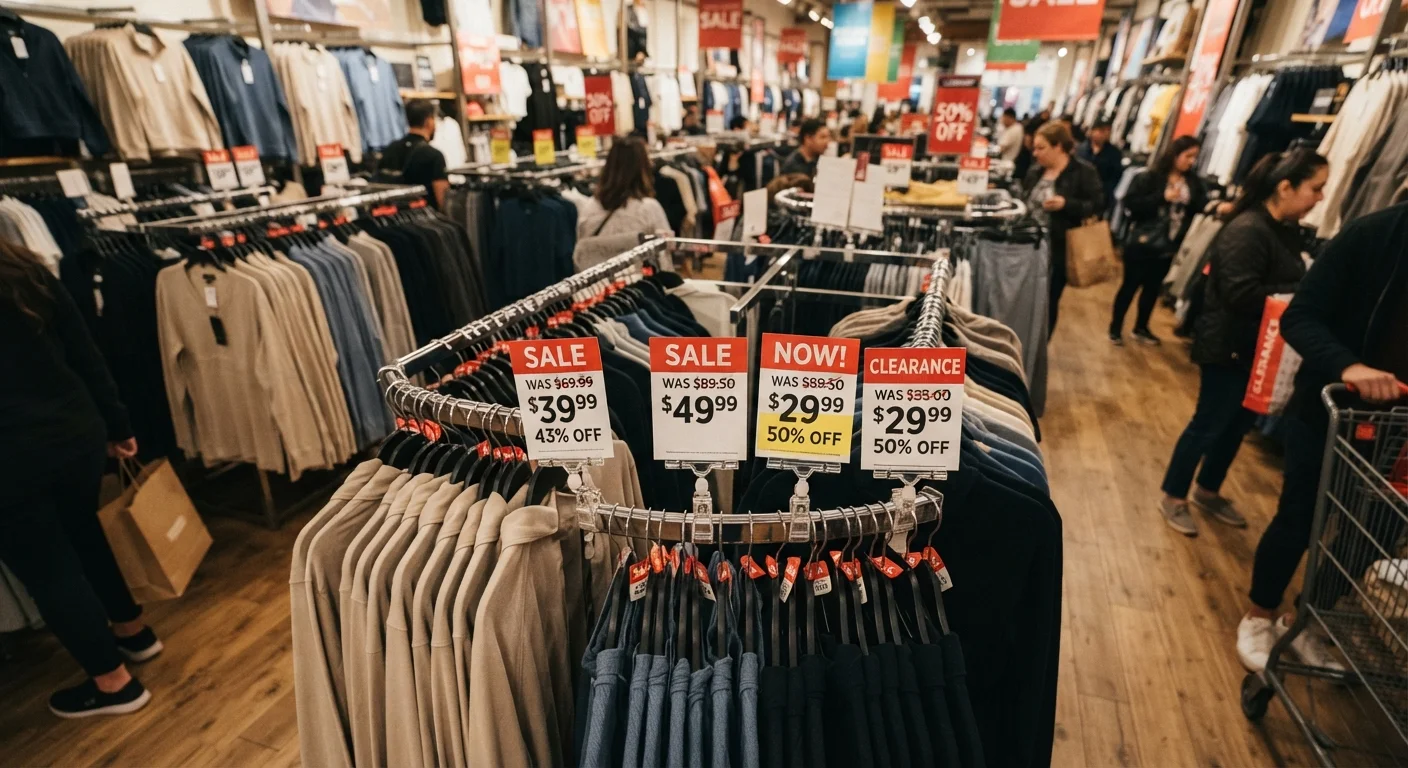
The most common tactic is charm pricing - setting prices just below a round number ($19.99 instead of $20). Even though the difference is one cent, shoppers mentally categorize a .99 price as closer to $19 than $20. The effect persists even at higher price points: $499 reads as meaningfully less than $500 in the way our brains process numbers quickly.
Anchor pricing is arguably more powerful. When a tag shows an item "was $120, now $79," the $120 becomes your reference point - the anchor - and $79 feels like a win. The problem is that the original price may have been set artificially high, rarely charged, or only briefly in effect. Without knowing the item's actual price history, there's no reliable way to judge the anchor on its face.
A Simple Check Before You Buy
Before acting on a sale price, search the item name plus "price history" or run it through a price tracking tool. If the "original" price appears to have been the standard price for an extended period, the discount framing tells you more about the retailer's strategy than it does about your savings.
For a deeper look at how sale framing often misleads shoppers, sale season myths breaks down how discount cycles actually work versus how they're marketed.
Scarcity, Urgency, and the Fear of Missing Out
Alongside price framing, retailers deploy timing and availability signals to compress your decision-making window. Countdown timers, "only 3 left in stock" notices, and "today only" banners all work on the same principle: when something feels scarce or fleeting, it feels more valuable.
Behavioral economics research calls this loss aversion - people generally feel the pain of missing out more acutely than they feel the pleasure of an equivalent gain. Retailers exploit this asymmetry deliberately. The result is that shoppers often make faster, less considered decisions when faced with urgency cues, even when the urgency is manufactured.
Urgency Cues Vary by Platform
Some urgency signals reflect genuine inventory or time limits; others are algorithmically generated to simulate scarcity regardless of actual stock. Major e-commerce platforms have faced scrutiny over the accuracy of countdown timers and "limited stock" indicators. Reading product listings carefully - including seller details and return policies - adds useful context. See what shoppers often miss in product listings for specifics.
This is one reason why building a smarter online shopping routine often comes down to deliberately slowing down - adding items to a wish list before purchasing, setting your own timeline rather than the retailer's.
~1¢
Price difference driving charm pricing effect
Consumer behavior studies consistently show that a one-cent reduction below a round number produces a disproportionately large perception of savings among shoppers.
60%+
Retail purchases influenced by in-store price displays
Research across retail environments suggests the majority of unplanned purchases are triggered by promotional price presentation rather than pre-planned intent.
How to Apply This Knowledge at the Point of Purchase
Awareness alone won't make these tactics disappear, but it does create a pause - and that pause is where better decisions happen. A few practical habits help cut through the noise.
Compare unit prices, not package prices. A larger pack at a "sale" price can still be a worse deal than a smaller pack at full price if the cost-per-unit is higher. Unit price math is the clearest equalizer across differently-sized products.
Check price history before acting on a sale. Price tracking tools can reveal whether a "sale" price is genuinely lower or whether the item has been at that price for months.
Don't assume online is cheaper. Dynamic pricing and platform markups mean that the same item can vary widely in actual cost online versus in-store. Why online prices aren't always lower covers the variables worth checking before assuming you've found a better deal.
Finally, before completing any purchase that felt urgent or like an obvious bargain, it's worth asking: Would I have wanted this item at this price if there were no sale tag, no countdown, and no "limited stock" notice? That question cuts through most pricing theater quickly.
“The price tag doesn't just tell you what something costs - it tells you a story about what the retailer wants you to believe something is worth. Those are two very different things.”
— Consumer behavior researchers, Behavioral economics and retail psychology literature