

Key Takeaways
- Price trackers show historical pricing data, helping you verify whether a listed discount is real.
- These tools have significant blind spots, including seller variations, bundled pricing, and data gaps.
- Price history alone shouldn't be your only factor - availability, seller reputation, and total cost matter too.
- Setting price drop alerts is more effective than checking manually at random times.
- Not all retailers' prices are captured accurately or consistently by tracking tools.
Price Tracking Tool
A price tracking tool is a browser extension, website, or app that monitors how the listed price of a product has changed over time. It records historical pricing data so shoppers can see whether a current price is genuinely lower than usual or simply appears to be a discount. These tools are designed to add context to a price tag that would otherwise be impossible to evaluate at a glance.
Most price trackers work by periodically scraping or querying retailer pages and logging the price at each interval. Coverage and update frequency vary significantly by tool and retailer.
What Price Tracking Tools Actually Do
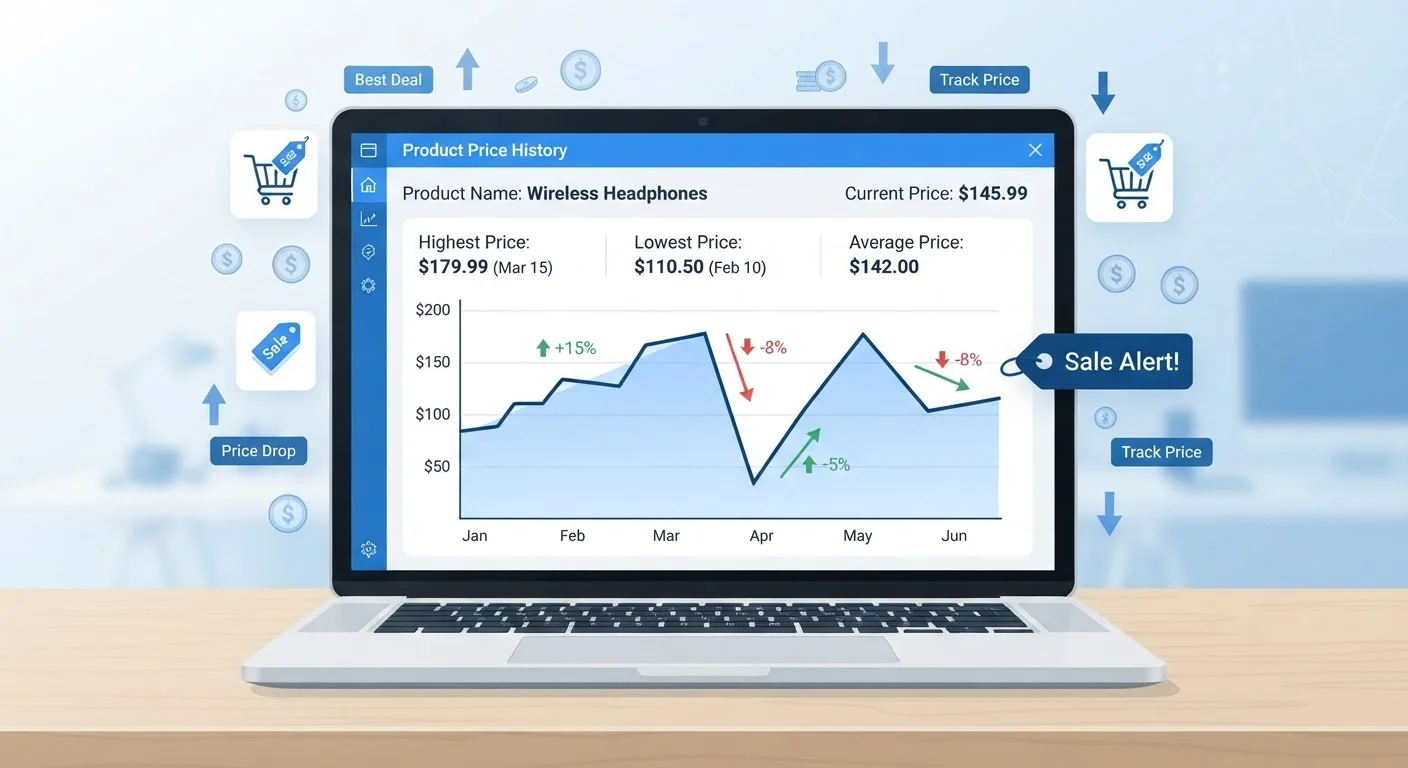
At their core, price tracking tools do one thing: they log what a product costs at different points in time and make that history visible to you. When you look at a product page showing a "40% off" badge, a price tracker can show you whether that item has been at that price - or lower - for months, or whether the discount is genuinely new.
Most tools work by checking prices at regular intervals and storing the results in a searchable database. Many also let you set alerts, so you receive an email or notification when a tracked item drops to a price you've defined. This moves you from passive browsing to active monitoring without requiring you to check manually every few days.
Understanding retail pricing psychology makes price trackers even more useful - because when you can see a chart of actual price movement, the anchoring and urgency tactics used in product listings lose much of their power.
~30%
Price inflation before major sale events
Consumer advocacy research has found that a significant share of products show price increases in the weeks before large retail promotions, making pre-sale tracking especially valuable.
Millions
Products tracked by leading price history tools
Major price tracking platforms cover tens of millions of product listings across multiple large retail sites, though coverage depth varies significantly by retailer.
The Real Limits of Price History Data
Price trackers are useful, but they are not a complete picture. Several limitations can undermine the conclusions you might draw from them.
- Seller variation: On marketplace platforms, the same product listing can be fulfilled by multiple sellers at different prices. A tracker may log the lowest available price at any moment, or the default seller's price - and those aren't always the same thing.
- Bundled or variant pricing: If a product is sold in bundles or with different specifications, the tracked price may not match the exact configuration you want.
- Data gaps: Trackers don't capture every price change in real time. If a flash sale runs for only a few hours, the historical low recorded may reflect that brief window - making today's price look artificially high by comparison.
- Retailer blocking: Some retailers actively limit or block price scraping. Their data may be missing entirely or stale.
This is why it's worth also understanding how online prices compare to in-store prices - a tracker only tells you about price changes on one platform, not the full market.
Check the Price Chart Before Big Sale Events
Pull up price history for any item you plan to buy during a major sale period - at least two to four weeks before the event. If the price has been quietly rising in the run-up, the "discount" may be smaller than it looks. A flat or declining price history before the sale is a stronger signal that the deal is genuine.
How to Use These Tools Without Over-Relying on Them
The most effective approach treats price history as one input among several, not the final word on whether something is worth buying.
Use trackers to validate, not decide. Before any major purchase, pull up the price history chart. If the current price aligns with or is below the historical average, that's meaningful. If it's near a spike that coincides with a promotional event, treat the "deal" with skepticism.
Set alerts rather than timing the market. Trying to predict the absolute lowest future price is speculative. Set an alert at a price you'd genuinely be happy paying, and buy when that threshold is reached. This removes the guesswork.
Check total cost, not just listed price. Shipping, taxes, and return policy costs all affect what you're actually spending. A tracked price drop that's offset by higher shipping isn't necessarily a better deal. Reading product listings carefully - including seller identity and return windows - is equally important.
Price tracking pairs well with broader budgeting habits. Knowing your limit before you start tracking means you're less likely to rationalize a purchase just because the price history graph looks favorable.
When Price Trackers Add the Most Value
These tools are most useful in specific situations rather than as a general habit for every purchase.
They're especially valuable before major retail events like holiday sales or seasonal promotions, when retailers sometimes raise prices ahead of a sale date to manufacture the appearance of a discount. A price history chart makes this tactic immediately visible.
They're also helpful for high-ticket, non-urgent purchases - electronics, appliances, or furniture - where patience can yield meaningful savings and the price tends to fluctuate in predictable patterns over weeks or months.
For everyday low-cost items, the time spent tracking rarely justifies the potential savings. Shopping with a focused list tends to be more efficient for routine purchases than tracking individual prices.
Finally, use price history alongside - not instead of - review evaluation. A low price on a poorly rated product is rarely a good deal. Reading reviews critically ensures price data is weighted alongside product quality signals.