

Key Takeaways
- Apply products from thinnest to thickest consistency as a reliable general rule.
- Heavier products can form a barrier that prevents lighter actives from absorbing.
- Sunscreen always goes last in a morning routine - after moisturizer.
- Waiting 30-60 seconds between steps gives each layer time to settle.
- Morning and evening routines follow the same sequencing logic but use different products.
Skincare Application Order
Skincare application order refers to the sequence in which you layer products onto your skin. The general principle is to apply products from thinnest to thickest consistency, allowing each layer to absorb properly before the next is added. Getting the order right ensures that active ingredients can reach the skin where they work best.
Molecular weight plays a role here: smaller molecules in lightweight formulas (such as serums with hyaluronic acid or niacinamide) need direct contact with skin to penetrate effectively, while occlusive agents in heavier creams form a surface layer that can physically block absorption of anything applied on top.
The Core Logic: Lightest to Heaviest
Think of your skin as a series of gates. Each gate only opens to molecules small enough to pass through. Apply a thick cream first and you've effectively shut those gates - a lightweight serum applied afterward will mostly sit on the surface rather than penetrate where it can do its job.
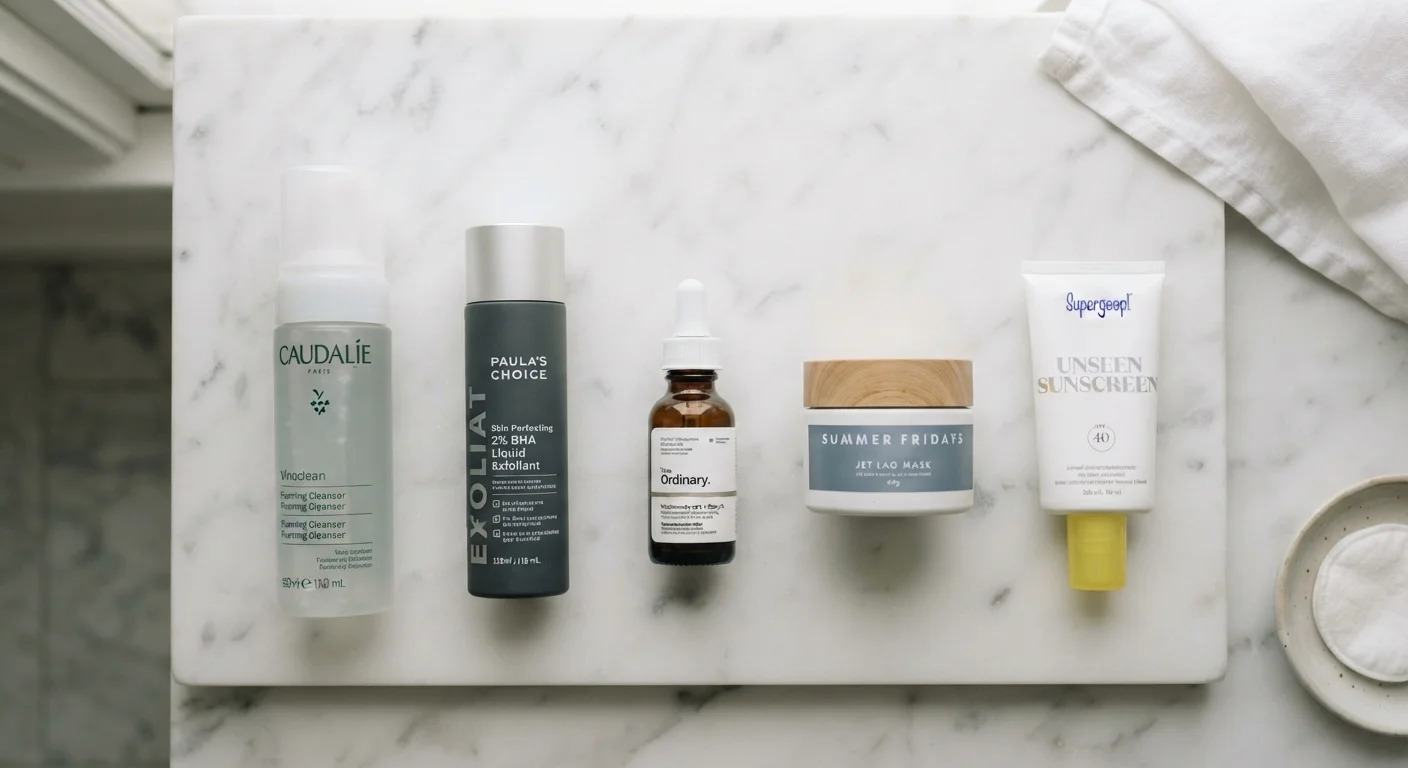
The foundational rule of skincare layering is straightforward: move from the thinnest, most water-like formulas to the thickest, most occlusive ones. A typical morning sequence looks like this:
- Cleanser (rinse off)
- Toner or essence
- Serum or treatment
- Eye cream
- Moisturizer
- Sunscreen (morning only, applied last)
This order exists because lighter formulas are designed to deliver concentrated actives directly to skin cells. Heavier formulas - rich creams and oils - are designed to seal in moisture and protect the skin's surface barrier. Mixing up that logic undermines both jobs.
If you're still figuring out which products belong in your routine at all, our guide to building a skincare routine from scratch is a useful starting point.
A Simple Test for Layering Order
If you're unsure where a product belongs, rub a small amount between clean fingers. Does it feel watery and absorb almost instantly? It goes earlier in your routine. Does it feel rich, oily, or slow to sink in? It belongs toward the end. This texture check won't be perfect for every formula, but it gives you a reliable starting point.
Where People Go Wrong - and Why It Matters
The most common sequencing mistake is applying moisturizer before serum. It feels intuitive - moisturizer seems like a base layer - but it works the opposite way. Moisturizers often contain occlusives like petrolatum or dimethicone, ingredients specifically designed to form a film over the skin. That film traps in hydration, which is exactly what you want - but only after your treatment products have had a chance to absorb.
Another frequent error involves sunscreen. SPF should always be the last step in a morning routine. Applying anything on top of sunscreen - even a light powder - can disturb its even distribution and reduce protection. Learn more about why this matters in our piece on why daily sunscreen is non-negotiable.
Oils are another source of confusion. Face oils are generally applied after moisturizer (or mixed into it) because their larger molecular structure means they sit on top of water-based products rather than absorbing through them. Using an oil before a water-based serum effectively waterproofs your skin against that serum.
~60%
Skin penetration lost with incorrect layering order
Dermatology educators commonly cite that misordering products can significantly reduce the amount of active ingredient that reaches the target skin layer, though exact figures vary by formula and ingredient.
30-60 sec
Recommended wait time between skincare steps
Skin barrier specialists generally recommend a brief pause between layers to allow partial absorption before applying the next product.
Timing, Technique, and a Few Practical Notes
You don't need to wait several minutes between every step - the 30-to-60-second rule works well in practice. Apply a product, give it a moment while you do something else, then move to the next. If you're using a prescription treatment or a high-concentration active like a retinoid, your dermatologist may recommend a specific waiting period; follow that guidance rather than general rules.
Application technique also matters. Pressing or patting products into skin is generally more effective than rubbing, which can disrupt the layer you just applied. For eye cream, use the ring finger and a gentle tapping motion - the skin around the eye is thin and delicate.
If you've recently changed products or added something new to your routine, it's worth being methodical. Our guide on how to switch skincare products without setbacks explains how to introduce changes gradually so you can actually tell what's working.
Morning and Evening Routines Follow the Same Rule
The lightest-to-heaviest principle applies at night just as it does in the morning. The key difference is the products involved: nighttime routines often include richer repair treatments and skip SPF entirely. Some active ingredients, like certain forms of retinol, are typically reserved for evening use due to sun sensitivity. Our article on morning vs. evening skincare differences walks through the reasoning in detail.
This article is for general informational purposes only and does not constitute medical or dermatological advice. If you have specific skin concerns or conditions, consult a qualified dermatologist or healthcare professional.