

| Human Hearing Range | 20 Hz - 20,000 Hz (20 kHz) (Established audiological consensus) |
| Typical Headphone Impedance Range | 16 Ω - 600 Ω (Common across consumer and professional headphones) |
| THD Threshold for Audibility | ~1% or higher (Distortion below ~0.1% is generally considered inaudible) |
| Standard Sensitivity Range (Headphones) | 85 - 120 dB/mW (Varies by driver type and design) |
| Low Impedance (Phone-Friendly) | Under 50 Ω (Optimized for portable devices without dedicated amplifiers) |
| High Impedance (Amp-Required) | 250 Ω and above (Common in professional studio headphones) |
Why Audio Specs Are Worth Understanding
When you look at a headphone or speaker listing, you'll typically see a wall of numbers: 32Ω, 20Hz-20kHz, 105dB/mW, THD <0.1%. These figures aren't decoration - they describe how a device behaves. But without context, they're easy to misread or over-rely on.
This guide gives you a plain-language reference for the specs you'll actually encounter. Use it alongside our guide to home audio formats to build a more complete picture of what you're evaluating.
| Human Hearing Range | 20 Hz - 20,000 Hz (20 kHz) (Established audiological consensus) |
| Typical Headphone Impedance Range | 16 Ω - 600 Ω (Common across consumer and professional headphones) |
| THD Threshold for Audibility | ~1% or higher (Distortion below ~0.1% is generally considered inaudible) |
| Standard Sensitivity Range (Headphones) | 85 - 120 dB/mW (Varies by driver type and design) |
| Low Impedance (Phone-Friendly) | Under 50 Ω (Optimized for portable devices without dedicated amplifiers) |
| High Impedance (Amp-Required) | 250 Ω and above (Common in professional studio headphones) |
Core Specifications Decoded
Impedance (Ω)
Impedance determines how much electrical resistance a headphone or speaker presents to its power source. Low-impedance headphones (under 50Ω) are designed for smartphones and laptops, which have limited output power. High-impedance models (250Ω and above) need a dedicated headphone amplifier to reach adequate volume and performance.
Pairing a high-impedance headphone with an underpowered source doesn't just produce quiet audio - it can alter the tonal character because different parts of the frequency range respond differently to insufficient current.
Frequency Response (Hz)
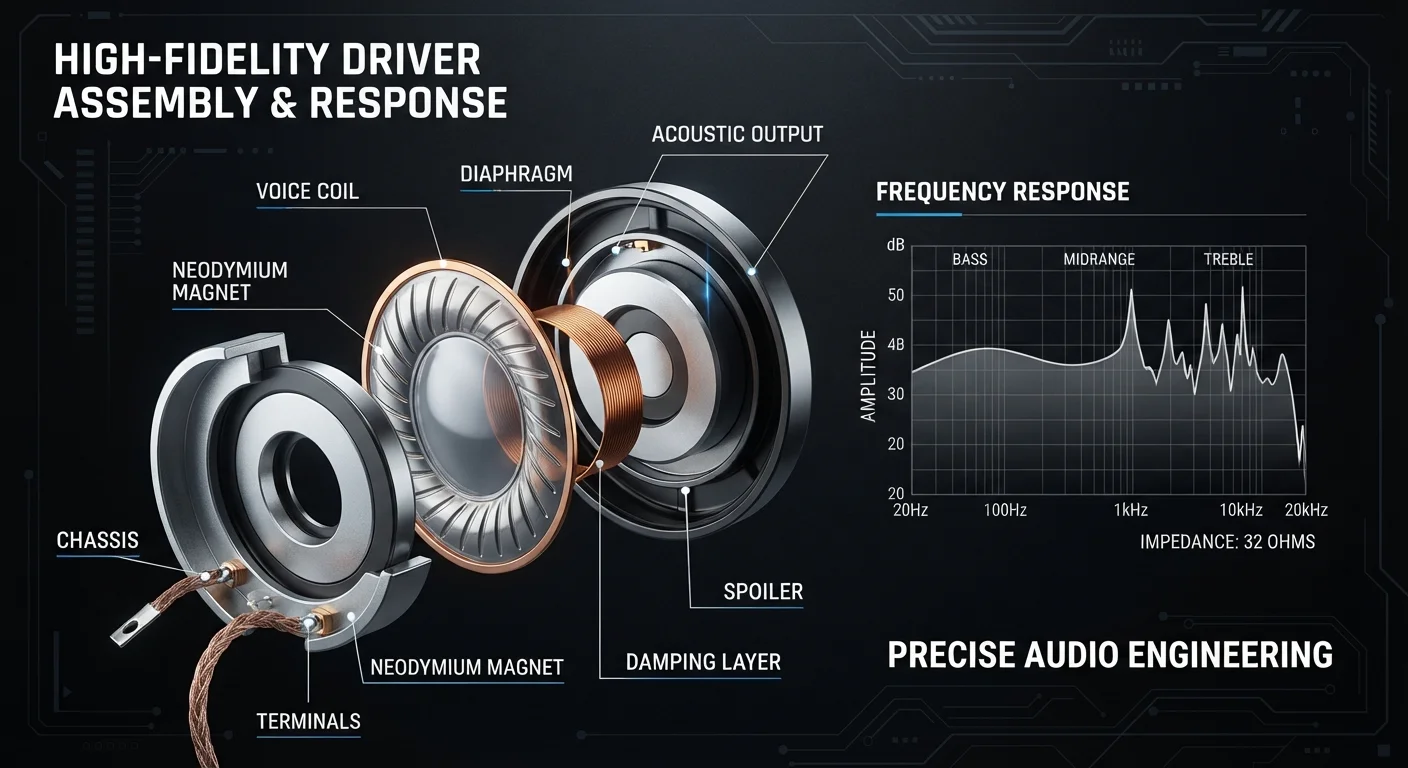
This spec tells you the range of pitches a device can reproduce. Human hearing typically spans 20Hz to 20kHz, so a device rated 20Hz-20kHz covers the full audible range. However, the flatness of the response across that range matters more than the endpoints. A device may technically reproduce 20Hz but do so very quietly or with significant distortion.
Manufacturers rarely publish full frequency response graphs in consumer listings, but audio review sites often measure and publish them - a far more informative resource than the raw numbers alone.
Sensitivity (dB/mW)
Sensitivity tells you how efficiently a device converts electrical power into sound. A headphone rated at 110dB/mW will be noticeably louder from the same source than one rated at 90dB/mW. This matters most for portable use: if sensitivity is low, a phone's output may not be sufficient for comfortable listening levels.
Specs Don't Tell the Whole Story
Manufacturers measure and report audio specs using different testing conditions, so direct numeric comparisons across brands can be misleading. A headphone with a wider frequency response on paper doesn't automatically sound better than one with a narrower range. Listening tests and trusted reviews remain important complements to spec sheets.
Total Harmonic Distortion (THD)
THD measures how much unwanted harmonic noise a device adds to the original signal, expressed as a percentage. Anything below approximately 0.1% is widely considered inaudible under normal listening conditions. Higher THD figures at high volume levels are a more meaningful concern than baseline THD at moderate levels.
Signal-to-Noise Ratio (SNR)
SNR quantifies how much clean signal you get relative to background noise. This matters more for amplifiers, DACs (digital-to-analog converters), and receivers than for passive headphones. A higher number - say, 110dB SNR versus 80dB - means quieter, cleaner audio in the spaces between sounds.
Impedance
Measured in ohms (Ω), impedance is a headphone or speaker's resistance to electrical current. Higher impedance generally requires more amplifier power to reach the same volume.
Frequency Response
The range of sound frequencies a device can reproduce, expressed in Hz (e.g., 20Hz-20kHz). It describes which pitches the device handles, not necessarily how accurately.
Sensitivity
How loudly a headphone or speaker converts power into sound, typically expressed in dB per milliwatt (dB/mW). Higher sensitivity means louder output from the same input power.
Total Harmonic Distortion (THD)
A measure of unwanted harmonic frequencies introduced by a device, expressed as a percentage. Lower THD values indicate a cleaner, more accurate sound reproduction.
Signal-to-Noise Ratio (SNR)
The ratio of useful audio signal to background noise, measured in dB. A higher SNR means less audible hiss or hum interfering with the intended audio.
Driver
The internal component that converts electrical signals into sound waves. Driver size (measured in millimeters) is often cited in headphone specs, though size alone doesn't determine quality.
Decibel (dB)
A logarithmic unit used to express sound pressure level, sensitivity, or signal strength. A 10 dB increase roughly doubles perceived loudness to the human ear.
Hertz (Hz)
The unit of frequency measuring sound cycles per second. Human hearing typically spans 20Hz (deep bass) to 20,000Hz or 20kHz (high treble).
Putting Specs in Context
No single number determines whether audio gear sounds good. Impedance, sensitivity, frequency response, and THD interact with each other and with the source device powering them. A high-sensitivity, low-impedance headphone might pair perfectly with a phone but sound harsh through a powerful amplifier designed for studio headphones.
For wireless audio, specs like these are only part of the picture - the codec used to transmit audio over Bluetooth also affects fidelity. Our Bluetooth codecs reference explains how SBC, AAC, aptX, and LDAC differ and when the distinction matters.
Similarly, if you're streaming music, the quality of the audio file or stream itself shapes what you hear before your hardware even comes into play. Streaming audio quality is a separate but related variable worth understanding.
Specs are best used as a filtering tool - a way to rule out clear mismatches (like pairing a 300Ω headphone with a smartphone) rather than a ranking system. If you're just beginning to build a listening setup, our home audio matching guide can help translate these concepts into practical decisions for your space.