

Key Takeaways
- Whole foods are minimally processed and retain most of their natural nutritional profile.
- Ultra-processed foods contain industrial additives not typically used in home cooking.
- The NOVA classification system groups foods by degree of processing, not nutrient content alone.
- Research associates high ultra-processed food intake with several adverse health outcomes.
- A practical approach focuses on dietary patterns rather than eliminating individual foods entirely.
Option A
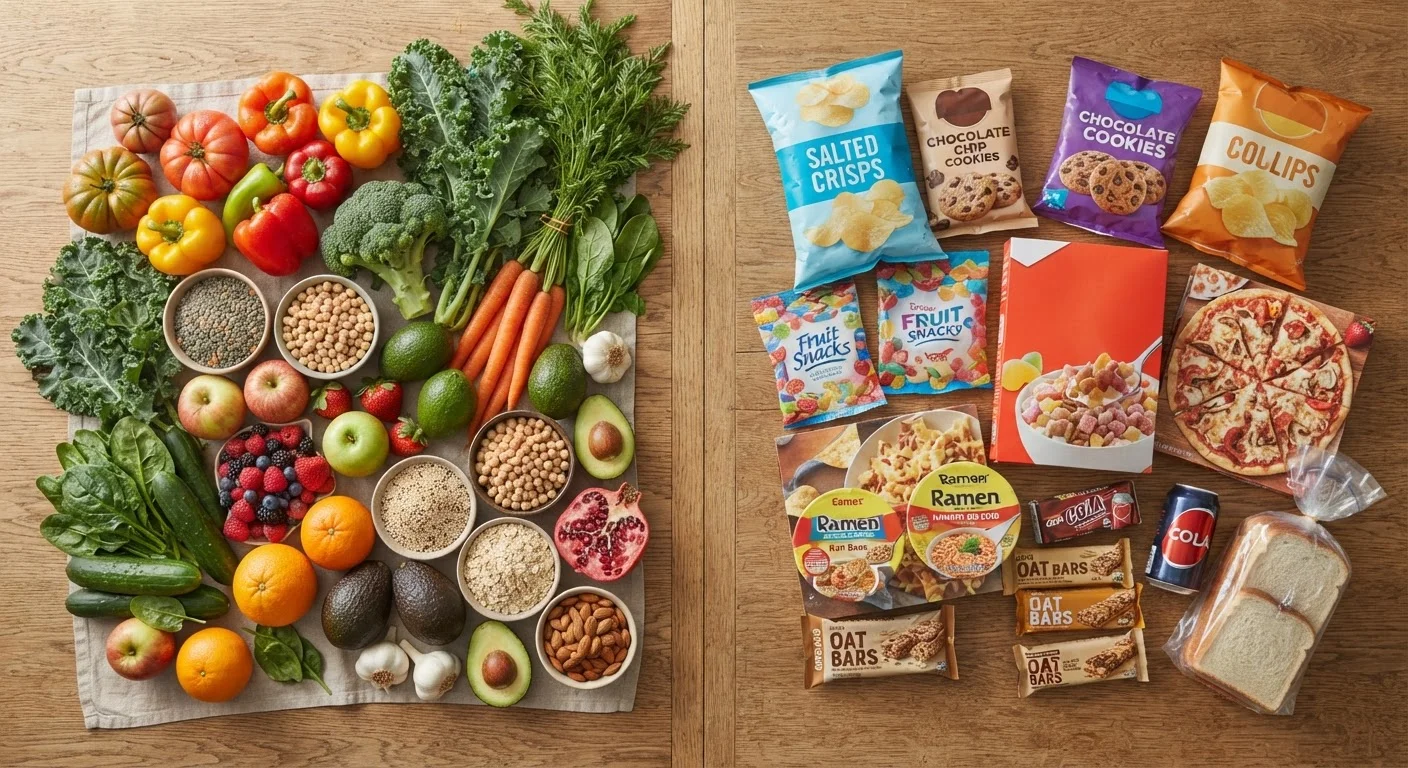
Whole Foods
Minimally altered ingredients in their natural or near-natural state.
Best for: Everyday dietary foundations for those seeking nutrient-dense, recognizable ingredients with minimal additives.
Option B
Ultra-Processed Foods
Industrially manufactured products engineered for palatability and shelf life.
Best for: Understanding as a category to limit - useful in context of convenience but associated with higher risk when consumed as a dietary staple.
If you want to build a nutrient-dense daily diet
Whole Foods
Whole foods provide fiber, vitamins, minerals, and phytonutrients in forms the body recognizes and uses efficiently, with little to no added chemicals or engineered flavors.
If you're evaluating convenience options and want to minimize risk
Whole Foods
Even minimally processed options like frozen vegetables or canned legumes retain most of their nutritional value and are far preferable to heavily engineered alternatives.
If you rely on packaged foods due to access, budget, or time
Ultra-Processed Foods (selectively)
Not all packaged foods are equal. Understanding processing levels helps you make more informed choices within real-world constraints, without requiring a perfect diet.
Defining the Terms: What Each Category Actually Means
The phrase "whole foods" is used widely, but it has a specific meaning in nutrition science. A whole food is one that has undergone little or no processing - think an apple, a handful of oats, dried lentils, or a raw egg. The ingredient is essentially the food itself. Minimally processed versions, such as washed and bagged spinach or pasteurized milk, are generally still considered part of this category because the processing doesn't substantially alter their nutritional structure.
"Ultra-processed foods," by contrast, are defined under the NOVA classification system - a framework developed by Brazilian nutrition researchers that categorizes foods based on the extent and purpose of processing, not on nutrient content alone. NOVA Group 4 foods (ultra-processed) contain ingredients rarely found in home kitchens: emulsifiers, flavor enhancers, hydrogenated oils, artificial colorings, and chemical preservatives. Examples include many packaged snack foods, certain breakfast cereals, flavored yogurts, fast food items, and carbonated soft drinks.
Critically, a food can be high in sugar or fat without being ultra-processed, and an ultra-processed food can appear nutritionally adequate on a label. Processing level and nutrient content are related but distinct dimensions. Understanding both is essential. For more on a related distinction, see the difference between added and natural sugar.
Head-to-Head: How They Compare Across Key Dimensions
The differences between whole and ultra-processed foods go beyond ingredient lists. They diverge in how they affect satiety, gut health, nutrient absorption, and long-term dietary patterns.
| Criterion | Whole Foods | Ultra-Processed Foods |
|---|---|---|
| Ingredient complexity | One or few recognizable ingredients | Long lists with industrial additives |
| Fiber content | Naturally present and intact | Often removed or absent |
| Micronutrient retention | High - structure largely preserved | Variable; often enriched artificially |
| Satiety response | Generally higher per calorie | Engineered to encourage overconsumption |
| Shelf stability | Lower - perishable | High - preservatives extend shelf life |
| Cost and accessibility | Varies; fresh produce can be costly | Often cheaper and more widely available |
| Research associations | Linked to lower chronic disease risk | Linked to higher chronic disease risk |
Fiber content is one of the starkest contrasts. Ultra-processed foods are frequently stripped of naturally occurring fiber and rarely replace it meaningfully. Fiber supports digestive health, blood sugar regulation, and satiety - all areas where whole food diets tend to show advantages in research literature. Additives in ultra-processed foods also interact with the gut microbiome in ways still being studied, with some emulsifiers showing potential to disrupt gut barrier function in early laboratory research.
57%
Share of US calories from ultra-processed foods
Research published in BMJ Open estimated that ultra-processed foods account for roughly 57% of energy intake among US adults.
10%+
Mortality risk increase per 10% UPF intake rise
A large prospective study in The BMJ found each 10% increase in ultra-processed food share of diet was associated with a statistically significant rise in all-cause mortality.
4 groups
NOVA food processing classification levels
The NOVA system, developed by researchers at the University of São Paulo, organizes all foods into four groups based on the extent and purpose of processing.
The Spectrum in Between: Processed Isn't Always a Dirty Word
It's important not to collapse the full spectrum into a simple binary. NOVA identifies four groups: unprocessed/minimally processed foods, processed culinary ingredients (like olive oil or flour), processed foods (like canned tomatoes, cheese, or bread), and ultra-processed foods. Most diets include elements from all four categories.
Frozen vegetables, canned beans, and plain yogurt are processed - but they retain significant nutritional value and don't contain the industrial additives that define ultra-processed products. Treating all processing as equivalent can lead to unnecessary dietary restrictions. For that reason, eliminating entire food categories is rarely the most effective or sustainable approach.
The practical goal for most people is to shift the proportion of their diet toward less-processed options over time, not to achieve perfection on every meal. Whole foods can anchor a diet without requiring every item to be farm-to-table. Navigating the grocery store with this in mind can help make those shifts feel manageable rather than overwhelming.
Not All Labels Tell the Full Story
A product labeled "natural" or "made with real ingredients" is not necessarily minimally processed. These terms are not strictly regulated by the FDA in the way that nutrition facts panels are. Reading the ingredient list - particularly noting additives like carrageenan, high-fructose corn syrup, or artificial flavors - gives a more accurate picture of where a product falls on the processing spectrum.
What the Research Says - and Its Limits
Observational research has consistently associated higher ultra-processed food consumption with increased risk of obesity, type 2 diabetes, cardiovascular disease, and certain mental health outcomes. A large prospective study published in The BMJ found that each 10% increase in ultra-processed food consumption was associated with a statistically significant increase in all-cause mortality risk. However, most evidence in this area remains observational - meaning researchers can identify associations but cannot definitively prove causation.
One challenge is that ultra-processed food consumption often correlates with other lifestyle factors, including lower overall diet quality, less physical activity, and socioeconomic constraints. Disentangling these variables is methodologically complex. That said, the breadth and consistency of findings across multiple countries and study designs give researchers reasonable confidence that ultra-processing is a meaningful dietary variable - not merely a proxy for other factors.
Dietary pattern matters as much as individual food choices. Whether someone follows a plant-based or omnivore eating pattern, the degree of processing across their overall diet appears to be a significant independent factor in health outcomes.
This article is for general informational and educational purposes only and does not constitute medical or dietary advice. Consult a registered dietitian or qualified healthcare provider for guidance tailored to your individual health needs.