

Key Takeaways
- Chronic stress in pets triggers measurable physical changes, including immune suppression and hormonal imbalance.
- Boredom-driven behaviors like excessive grooming or repetitive pacing are signs of an unmet health need, not just bad habits.
- Enrichment should match the species, age, and individual temperament of each pet.
- Simple, low-cost changes to a pet's environment can meaningfully reduce stress indicators.
- Senior pets and those in multi-pet households have distinct enrichment needs worth addressing separately.
Mental Enrichment for Pets
Mental enrichment refers to activities, environments, and interactions that engage a pet's mind, senses, and natural instincts. It goes beyond physical exercise to challenge problem-solving, curiosity, and species-specific behaviors. When pets lack sufficient mental stimulation, the resulting boredom and stress can affect their physical health - not just their behavior.
Veterinary behaviorists distinguish enrichment types - sensory, cognitive, social, feeding-based, and environmental - each targeting different neurological and behavioral needs depending on the species and individual animal.
Why Mental Health in Pets Is a Physical Health Issue
Most pet owners understand that their animals need food, water, veterinary care, and exercise. What receives far less attention is the mental dimension - and the science is clear that this is a meaningful gap. Chronic stress and persistent boredom don't just create behavioral problems; they produce measurable physiological changes inside your pet's body.
When an animal experiences ongoing stress - whether from under-stimulation, an unpredictable environment, or social conflict - the body responds by releasing cortisol and other stress hormones. Over time, elevated cortisol suppresses immune function, disrupts the gut microbiome, impairs wound healing, and contributes to chronic inflammation. These are the same biological mechanisms at work in chronically stressed humans.
For a deeper look at how unaddressed emotional states create downstream health effects, the parallels explored in how suppressing emotions worsens stress outcomes offer useful context - the principle that unresolved internal states affect physical wellbeing applies across species.
70%+
Dogs showing anxiety-related behaviors
A large-scale study published in Scientific Reports found that over 70% of dogs displayed at least one anxiety-related behavior, highlighting how widespread the issue is in companion animals.
~40%
Cats affected by stress-related illness
Veterinary internal medicine research suggests a significant proportion of feline lower urinary tract disease cases are linked to environmental stress rather than infection or structural causes.
2-3x
Immune response improvement with enrichment
Studies in laboratory and zoo animal populations have shown that structured environmental enrichment can meaningfully improve immune markers and reduce stress hormone levels.
What Stress and Boredom Actually Look Like in Pets
Stress signals in pets are easy to misread. A dog that chews furniture is often labeled destructive. A cat that over-grooms until bald patches appear may be dismissed as having a skin condition. A bird that feather-plucks or a rabbit that repetitively circles its enclosure - these are behavioral red flags that frequently have a mental health component.
Veterinary behaviorists refer to some of these patterns as stereotypies - repetitive, invariant behaviors that develop when an animal has insufficient outlets for natural drives. In farm animals and zoo populations, these behaviors are well-documented responses to impoverished environments. The same phenomenon occurs in companion animals, and it's a signal worth taking seriously rather than correcting through punishment.
Other, subtler signs include changes in appetite, social withdrawal, excessive clinginess, increased aggression, or house soiling in previously reliable animals. None of these symptoms are exclusively caused by mental understimulation - your veterinarian should always evaluate for underlying medical causes first. But when physical causes are ruled out, the environment and enrichment picture deserves close examination.
Start With Observation Before Intervention
Before purchasing new toys or restructuring your pet's environment, spend a few days observing when stress behaviors occur - time of day, duration, triggers. This information is valuable both for your own problem-solving and for any veterinarian or behaviorist you consult. Patterns often reveal the simplest, most targeted solutions.
What Enrichment Actually Involves
Enrichment is sometimes reduced to "giving your pet toys," but the concept runs deeper. Certified animal behaviorists typically categorize enrichment across several dimensions:
- Sensory enrichment: Engaging smell, sight, hearing, or touch - such as introducing novel scents, nature sounds, or textured surfaces.
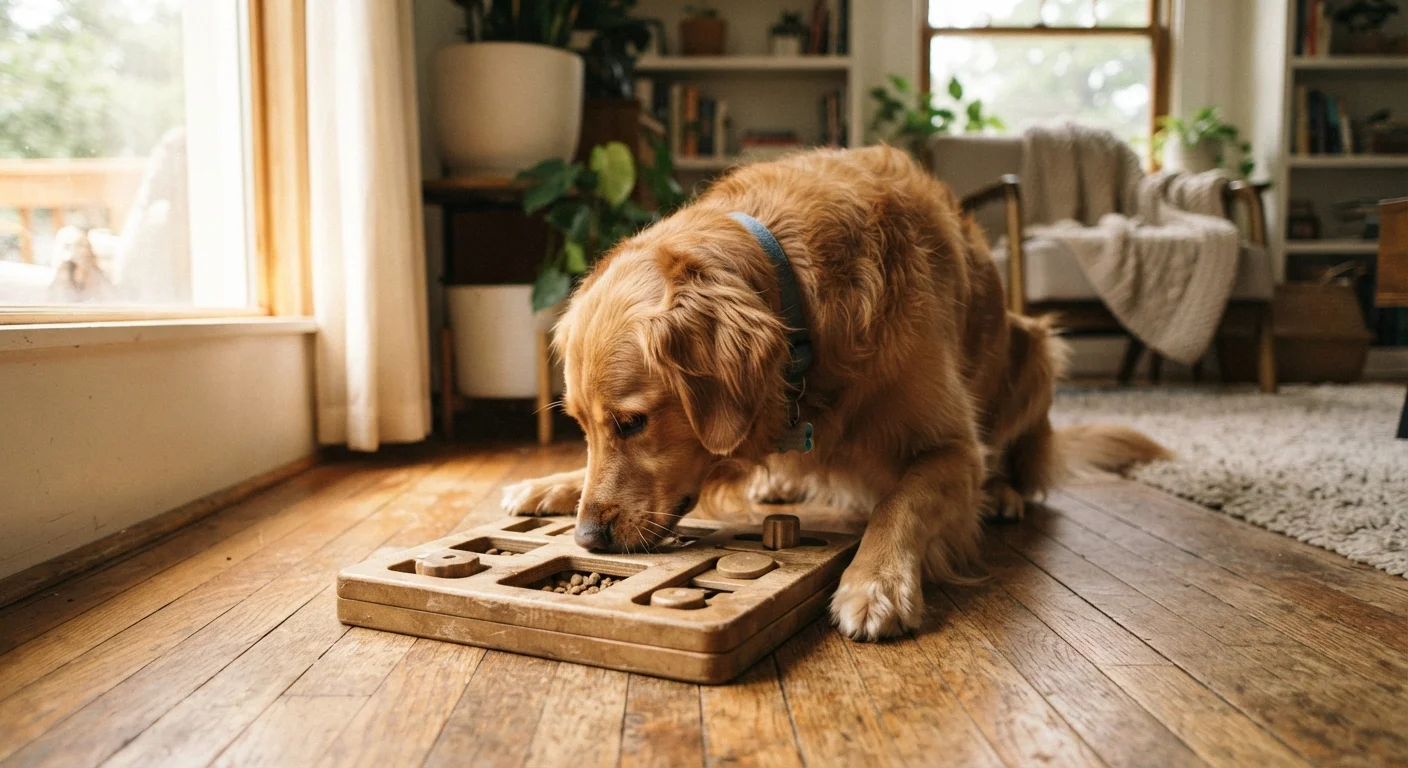
- Cognitive enrichment: Puzzle feeders, lick mats, and tasks that require the animal to solve a problem to receive a reward.
- Social enrichment: Appropriate interaction with people, other animals, or - in highly social species - companions of the same kind.
- Feeding enrichment: Replacing a bowl with foraging opportunities that mimic how animals find food in the wild.
- Environmental enrichment: Structural changes like climbing opportunities for cats, digging zones for dogs, or burrow materials for small mammals.
The right mix depends entirely on the individual animal. Mental stimulation strategies for different species vary considerably - what engages a terrier may do little for a senior cat or a parrot.
“Behavioral problems are often welfare problems in disguise. When an animal cannot perform behaviors that are natural and necessary to its species, distress follows - and that distress has a biology.”
— Franklin McMillan, Veterinarian and researcher specializing in animal mental health and quality of life
Special Considerations: Age, Household Complexity, and Lifestyle
Enrichment needs shift across a pet's lifetime. Younger animals often require more cognitive challenge and higher activity levels, while senior pets may need gentler, lower-intensity engagement that still keeps their minds active without physical strain. If you share your home with an older companion, the guidance in caring for aging pets addresses how routines and stimulation should evolve alongside your pet's changing needs.
Households with multiple pets introduce an additional layer of complexity. Social dynamics - including competition for resources, territory, and attention - can themselves become chronic stressors. Two pets living in the same home aren't automatically providing enrichment for each other; the relationship between them matters enormously. Managing multi-pet households requires thoughtful attention to individual space, feeding arrangements, and interaction quality.
For cat owners specifically, the indoor versus outdoor question has real enrichment implications. Indoor and outdoor lifestyle trade-offs for cats affect sensory exposure, predatory behavior outlets, and risk profiles differently - understanding the research helps owners make informed, environment-appropriate decisions.
This article is for general informational purposes and does not constitute veterinary advice. Always consult a qualified veterinarian or certified animal behaviorist for guidance specific to your pet's health and behavior.