

Key Takeaways
- Start by removing everything and sorting by category before returning anything to the shelves.
- Folding sheets inside their own pillowcases keeps sets together and avoids rummaging.
- Assign shelf zones by frequency of use - everyday items at eye level, extras on higher or lower shelves.
- Labels and consistent folding methods are what make organisation stick long-term.
- A quarterly review prevents the closet from quietly reverting to clutter.
What you will need
Why Linen Closets Tend to Fall Apart
Most linen closet organisation attempts fail not because of poor intentions, but because the original system didn't account for how the closet actually gets used. Sheets get stuffed back in after laundry, towels pile up unevenly, and within a month the closet looks worse than before any effort was made.
The underlying problems are usually the same: no defined zones, inconsistent folding, and too many items for the available space. Solving all three - not just one - is what produces a closet that stays functional.
If you're working on broader household organisation, the same principles apply to bathroom storage and medicine cabinet organisation. A system only works when it fits real daily behaviour, not an idealised version of it.
Don't Skip the Purge Step
Organising around items you no longer use guarantees the system fails quickly. Before you fold or label anything, remove worn-out towels, mismatched sheets, and excess spares that never actually get used. Donating or repurposing these frees up the space your remaining linens actually need to stay tidy.
What You'll Need
You don't need to buy much - or anything - to organise a linen closet effectively. The most important inputs are time and a willingness to reduce what's stored. That said, a few low-cost tools make the system significantly easier to maintain.
Shelf dividers
Keep stacks of folded towels and sheets upright and separated by category without toppling.
Baskets or bins
Corral loose or irregularly shaped items like washcloths, guest soaps, or spare pillowcases.
Label maker or adhesive labels
Mark shelf zones and bins clearly so every household member knows where items belong.
Slim velvet or non-slip shelf liner
Prevents folded stacks from sliding and protects shelves from snags.
What you will need
If you're simultaneously working on a laundry routine, coordinating both projects at once is efficient - you'll handle the same items in both passes.
Step-by-Step: Organising the Closet
Avoid Storing Damp Linens
Putting even slightly damp towels or sheets into a closed closet encourages mildew and musty odours. Always confirm linens are fully dry before folding and storing them. If your dryer run time feels insufficient, a second short cycle is worth it.
Empty the closet completely
Pull every item out and place it on a nearby bed or floor. This forces an honest inventory rather than working around existing piles. Check the back of shelves for forgotten extras - random pillow covers, ancient mattress pads, and solo pillowcases often hide there.
Sort by category and decide what stays
Group linens into clear categories: bed sheets by size, bath towels, hand towels, washcloths, guest bedding, and extras like throw blankets or mattress protectors. Then evaluate each pile honestly - anything faded, fraying, or without a matching set is a candidate for removal.
A good rule of thumb: keep two to three sets per bed in the house and two sets of towels per person. Anything beyond that is usually excess that fills space without adding practical value.
Plan your shelf zones before putting anything back
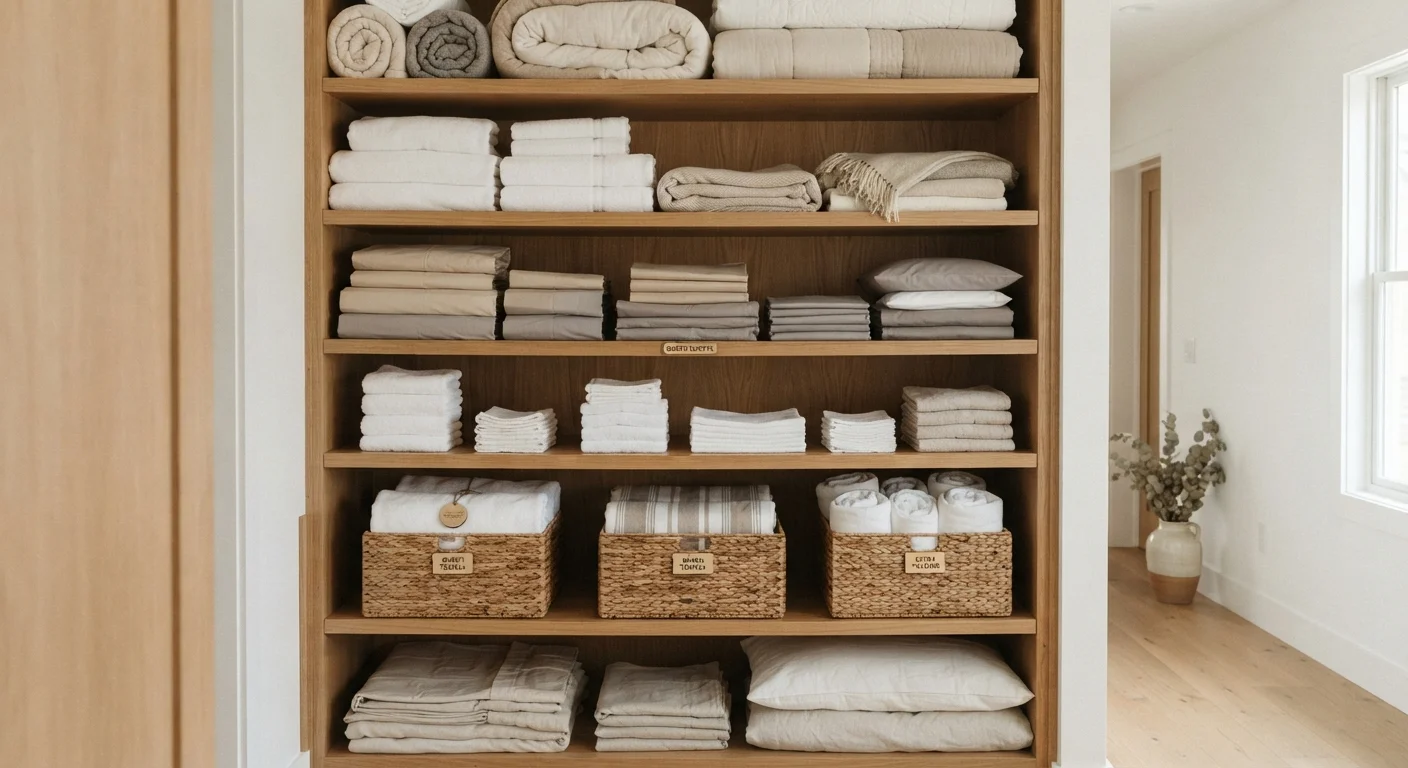
Assign areas by use frequency. Everyday towels and the sheets you rotate most often belong at eye level - easiest to grab without bending or reaching. Guest linens, seasonal bedding, and spare sets can go on upper shelves. Bulky extras like comforters or mattress pads store well on lower shelves or in large bins.
Group the same household member's towels or the same bed's sheet sets together so the right items are always in one predictable spot.
Fold using consistent, space-efficient methods
Consistent folding isn't about aesthetics - it makes stacks stable and uniform, which means less digging. Fold towels in thirds lengthwise, then in half or thirds again, and stack with the folded edge facing out so the stack looks tidy and doesn't unravel when you pull one from the middle.
For sheet sets, use the pillowcase pocket method: fold the fitted and flat sheets neatly, then slip both inside one pillowcase to create a self-contained bundle. This makes grabbing a full set effortless and keeps nothing separated.
Add bins, dividers, and labels
Place shelf dividers between categories to prevent stacks from merging over time. Use a bin or basket for smaller items - washcloths, hand towels, or spare guest soaps - that don't stack neatly on their own. Label every zone and bin clearly, even if it feels obvious. Labels are what allow other household members (and your future self) to maintain the system without relearning it.
Build a rotation habit and schedule a quarterly review
When you return clean linens to the closet, place them at the bottom of the stack so older ones get used first. This prevents any set from sitting untouched long enough to develop a stale smell.
Every three months, do a brief check: pull the closet open, confirm categories are intact, and remove anything that has worn out since the last review. This takes about ten minutes and is what keeps the system from quietly collapsing.
Use the Pillowcase Pocket Method
Fold a complete sheet set - fitted sheet, flat sheet, and extra pillowcase - and tuck them inside one matching pillowcase. The bundle stays together, takes up less space, and eliminates the frustration of hunting for matching pieces at bedtime.
Keeping It Working Over Time
The steps above get the closet organised. Keeping it that way requires two small ongoing habits: consistent put-away behaviour and a brief periodic review.
When linens come out of the dryer, fold them immediately using the same method every time - this takes no longer than folding haphazardly but produces a stack that stays stable. Rotate from the bottom of each stack so nothing sits unused long enough to develop a musty smell. For households that go through significant seasonal changes in bedding, the seasonal transition checklist approach - review, remove, reorganise - transfers directly to the linen closet.
For tracking when supplies are running low or need replacing, a restocking strategy helps you stay ahead of shortfalls without over-purchasing. The goal is a closet with enough inventory to cover your household's actual needs - not a stockpile that creates the clutter you organised your way out of.