

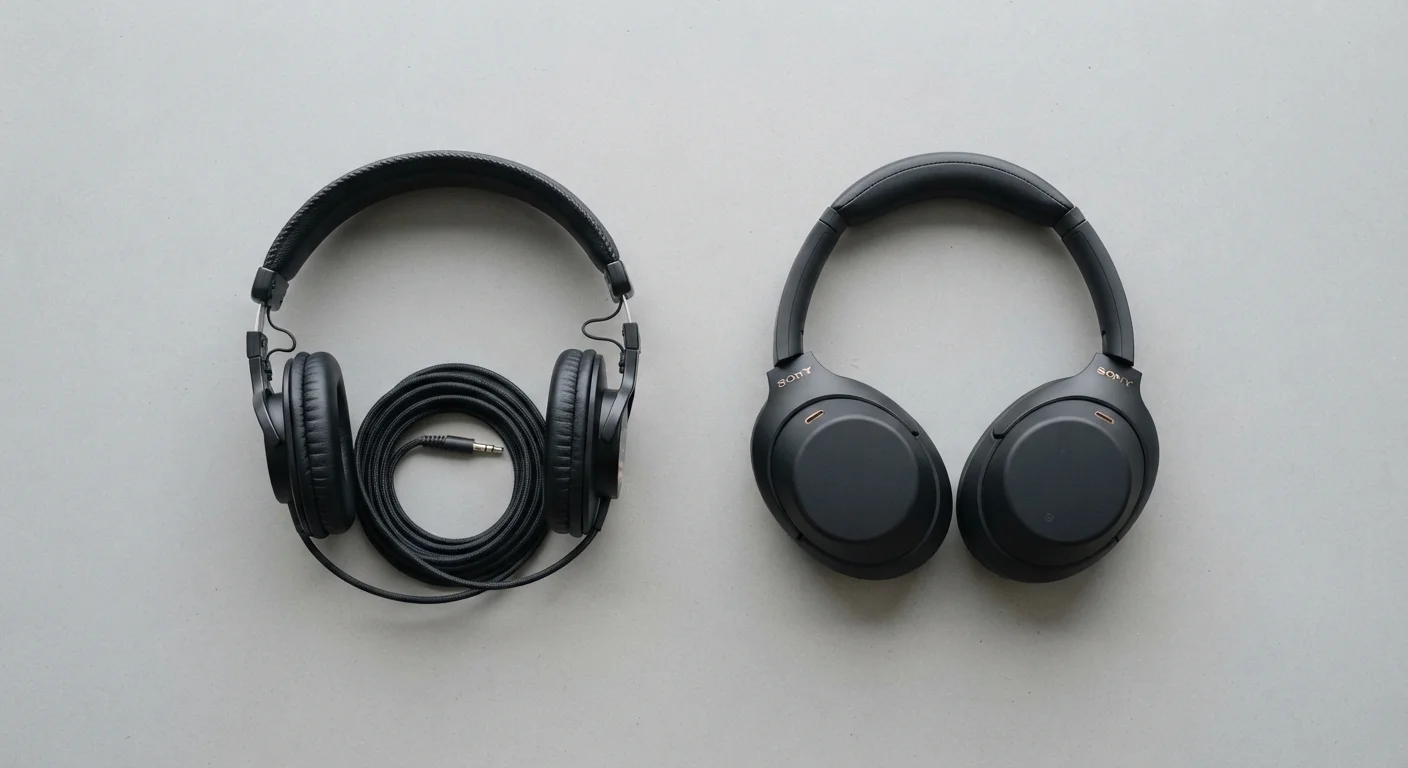
Key Takeaways
- Wired headphones deliver a stable, lossless signal with zero battery dependency or latency concerns.
- Wireless headphones compress audio via Bluetooth codecs, which can affect quality depending on the codec used.
- Wireless latency has improved significantly but remains a real factor for video editing and gaming.
- Battery life is the primary practical constraint of wireless headphones, typically ranging from 20 to 40 hours.
- Wired connections depend on a 3.5mm jack or USB-C port, which are absent on many modern smartphones.
- Neither type is objectively better - the right choice depends on how and where you listen.
Option A
Wired Headphones
The reliable, no-compromise audio connection.
Best for: Listeners who prioritize consistent audio fidelity, zero latency, and freedom from charging dependencies.
Option B
Wireless Headphones
The flexible, cable-free listening experience.
Best for: Active users, commuters, and anyone who values mobility and convenience over absolute audio purity.
If you prioritize the most accurate audio reproduction possible
Wired Headphones
A wired connection transmits an uncompressed analog signal, eliminating the codec-related quality ceiling that Bluetooth imposes - an important distinction when listening to high-resolution or lossless audio.
If you commute, exercise, or move around frequently
Wireless Headphones
No cable to manage means greater freedom of movement and far less physical frustration during active use.
If you use headphones for video production, gaming, or precise audio-video sync
Wired Headphones
Even well-optimized Bluetooth connections carry some latency; a wired setup removes that variable entirely.
If you use a modern smartphone without a headphone jack as your primary device
Wireless Headphones
Without a 3.5mm port, wired listening requires a dongle adapter, adding inconvenience that wireless headphones sidestep completely.
If you listen for long sessions at a desk or stationary setup
Wired Headphones
Wired headphones never need charging, making them well-suited to marathon listening sessions where battery management would become a recurring interruption.
The Core Difference: How Signal Gets to Your Ears
Wired headphones carry audio as an electrical signal through a physical cable - typically via a 3.5mm headphone jack or USB-C connector. The signal path is direct and unmodified, which means the audio arriving at the driver (the component that produces sound) is as close as possible to what the source device sends.
Wireless headphones use Bluetooth, a short-range radio protocol that compresses audio data for transmission and then decodes it at the headphone end. The codec - the algorithm handling that compression and decompression - determines how much quality is preserved. Common codecs like SBC apply heavier compression; higher-end options like aptX HD or LDAC retain significantly more detail. For a deeper look at how these codecs differ, see our guide to Bluetooth audio codecs.
The practical implication: wired audio has no theoretical ceiling imposed by encoding. Wireless audio quality is bounded by the codec both your source device and headphones support - and those need to match.
| Criterion | Wired Headphones | Wireless Headphones |
|---|---|---|
| Signal path | Direct analog/digital cable | Bluetooth radio transmission |
| Audio compression | None - uncompressed signal | Codec-dependent compression |
| Latency | Effectively zero | 30-200ms depending on codec |
| Battery required | No | Yes - 5 to 40 hours typical |
| Cable management | Required | None |
| Smartphone compatibility | Requires 3.5mm jack or adapter | Universal via Bluetooth |
| Long-term durability | No battery degradation | Battery capacity declines over time |
| Best use context | Studio, desk, stationary listening | Commuting, gym, mobile use |
Latency, Battery, and the Practical Gaps
Latency is the delay between a sound being produced at the source and reaching your ears. Wired headphones are effectively instantaneous. Bluetooth introduces measurable delay - typically between 30 and 200 milliseconds depending on the codec and hardware - which is imperceptible for music but can create a noticeable lip-sync mismatch when watching video or a disorienting gap in gaming audio.
Modern codecs like aptX Low Latency and LC3 (used in Bluetooth LE Audio) have pushed wireless latency into a range most users won't notice in casual video watching. But for precise work - audio production, video editing, competitive gaming - wired remains the reliable choice.
Battery life is wireless headphones' most visible constraint. Most over-ear wireless models offer between 20 and 40 hours per charge, while true wireless earbuds tend to run 5-10 hours before needing the charging case. Running out mid-commute is a real-world frustration wired users never face.
30-200ms
Typical Bluetooth audio latency range
Latency varies significantly by codec; aptX Low Latency and LC3 sit at the lower end of this range, while standard SBC connections often measure higher.
20-40 hrs
Typical over-ear wireless battery life
Battery performance varies by model and usage; features like active noise cancellation generally reduce total playback time.
990 kbps
Maximum LDAC transmission bitrate
LDAC, developed by Sony, supports up to 990 kbps - substantially higher than SBC's ceiling of around 345 kbps - narrowing the gap with wired connections.
Wired headphones also avoid the gradual battery degradation that affects all lithium-ion cells over time. A pair of wired headphones bought five years ago works identically today; a wireless pair from the same era may have noticeably reduced battery capacity.
What Audio Quality Claims Actually Mean
Marketing language around headphone audio quality can mislead in both directions. Wired headphones are not automatically superior - a poorly designed wired pair will sound worse than a well-engineered wireless one. And wireless audio has improved substantially; at typical streaming bitrates, many listeners cannot reliably distinguish a high-quality Bluetooth connection from a wired one in a blind test.
The gap becomes more relevant at the extremes: if you stream lossless audio or play high-resolution files, a wired connection lets that quality reach your ears without a codec bottleneck. Our article on streaming audio quality covers how much the source format actually contributes to what you hear.
Driver quality, ear-pad seal, and headphone form factor shape the listening experience just as much as the connection type. Whether a headphone sits in-ear, on-ear, or over-ear affects isolation and bass response noticeably - a topic explored in our piece on headphone form and sound.
Noise Cancellation Is a Separate Question
Active noise cancellation (ANC) is a wireless-headphone feature in popular perception, but it's technically independent of the wired vs. wireless question. Some wired headphones include ANC circuitry; most do not. If noise isolation is a priority, both connection types have options - though wireless ANC headphones dominate the market. For a full breakdown, see our article on ANC vs. passive isolation.
Compatibility and Convenience in Daily Use
Wired headphones face a growing compatibility challenge: the 3.5mm headphone jack has disappeared from most flagship smartphones. Listening wired on these devices requires a USB-C to 3.5mm adapter, which adds a physical dependency and can be easy to lose. Many laptops still include the jack, making wired connections simpler in desktop or home environments.
Wireless headphones sidestep that issue entirely - Bluetooth is universal across phones, tablets, laptops, and smart TVs. The trade-off is pairing management: switching a wireless headphone between multiple devices requires re-pairing or using multipoint connection features (available on many current models) that allow simultaneous connection to two sources.
For users building a broader home audio setup, understanding how headphones fit within a larger system is worth exploring - our home audio setup guide addresses how to match listening gear to your actual space and habits.