

Key Takeaways
- 3G introduced mobile internet browsing; 4G made streaming video practical.
- 4G LTE remains the backbone of most US mobile data connections today.
- 5G delivers dramatically lower latency and higher capacity, not just faster downloads.
- The real-world impact of each generation depends on carrier coverage and your location.
- A 5G phone on a weak 5G signal will often underperform a 4G phone with strong coverage.
Cellular Network Generation
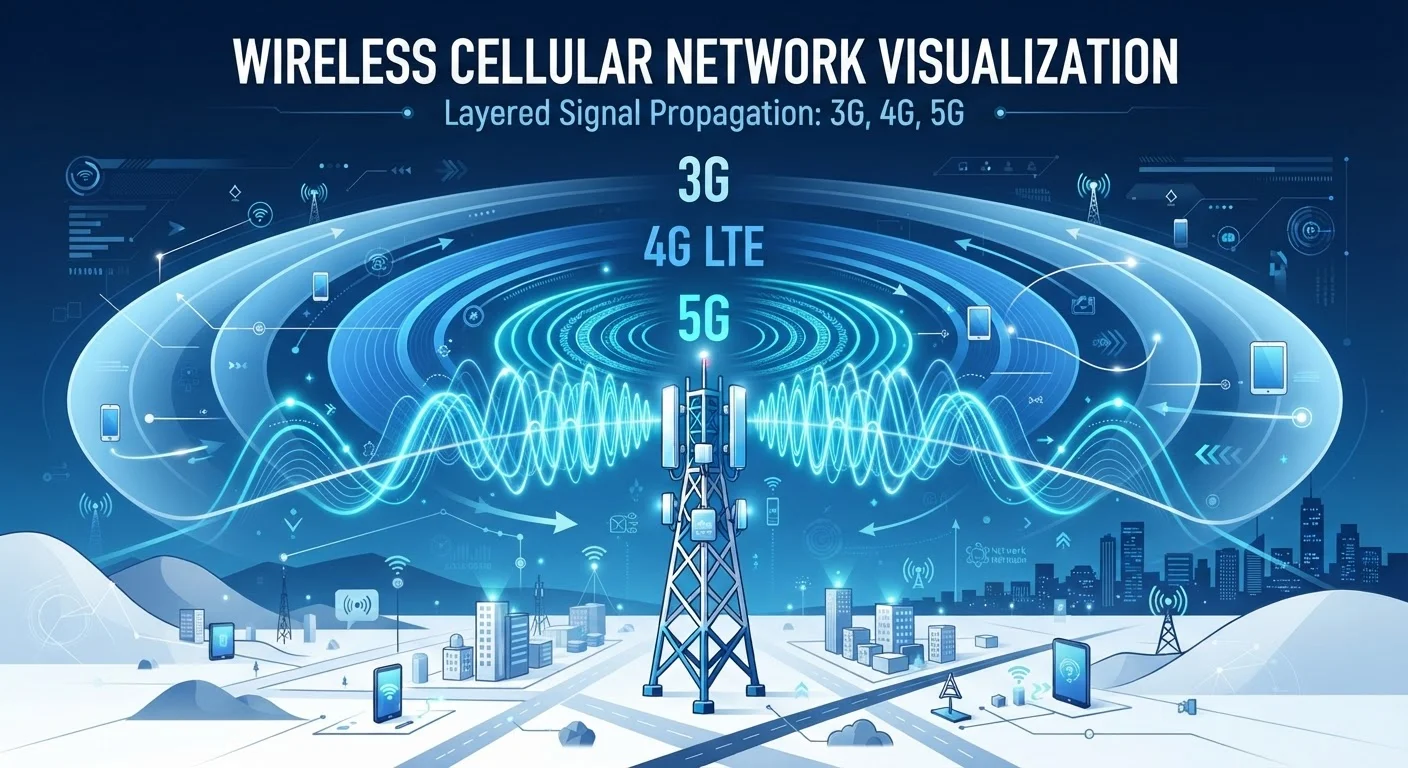
A cellular network generation (G) refers to a set of technology standards that define how mobile devices communicate with cell towers. Each new generation introduces faster data speeds, lower delays, and improved capacity over its predecessor. The jump from 3G to 4G to 5G isn't just a speed boost - it reshapes what mobile devices can realistically do.
Generations are defined by industry bodies like the ITU (International Telecommunication Union) and 3GPP; each must meet specific performance benchmarks, such as minimum peak data rates and spectral efficiency requirements, to carry the official designation.
Why Generations Exist - and What They Actually Define
Mobile network generations aren't just marketing labels. Each one represents a ratified set of technical standards governing how devices transmit and receive wireless data. When carriers upgrade their infrastructure to a new generation, they're building a fundamentally different communication system - not simply turning up the speed dial on an existing one.
The number attached to each generation (3, 4, 5) tracks roughly with the decade it emerged. 3G arrived in the early 2000s, 4G around 2010, and 5G began rolling out commercially around 2019. Each transition has required new hardware at the tower level and new radios inside handsets - which is why older phones can't simply be updated to use a newer network.
Understanding what each generation changes - rather than just that it changes something - helps you make sense of carrier marketing, coverage maps, and whether a newer device is worth considering for your situation. See our guide to smartphone specs decoded for how network generation fits alongside other hardware factors.
3G: The Generation That Made Mobile Internet Possible
Before 3G, mobile phones could send text messages and make calls, but meaningful internet access was essentially unavailable. 3G introduced packet-switched data - meaning your phone could send and receive data in discrete packets rather than maintaining a continuous, circuit-like connection - which made web browsing and email realistic for the first time.
Typical 3G download speeds ranged from roughly 0.5 to 3 Mbps under real-world conditions. That's enough to load a basic webpage, but not enough to stream video smoothly or handle the data demands of modern apps. Most major US carriers decommissioned their 3G networks between 2022 and 2023, which rendered some older devices unable to connect at all.
~1 Mbps
Typical 3G average download speed
Real-world 3G speeds were generally insufficient for streaming video or running modern app ecosystems.
30-50 ms
Typical 4G LTE latency
4G reduced latency dramatically compared to 3G, enabling smooth video calls and real-time app use.
<10 ms
5G latency under optimal conditions
Low latency is one of 5G's core design improvements, enabling real-time applications beyond basic browsing.
4G LTE: The Network That Changed What Phones Are For
4G - specifically the LTE (Long-Term Evolution) standard - is the reason smartphones became everyday streaming, navigation, and communication devices. With real-world download speeds typically ranging from 10 to 50 Mbps (and often higher in good conditions), 4G made it practical to stream HD video, use GPS turn-by-turn navigation in real time, and run cloud-connected apps reliably.
Beyond speed, 4G reduced latency significantly compared to 3G. Latency - the delay between sending a request and receiving a response - dropped from hundreds of milliseconds on 3G to typically 30-50 milliseconds on 4G. That responsiveness is what enables smooth video calls and real-time app interactions.
4G LTE remains the dominant data standard across most of the US today, and in well-covered areas it handles virtually every common smartphone task without friction. As our piece on avoiding unnecessary upgrades notes, 4G coverage quality often matters more than chasing the newest generation.
Check Your Carrier's Coverage Map
Before assuming a network generation upgrade will improve your experience, verify what's actually deployed in your area. Carrier coverage maps distinguish between low-band, mid-band, and mmWave 5G - each delivers a very different real-world experience. A strong 4G LTE signal often outperforms a weak 5G connection.
5G: Faster Speeds, but the Bigger Story Is Capacity and Latency
5G's headline numbers - potential peak speeds of 1 Gbps or more - grab attention, but they describe ideal conditions rather than typical experience. The more meaningful changes 5G introduces are network capacity and latency.
5G is designed to serve many more simultaneous users in the same area without performance degradation. In dense environments like stadiums, transit hubs, or downtown cores, this means more consistent speeds when lots of people are connected at once. Latency on 5G can drop to single-digit milliseconds under optimal conditions, opening the door to applications like real-time AR, responsive cloud gaming, and connected industrial systems.
5G operates across multiple spectrum bands. Low-band 5G covers large areas and penetrates buildings well, but offers speed improvements only modestly above 4G LTE. Mid-band (sub-6 GHz) balances coverage and speed meaningfully. Millimeter-wave (mmWave) 5G delivers the highest speeds but only within very short distances and is largely limited to urban centers.
Understanding what's inside a modern 5G device involves more than the radio - the chipset plays a major role too. The explainer on mobile processors covers how the hardware handles these connections end to end.
What This Means When You're Choosing a Device
Network generation capability matters, but it's only one factor in how your phone actually performs. Signal strength, carrier infrastructure in your area, and the number of users sharing a tower all influence real-world speeds regardless of which G your phone supports.
A practical approach: check which generation your carrier has deployed in the places you spend most of your time - home, work, and commute. If 5G coverage is dense and mid-band in your area, a 5G-capable device may deliver a noticeable improvement. If 5G coverage is sparse or primarily low-band, the difference in everyday use may be minimal.
“The value of 5G is less about the speed a single user experiences and more about what becomes possible when millions of devices are connected simultaneously with very low delays.”
— Industry telecom engineering consensus, Widely cited framework in mobile network architecture literature
Network generations also have a shelf-life dimension. Because 3G has been retired, a device without at least 4G capability is no longer functional on US networks. As 5G infrastructure matures, having 5G capability in a new device provides longer-term relevance - though it shouldn't be the sole driver of a purchasing decision.