

| Minimum useful RAM (2024 phones) | 6 GB (General industry consensus for smooth multitasking) |
| Standard display refresh rate | 60 Hz (Most mid-range and entry-level phones) |
| Outdoor-readable brightness threshold | 800+ nits (Display industry guideline) |
| IP68 water resistance depth | 1.5 m for 30 min (IEC standard 60529) |
| Typical 5G sub-6GHz peak speed | 100-900 Mbps (Carrier network averages vary widely) |
| Fast charging threshold | 25W+ (Common industry marker for fast charging) |
Why Spec Sheets Confuse Most Shoppers
Phone spec sheets are written for engineers, not everyday buyers. A list of gigahertz, megapixels, and milliamp-hours communicates very little on its own - context is everything. The goal of this guide is to translate those numbers into real-world meaning, so you can evaluate what actually matters for how you use a phone.
For a parallel look at how similar specs apply to laptops and desktops, see what RAM, storage, and processors mean for everyday computing. Many of the underlying concepts overlap.
Specs Don't Tell the Whole Story
Manufacturers measure and report specifications under varying conditions, so two phones with identical numbers on paper can perform quite differently in practice. Software optimization, thermal management, and build quality all affect real-world experience. Treat spec sheets as a useful starting framework, not a definitive verdict.
Performance Specs: RAM, Processor, and Storage
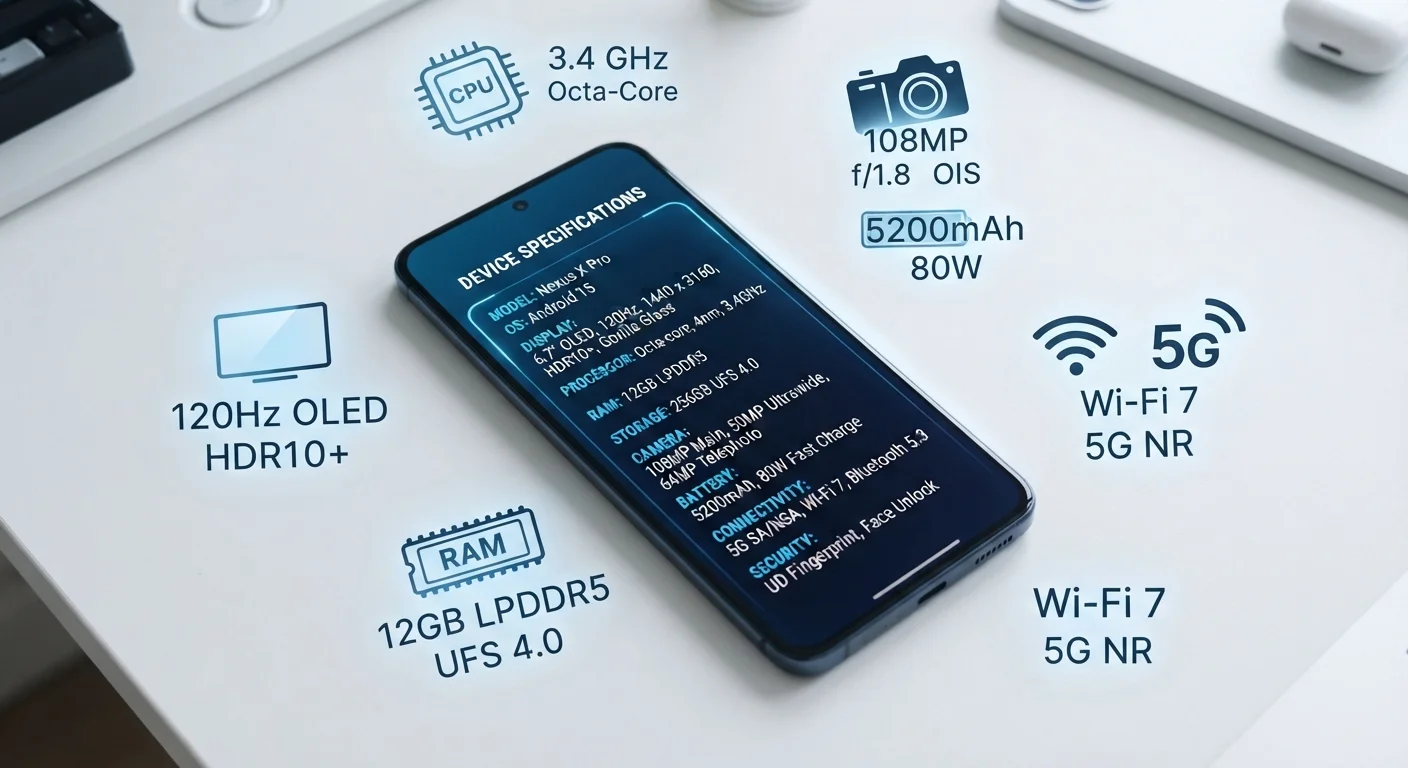
RAM determines how many things your phone juggles at once. If you frequently switch between apps, video call while browsing, or run navigation alongside music, more RAM prevents the phone from having to reload apps from scratch each time. Most people find 8 GB sufficient; power users benefit from 12 GB or more.
Processor (SoC) affects nearly everything - app speed, gaming smoothness, camera processing, and battery efficiency. Clock speed (GHz) only tells part of the story; the number and type of cores, manufacturing process node, and software optimization all contribute. See how phone processors actually work for a full breakdown.
Storage comes in two formats: older eMMC and faster UFS. Even if two phones list the same 128 GB capacity, the UFS variant will launch apps and load files noticeably faster. Look for UFS 3.1 or UFS 4.0 on mid-range and flagship devices.
| Minimum useful RAM (2024 phones) | 6 GB (General industry consensus for smooth multitasking) |
| Standard display refresh rate | 60 Hz (Most mid-range and entry-level phones) |
| Outdoor-readable brightness threshold | 800+ nits (Display industry guideline) |
| IP68 water resistance depth | 1.5 m for 30 min (IEC standard 60529) |
| Typical 5G sub-6GHz peak speed | 100-900 Mbps (Carrier network averages vary widely) |
| Fast charging threshold | 25W+ (Common industry marker for fast charging) |
Display Specs: Resolution, Refresh Rate, and Brightness
Resolution (e.g., 1080p, 1440p) describes pixel density. At typical phone viewing distances, 1080p is sharp enough for most people; the difference from 1440p is subtle unless you use a VR headset attachment or look very closely.
Refresh rate measured in Hz has a direct, perceivable effect. Scrolling a social feed on a 120Hz display feels visibly smoother than on a 60Hz panel. If you spend significant time scrolling or gaming, this is worth prioritizing - though it does increase battery consumption.
Brightness (nits) determines outdoor usability. A screen rated under 500 nits can be hard to read in direct sunlight. For display technology context - including OLED vs. LCD differences - see what OLED and LED panel types mean.
Camera, Connectivity, and Durability Numbers
Megapixels count how many pixels the camera captures, but more isn't always better. Sensor size, aperture, and image processing software matter more. A 50MP phone with a small sensor can produce worse low-light photos than a 12MP phone with a larger one. For a thorough camera spec guide, see our complete smartphone camera explainer.
IP ratings follow a two-digit format: the first digit rates dust resistance (6 is fully dust-tight), the second rates water resistance (8 means submersible to at least 1.5 meters for 30 minutes). IP67 and IP68 are the ratings most commonly found on mainstream phones.
Connectivity specs like Wi-Fi 6/6E and 5G indicate network capability, but your experience depends on local infrastructure. What cellular network generations actually change explains when those specs translate to real speed gains.