
Key Takeaways
- Clicker training uses a distinct sound to mark the exact moment a pet performs the desired behavior.
- Verbal cues are words or phrases conditioned to prompt specific behaviors over repeated practice.
- Clickers offer superior precision; verbal cues offer greater convenience and portability.
- Both methods rely on positive reinforcement and work best with consistent timing and short sessions.
- Many trainers combine both approaches - a clicker to teach new behaviors, verbal cues to maintain them.
- Your pet's species, hearing ability, and environment can all influence which method works better.
Option A
Clicker Training
The precise, consistent signal-based approach.
Best for: Pets and owners who benefit from an unambiguous, split-second marker that never varies in tone or timing.
Option B
Verbal Cues
The hands-free, always-available communication method.
Best for: Owners who want a low-equipment approach that integrates naturally into daily routines and real-world scenarios.
If you're teaching a brand-new behavior for the first time
Clicker Training
The clicker's precise, consistent click marks the exact correct moment, dramatically shortening the learning curve for new skills.
If you want a method that works in noisy or equipment-free situations
Verbal Cues
Your voice is always with you. Verbal cues require no extra tool and travel seamlessly from home to park to vet's office.
If your pet is hard of hearing or deaf
Clicker Training
A tactile vibration clicker or a flashlight-based visual marker can replace sound, making this approach adaptable for hearing-impaired animals.
If you're training a cat or small animal
Clicker Training
Animals less naturally tuned to human speech often respond more reliably to a neutral, species-agnostic sound signal paired with a reward.
If you want to maintain already-learned behaviors during everyday life
Verbal Cues
Once a behavior is established, a simple spoken word is efficient to deliver mid-walk or mid-meal without reaching for a device.
How Each Method Actually Works
At their core, both clicker training and verbal cues are forms of conditioned communication - you're teaching your pet that a specific signal predicts something good. Understanding the mechanism helps you use either method more effectively. If foundational terms like conditioning or reinforcement are new to you, the plain-language training glossary is a helpful starting point.
Clicker Training
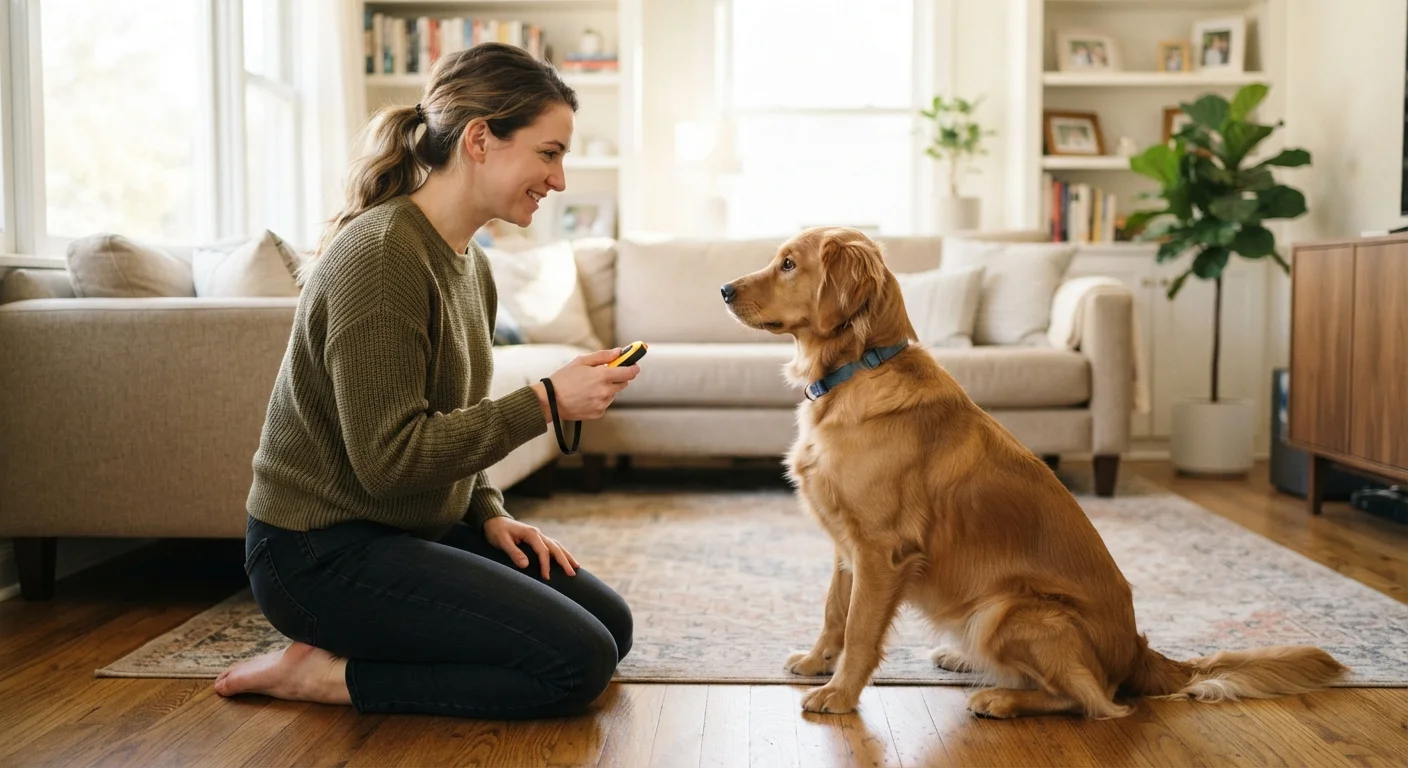
A clicker is a small handheld device that produces a short, distinct click sound. Through repeated pairing with a treat or reward, that click becomes a conditioned reinforcer - the pet learns that the click means "that exact action just earned you something good." Because the click is instantaneous, emotionally neutral, and identical every time, it bridges the gap between the behavior and the reward with remarkable accuracy. This is called event marking, and it's the clicker's core advantage.
Verbal Cues
A verbal cue is a word or short phrase - "sit," "stay," "come" - that your pet has learned to associate with a specific behavior through consistent repetition and reward. Unlike the clicker's role as a marker, a verbal cue acts as a prompt: it signals what behavior you'd like to see, rather than confirming the moment the behavior occurred. Verbal cues work best once a pet has some understanding of what's being asked.
| Criterion | Clicker Training | Verbal Cues |
|---|---|---|
| Primary function | Marks the exact correct moment | Prompts a known behavior |
| Timing precision | Very high - split-second accuracy | Moderate - depends on delivery speed |
| Equipment needed | Clicker device required | No equipment needed |
| Consistency | Always the same sound | Tone and volume vary by human |
| Best phase of learning | Teaching new behaviors | Maintaining established behaviors |
| Works for non-dog species | Yes - cats, birds, small animals | Varies - less reliable for non-dogs |
| Hands-free use | No - requires one hand | Yes - fully hands-free |
| Noise sensitivity risk | May startle sensitive animals | Generally low risk |
Where Clickers Excel - and Where They Fall Short
The clicker's greatest strength is timing precision. When you're shaping a complex behavior - like teaching a dog to touch a target with its paw, or a cat to jump through a hoop - the clicker lets you reward the exact micro-moment that matters. This reduces confusion and speeds learning considerably.
Clickers are also species-agnostic. Training cats is a great example: felines tend to be less oriented toward human speech than dogs, and the neutral click often cuts through that gap more cleanly than a word does.
That said, clickers have real limitations. You need a free hand to hold one - awkward if you're managing a leash and treats simultaneously. The click can also startle noise-sensitive animals at first, requiring a desensitization step before training begins. And in a crowded park or noisy household, a click can blend into background sounds.
Hearing-Impaired Pets and Clicker Alternatives
If your pet has partial or complete hearing loss, a standard audible clicker isn't the right fit - but the principle still applies. Vibration-based clickers (which emit a tactile buzz) or a small flashlight used as a visual marker can serve the same event-marking function. The mechanics of conditioning remain identical; only the sensory channel changes. A certified professional trainer experienced with deaf animals can guide you through adapting these techniques.
Where Verbal Cues Excel - and Where They Fall Short
Verbal cues win on accessibility and real-world integration. Once a pet has learned a cue, you can deploy it instantly in any environment without reaching for a device. This makes verbal cues the workhorse of everyday pet management - asking your dog to "sit" before crossing the street, or "leave it" when they find something suspicious on a walk.
The challenge with verbal cues is human inconsistency. We don't always say "sit" in the same tone, at the same volume, or with the same energy. Dogs and other animals are sensitive to these variations and can struggle when a cue sounds different from how they learned it. If your pet seems to be ignoring a command, tonal inconsistency is often a hidden culprit.
Verbal cues also take longer to establish from scratch. Unlike a clicker - which becomes meaningful to a pet within a handful of sessions - a word requires more repetition before the association is reliable, particularly with animals less wired for language comprehension.
Combining Both: The Practical Middle Ground
Most professional trainers don't see clickers and verbal cues as an either/or choice. A common and effective workflow is to use the clicker during the acquisition phase - when a pet is first learning a behavior - then layer in a verbal cue once the behavior is reliable. The clicker handles the precision of early learning; the word handles the convenience of long-term use.
This combination also reflects how universal training principles apply across species: clear signals, consistent timing, and short focused sessions matter regardless of which tool you're holding.
~5-10 sessions
Average sessions to condition a clicker
Animal behavior research consistently shows that a neutral sound can become a reliable conditioned reinforcer after just a handful of reward-paired repetitions.
3x
Verbal cue variations humans produce unknowingly
Studies in animal cognition suggest dogs can distinguish subtle tonal differences in human speech, meaning unintentional variation in a spoken cue can slow learning.
It's also worth considering your specific context. Training format - whether you're working one-on-one with a professional, in a group class, or on your own - can shape which method is easiest to maintain consistently. For a broader look at that decision, see our comparison of group classes, private lessons, and self-directed training.
Pay attention to your pet's body language throughout any session, too. Reading your pet's physical signals during training helps you catch stress or confusion early - and adjust before frustration sets in for either of you.
This article is for general educational purposes only and is not a substitute for personalized advice from a certified animal behaviorist or professional trainer. Every pet is an individual, and what works well for one may need adaptation for another.