Key Takeaways
- Casual prioritizes comfort and personal expression with minimal dress expectations.
- Smart casual requires intentional choices - fit, fabric, and footwear all matter more.
- The key difference is structure: smart casual always includes at least one elevated element.
- Footwear is often the fastest way to shift an outfit from casual to smart casual.
- When in doubt, smart casual errs toward refinement rather than relaxation.
- Context is everything - the same venue can have different expectations depending on occasion.
Option A
Casual
The relaxed, no-rules everyday standard.
Best for: Weekends, informal social settings, errands, and any occasion with no dress expectation attached.
Option B
Smart Casual
The polished middle ground between relaxed and formal.
Best for: Dinner reservations, casual workplaces, date nights, and social events where a little effort is expected.
If you're heading to a friend's backyard barbecue or running weekend errands
Casual
No dress expectations exist, so comfort and personal preference should lead. Save the elevated pieces for when they'll actually be noticed.
If you're attending a dinner reservation, office happy hour, or casual wedding reception
Smart Casual
These settings call for effort without formality. Smart casual signals that you're socially aware and have dressed intentionally for the occasion.
If the invitation says 'casual' but the venue is upscale
Smart Casual
Venue context matters as much as the stated dress code. Defaulting to smart casual avoids the risk of being underdressed.
If you're building a wardrobe and need the most versatile option
Smart Casual
Smart casual pieces can dress down into casual looks more easily than the reverse. The investment in structured basics pays off across more settings.
Why the Distinction Matters
The words "casual" and "smart casual" appear on invitations, workplace policies, and restaurant dress codes - often without explanation. Most people treat them as interchangeable, which is exactly how someone ends up in a graphic tee at a wine bar or overdressed in a blazer at a backyard cookout.
Understanding the actual difference isn't about fashion snobbery. It's practical social literacy. Dress codes exist to signal the expected tone of an occasion, and showing up appropriately is a form of respect - to your host, your environment, and yourself. For a broader breakdown of formality levels, this guide to dress codes covers the full spectrum from casual to black tie.
The core distinction comes down to one word: intention. Casual dressing is largely unrestricted - you wear what's comfortable and personally expressive. Smart casual dressing involves deliberate choices designed to look put-together without crossing into formal territory.
What Casual Actually Means
Casual is the least restricted dress category, but that doesn't mean anything goes in every context. True casual dressing is comfortable, relaxed, and driven by personal preference over social expectation. Think worn-in jeans, t-shirts, hoodies, sneakers, and casual sandals.
Fit still matters in casual dress - clothes that are wildly oversized or visibly damaged can read as sloppy rather than relaxed - but the bar for precision is lower. Fabrics tend to be soft and forgiving: jersey, denim, cotton knits. Colors and prints are largely unrestricted.
Where casual gets people into trouble is in assuming it applies to more situations than it does. A restaurant with cloth napkins and a reservations-only policy is not a casual environment regardless of the absence of a stated code. Reading the room is a skill casual dressing still requires.
| Criterion | Casual | Smart Casual |
|---|---|---|
| Overall tone | Relaxed, unrestricted | Polished but approachable |
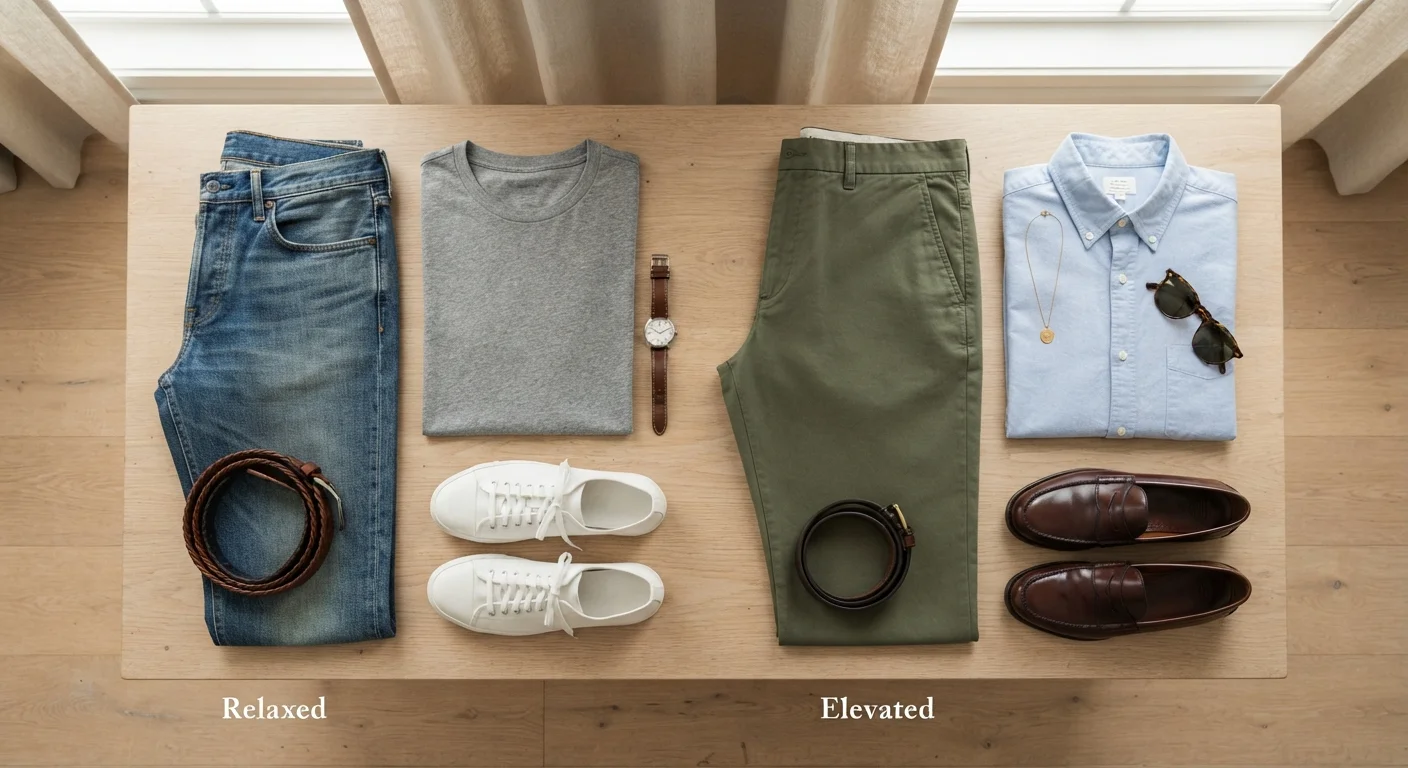
| Typical bottoms | Any jeans, joggers, shorts | Chinos, tailored trousers, dark jeans |
| Typical tops | T-shirts, hoodies, casual tees | Button-downs, fitted knits, blazers |
| Footwear | Sneakers, sandals, slip-ons | Loafers, Chelsea boots, clean leather sneakers |
| Fabric expectations | Jersey, worn denim, fleece | Cotton twill, wool blends, ponte |
| Fit precision | Comfortable, relaxed | Fitted and intentional |
| Appropriate settings | Errands, friends' homes, weekends | Dinner, casual offices, social events |
What Smart Casual Actually Requires
Smart casual is frequently misunderstood because it sounds like a contradiction - how can something be both smart (polished) and casual (relaxed)? The answer is balance. Smart casual means pairing at least one structured or elevated element with something more relaxed, resulting in an outfit that feels intentional without being stiff.
Classic smart casual combinations include chinos or tailored trousers with a fitted polo or open-collar button-down shirt; dark jeans paired with a blazer and clean leather or suede footwear; or a midi dress with understated accessories. The through-line is that every piece looks considered.
The 'One Elevated Element' Rule
A reliable shortcut for smart casual: ensure at least one item in your outfit is visibly elevated - a structured shoe, a tailored layer, or a quality fabric. The rest of the outfit can remain relaxed. This single-element rule prevents both overdressing and the common mistake of assembling a look that unintentionally reads as purely casual.
Footwear does significant heavy lifting in smart casual. Swapping athletic sneakers for leather loafers, clean white minimalist sneakers, Chelsea boots, or block-heeled mules can shift an entire outfit's register upward. Fit is equally important - a well-fitting casual shirt reads smarter than a poorly fitting dress shirt every time.
Side-by-Side: The Key Differences
The table above captures the practical distinctions between both dress levels. A few patterns are worth underlining:
- Structure: Smart casual almost always includes at least one structured garment - a blazer, a tailored trouser, a fitted knit - while casual has no such requirement.
- Footwear: Athletic sneakers, flip-flops, and heavily worn shoes are casual-only territory. Smart casual calls for cleaner silhouettes.
- Fabric quality: Casual tolerates fleece, well-worn denim, and jersey. Smart casual benefits from fabrics that hold their shape - wool blends, ponte, cotton twill, leather.
If you're building a wardrobe that navigates both registers efficiently, dressing for your body shape is a useful lens - pieces that fit well naturally look more elevated, which means the same garment can perform across both categories depending on how it's styled and paired.
~65%
Adults unsure how to interpret smart casual
Multiple style surveys and fashion polls have consistently found that the majority of adults find 'smart casual' the most confusing dress code term to interpret.
#1
Most misread dress code on invitations
Smart casual is widely cited by etiquette experts and style educators as the dress code most frequently misunderstood or ignored on event invitations.
The Most Common Mistakes
The most frequent error people make is defaulting to casual when the setting calls for smart casual. This often happens because the occasion sounds low-key - a friend's birthday dinner, a first date at a neighborhood wine bar - when the social expectation is subtly elevated.
The reverse also happens: overdressing for a genuinely casual occasion by adding a blazer or dress shoes to a setting where it creates social distance rather than polish. Smart casual is a register, not a uniform, and forcing it where it doesn't belong can feel as off as underdressing.
A practical rule of thumb: when uncertain, lean toward the smarter interpretation. It's far easier to remove a blazer and roll up your sleeves than to wish you'd brought one. This approach aligns with the investment logic behind building a wardrobe with intentional pieces - versatile, well-made basics are the engine of navigating both dress levels confidently.