| U.S. Regulatory Body | Federal Trade Commission (FTC) (FTC Textile and Wool Act regulations) |
| Care Symbol Standard | ASTM D5489 (ASTM International) |
| Fiber Listing Order | Descending by weight percentage (FTC Textile Fiber Products Identification Act) |
| Label Must Be | Permanent (attached to garment) (FTC Care Labeling Rule) |
| "Made in USA" Standard | All or virtually all domestic production (FTC Made in USA standard) |
What's Actually on a Clothing Label
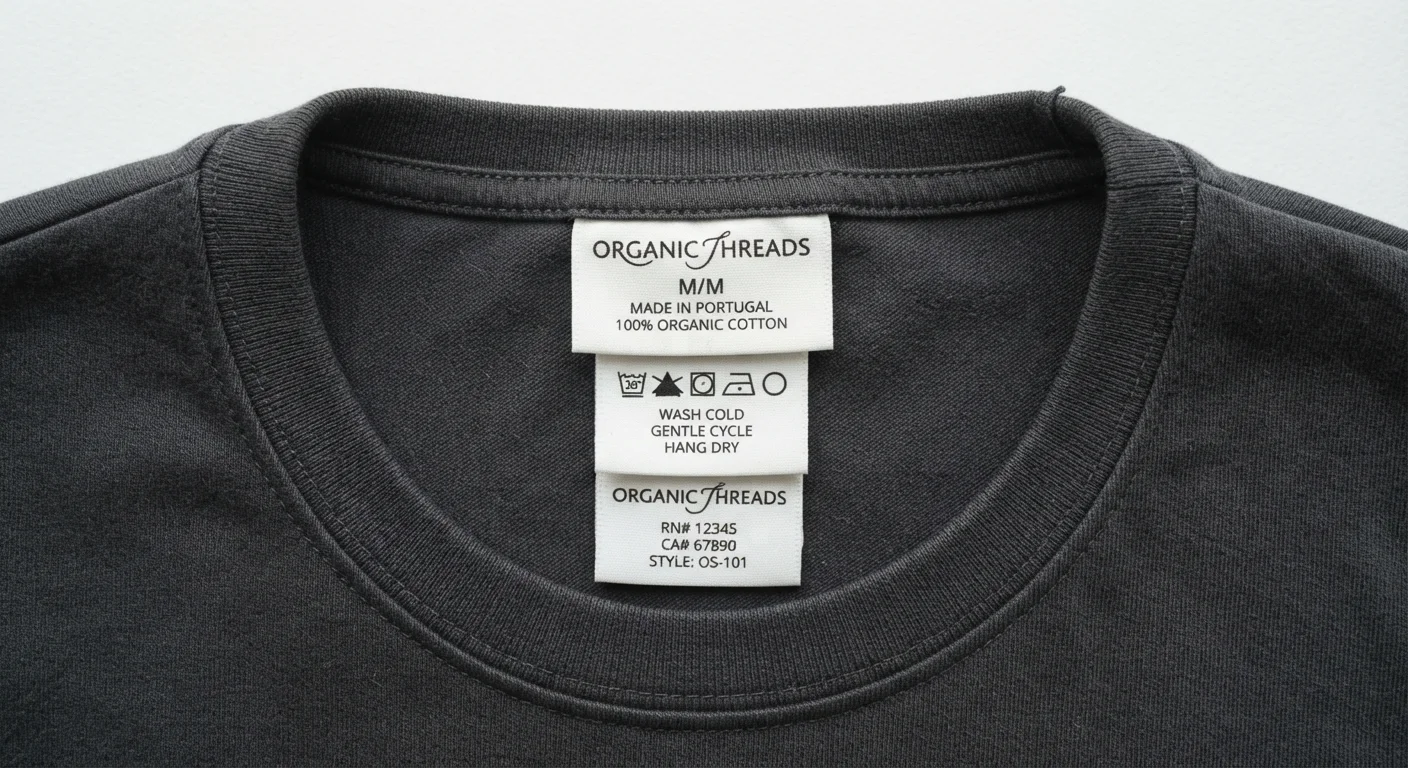
Every garment sold in the United States is required by the Federal Trade Commission (FTC) to carry a permanent label with specific information. That tag tucked into your collar or side seam isn't just scratchy filler - it's a regulated disclosure covering four key areas: fiber content, country of origin, manufacturer identity, and care instructions.
Understanding each section helps you shop smarter, care for clothes correctly, and know what you're actually buying. Think of it as a quick reference card that travels with the garment forever - much like the breakdown on a food nutrition label tells you what's inside your food.
| U.S. Regulatory Body | Federal Trade Commission (FTC) (FTC Textile and Wool Act regulations) |
| Care Symbol Standard | ASTM D5489 (ASTM International) |
| Fiber Listing Order | Descending by weight percentage (FTC Textile Fiber Products Identification Act) |
| Label Must Be | Permanent (attached to garment) (FTC Care Labeling Rule) |
| "Made in USA" Standard | All or virtually all domestic production (FTC Made in USA standard) |
Fiber Content: The Percentage Breakdown
Fiber content must be listed in descending order by weight, using the full generic name of each fiber (not brand names). So a label reading 60% Cotton, 35% Polyester, 5% Spandex tells you cotton dominates, polyester adds durability or wrinkle resistance, and a small amount of spandex provides stretch.
Blended fabrics are extremely common, and the blend affects everything - how the garment breathes, how it holds its shape, and how you wash it. For a deeper look at how individual fibers behave, see Fabric Types Every Shopper Should Recognize.
Fiber Content
The percentage breakdown of each textile fiber used in a garment, listed by generic fiber name in descending order by weight. Required on all U.S. garment labels under FTC rules.
Generic Fiber Name
The standardized, non-brand name for a textile fiber - such as "polyester," "nylon," or "rayon" - as defined by the FTC. Brand names like Lycra or Tencel cannot substitute for the generic name on labels.
RN Number
A Registered Number assigned by the FTC to U.S. manufacturers, importers, and sellers. It appears on labels in place of a full company name and can be looked up in the FTC's public database.
Shell Fabric
The outermost, visible layer of a garment. Labels often list fiber content separately for the shell versus the lining or trim when these differ.
Care Symbol
A standardized icon (per ASTM D5489) that communicates washing, drying, ironing, bleaching, or dry-cleaning instructions without relying on text or a single language.
Country of Origin
The country where a garment was substantially transformed into its finished form. Required on all U.S. garment labels; subject to strict FTC definitions, especially for "Made in USA" claims.
One exception: trims, linings, and decorative elements may have different fiber content than the shell fabric. Labels often call this out separately (e.g., "Shell: 100% Silk / Lining: 100% Polyester").
Care Symbols: A Visual Shorthand
The care symbols used on U.S. labels follow the ASTM D5489 standard, a system of icons developed to communicate laundering instructions across language barriers. Here's what the core symbols mean:
- Washtub icon: Machine or hand washing. Dots inside indicate water temperature (one dot = cold, two = warm, three = hot). An X through it means do not wash.
- Triangle: Bleaching instructions. Empty triangle = any bleach okay. Triangle with lines = only non-chlorine bleach. X through it = do not bleach.
- Square with circle: Tumble drying. Dots indicate heat level. An X means lay flat or hang to dry.
- Iron icon: Ironing. Dots again signal heat level (one = low, two = medium, three = high). An X means do not iron.
- Circle: Dry cleaning. Letters inside (P, F, W) guide the dry cleaner on which solvents to use. An X means do not dry clean.
Symbols Vary by Country of Sale
Care symbols on garments made for international markets may follow slightly different standards - for example, ISO 3758 is used in many European countries. If you purchase clothing abroad or from international retailers, the icons may look similar but carry slightly different meanings. When in doubt, default to cold water and low heat to protect the garment.
When multiple care instructions appear together, follow the most restrictive one to protect the fabric. A garment with both a "do not tumble dry" and a "low heat iron" symbol needs the gentler treatment in both steps.
Country of Origin and Manufacturer Information
FTC rules require that garments disclose where they were made - the country where the product was substantially transformed into its final form. Labels reading "Made in USA" have strict criteria: the item must be all or virtually all made domestically. "Assembled in USA of imported components" is a separate, permitted disclosure when only part of the process happened domestically.
The manufacturer or importer name (or an RN/WPL registration number assigned by the FTC) must also appear. If you ever need to look up a manufacturer from a registration number, the FTC maintains a searchable database online.
Country of origin does not indicate quality on its own - production standards vary widely within any country. It's one data point, not a shortcut for judging a garment. Pair label literacy with knowledge of what different dress contexts actually demand to make fully informed wardrobe choices.