

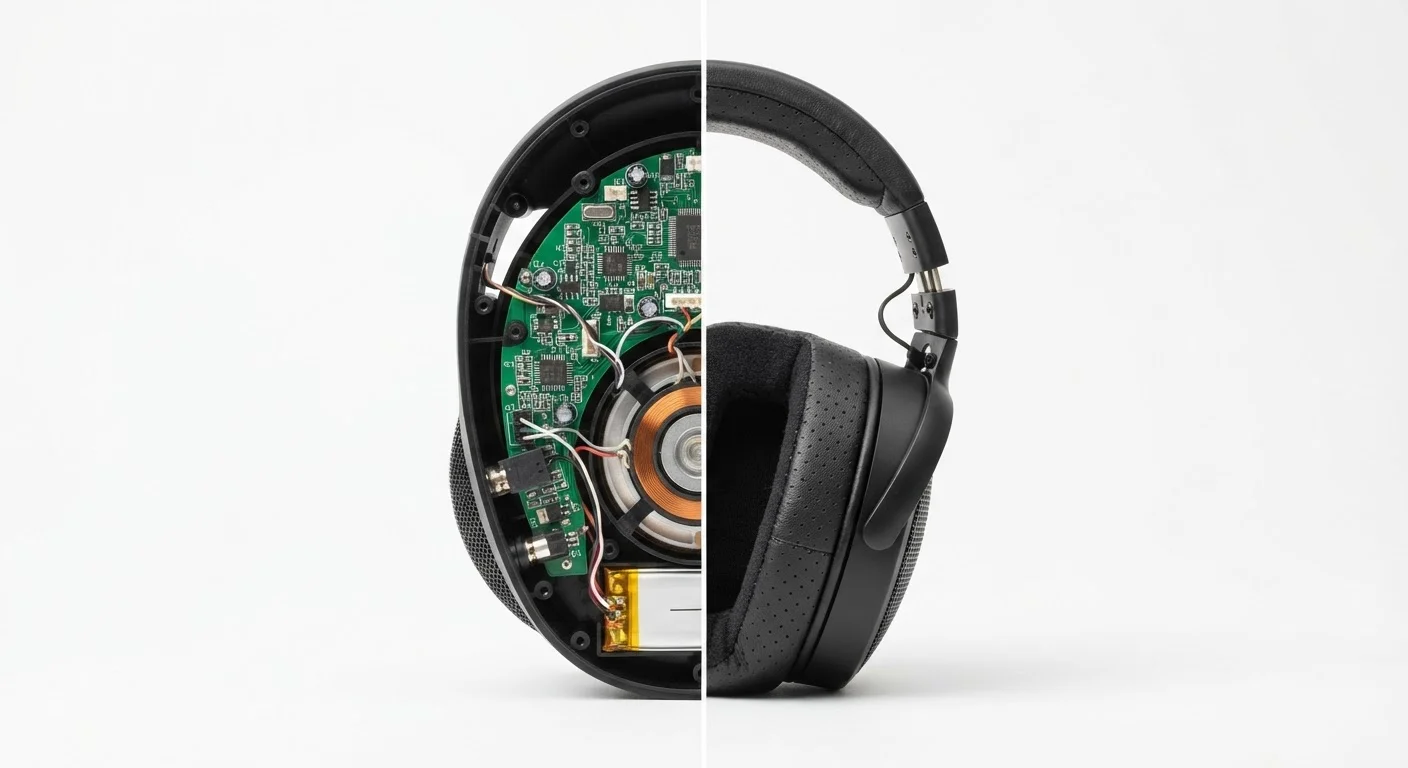
Key Takeaways
- ANC uses microphones and processing to generate anti-phase sound waves that cancel incoming noise electronically.
- Passive isolation physically blocks sound using dense materials, ear cushion seals, and enclosure design.
- ANC excels at low-frequency, continuous sounds; passive isolation handles higher-frequency and impulsive noise better.
- ANC requires battery power and adds circuit complexity; passive isolation works without any power source.
- Many modern headphones combine both methods to cover a broader range of noise frequencies.
- Neither approach eliminates all sound - understanding their limits helps set realistic expectations.
Option A
Active Noise Cancellation (ANC)
The electronics-powered approach to silencing your environment.
Best for: Commuters and travelers dealing with steady, low-frequency noise like engines, trains, or HVAC systems.
Option B
Passive Noise Isolation
The physics-first approach using materials and fit to block sound.
Best for: Anyone needing reliable, battery-free protection from mid-to-high frequency noise in workplaces or studios.
If you frequently travel by plane, train, or bus
Active Noise Cancellation (ANC)
ANC is purpose-built for sustained, low-frequency engine and cabin noise, dramatically reducing fatigue on long journeys.
If you work in a loud environment and can't rely on battery life
Passive Noise Isolation
Passive isolation never runs out of power and consistently attenuates workplace machinery and ambient chatter without electronics.
If you want the widest possible noise reduction across all frequencies
Active Noise Cancellation (ANC)
Headphones with strong ANC combined with good passive seal tackle both low rumble and mid-range noise more comprehensively than either alone.
If you prioritize audio fidelity and minimal signal processing
Passive Noise Isolation
Passive isolation introduces no electronic processing chain, preserving source audio integrity for critical listening and studio use.
How Active Noise Cancellation Actually Works
Active Noise Cancellation is an electronic process, not a physical one. Headphones equipped with ANC contain one or more tiny microphones - typically positioned on the outer shell of the ear cup - that continuously sample the ambient sound around you. A dedicated processor analyzes that audio signal and generates a new sound wave that is the mathematical inverse, or "anti-phase," of the incoming noise.
When this anti-phase wave is fed into the headphone's drivers alongside your audio, it meets the incoming noise wave and the two largely cancel each other out - a phenomenon called destructive interference. The effect can be dramatic with steady, predictable sounds like aircraft cabin hum or air-conditioning rumble, which are predominantly low-frequency. ANC can reduce these sounds by 20-30 decibels in practical use.
However, ANC has real limitations. Because the processor needs time to sample and compute a response, it is less effective against sudden, impulsive noises - a door slamming or a sharp voice - and against higher-frequency sounds, which cycle too quickly for the system to track accurately. ANC also consumes battery power and adds circuit complexity. Some listeners report a faint pressure sensation or background hiss when ANC is active, caused by the anti-phase signal itself. Battery dependency is one of several trade-offs to weigh when choosing between headphone types.
| Criterion | Active Noise Cancellation | Passive Isolation |
|---|---|---|
| Mechanism | Electronic anti-phase wave generation | Physical material and seal |
| Best frequency range | Low frequencies (rumble, engines) | Mid-to-high frequencies (speech, machinery) |
| Power required | Yes - battery dependent | No - always works |
| Audio processing artifacts | Possible hiss or pressure sensation | None |
| Effectiveness on sudden noise | Limited | Moderate |
| Typical attenuation (dB) | 20-30 dB (low frequencies) | 15-25 dB (mid/high frequencies) |
| Cost impact | Adds significant cost | Minimal added cost |
How Passive Noise Isolation Works
Passive isolation requires no electronics at all. It works through simple acoustics: dense physical materials absorb and reflect sound waves before they reach your ears. The effectiveness of passive isolation depends on three main factors - material density, ear seal quality, and enclosure design.
Over-ear headphones with thick memory foam cushions create a sealed chamber around the ear, preventing sound from leaking in or out. In-ear monitors (IEMs) achieve isolation differently: silicone or foam ear tips fill the ear canal, blocking sound much like an earplug. The tighter and more consistent the seal, the more sound is attenuated.
Passive isolation is particularly effective at mid-to-high frequencies - the range that includes human speech, office machinery, and many environmental sounds. It requires no power and introduces no processing artifacts into your audio signal, making it a preferred choice in professional recording environments where signal purity matters. Headphone form factor directly influences how much passive isolation you can achieve, which is worth understanding before you buy.
20-30 dB
Typical ANC attenuation of low-frequency noise
According to acoustic engineering literature, well-implemented ANC systems reduce steady low-frequency noise by approximately this range under real-world conditions.
15-25 dB
Passive isolation attenuation range for over-ear headphones
Audio industry testing generally places over-ear passive isolation in this range for mid and high frequencies, varying by cushion material and fit quality.
When They Work Together - and When Each Falls Short
Most premium over-ear headphones today combine both technologies: the physical construction provides a passive seal, while the ANC electronics handle the low-frequency content that materials alone struggle to block. This hybrid approach covers more of the audible spectrum than either method can manage independently.
That said, both have documented shortcomings. ANC struggles with variable, unpredictable noise - a crowded conversation or a city street - because the processor cannot compute a clean anti-phase response fast enough. Passive isolation, meanwhile, does little for low-frequency rumble; low-pitched sounds have long wavelengths that pass more easily through physical barriers.
Understanding the acoustic environment you spend time in should guide your decision. Quiet offices may benefit just as much from a well-fitted pair of headphones with good passive isolation as they would from an ANC-equipped model. Loud transit or open-plan workspaces with consistent HVAC noise are where ANC delivers the most noticeable difference. Room acoustics also play a role in how much noise reaches your ears in the first place - particularly in home listening environments.
Neither Method Blocks All Sound
Even the most effective ANC headphones and the best-sealing passive designs allow some sound through. ANC attenuation is frequency-dependent and degrades in the presence of variable or high-frequency noise. Passive isolation can break down if the physical seal is compromised by glasses frames, facial hair, or ear anatomy. Setting realistic expectations about noise reduction - rather than expecting total silence - leads to more satisfying listening experiences.