

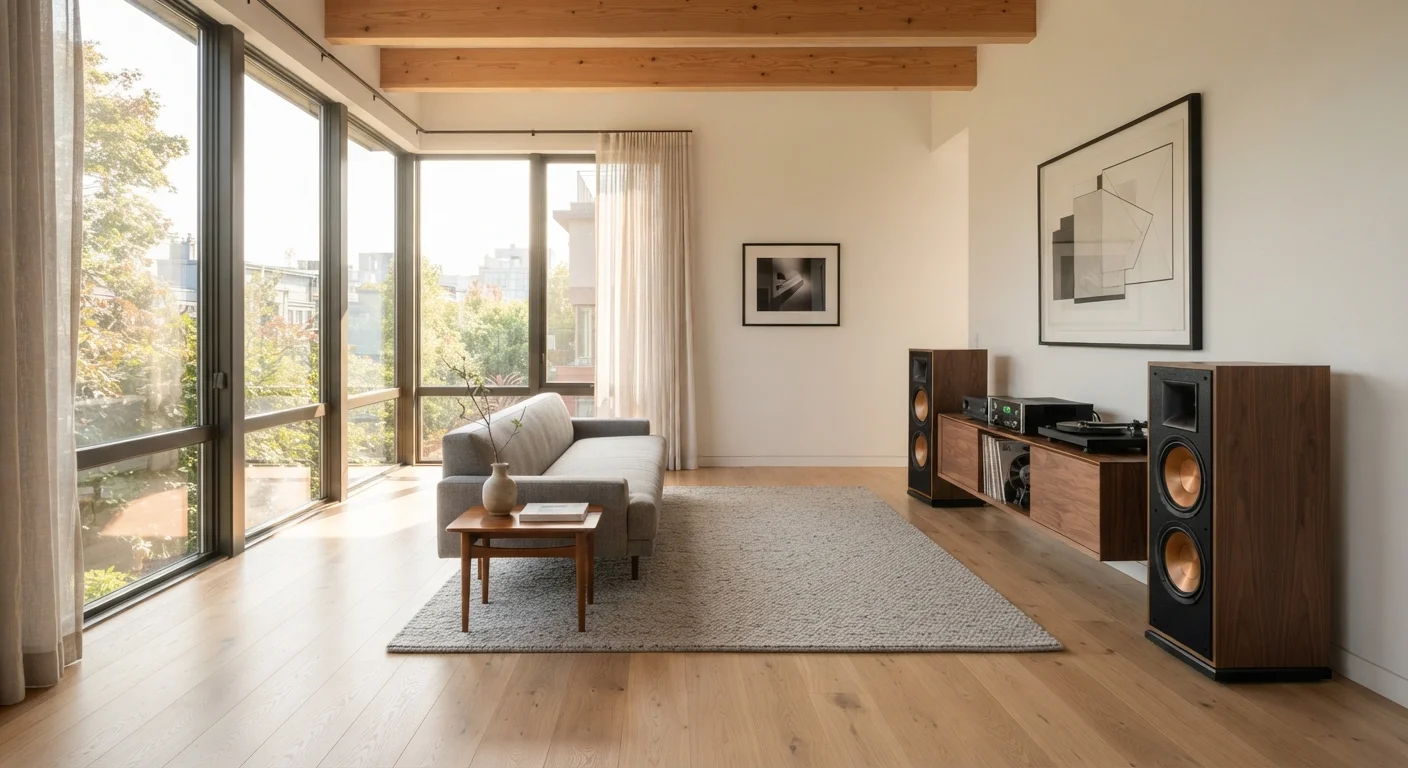
Key Takeaways
- Hard, flat surfaces reflect sound waves and can cause echo, harshness, and muddiness.
- Low-frequency bass buildup in room corners is one of the most common and overlooked audio problems.
- Soft furnishings like rugs, curtains, and upholstered furniture naturally absorb and tame reflections.
- Room geometry - including parallel walls and ceiling height - significantly affects how sound behaves.
- Acoustic treatment doesn't require professional gear; strategic furniture arrangement can make a real difference.
- Understanding your room helps you get more from any audio equipment you already own.
Why Your Room Is Part of Your Sound System
Most people focus entirely on speakers, amplifiers, or streaming quality when trying to improve what they hear at home. But acoustic engineers have long understood that the room itself shapes the sound as much as the equipment playing it. Sound waves don't travel in a straight line from speaker to ear - they bounce, scatter, and interact with every surface they encounter before reaching you.
Hard floors, parallel walls, low ceilings, bare windows: all of these influence timing, frequency balance, and clarity. A high-quality speaker system placed in an acoustically difficult room can sound mediocre, while a modest setup in a well-treated space can perform remarkably well. Understanding the principles behind room acoustics gives you practical leverage regardless of your budget. See our guide to matching audio setups to your space for context on how room factors fit into the bigger picture.
Test your room before buying new gear
Before investing in new speakers or audio equipment, spend time listening critically in your space. Move your listening position forward, backward, and side to side to hear how dramatically the room changes the sound. This simple exercise reveals whether your audio challenges are equipment-related or room-related - and often points toward low-cost solutions like furniture repositioning rather than new purchases.
Key Ways Room Acoustics Shape What You Hear
Reflections from hard surfaces blur the sound
When a sound wave hits a hard, flat surface - a tile floor, a glass window, a bare plaster wall - it bounces back into the room. These reflected waves arrive at your ears milliseconds after the direct sound from the speaker. Your brain partially integrates these reflections, which can smear transient detail (the sharp attack of a snare drum, for example) and make vocals sound less focused or intelligible.
Early reflections - those that arrive within roughly 20 milliseconds of the direct sound - are particularly problematic for clarity. Placing soft materials at the primary reflection points (roughly at ear height on side walls) is the most targeted way to address this issue without treating the entire room.
Early reflections arriving within 20 milliseconds of direct sound are the main culprit behind blurred, unfocused audio.
Parallel walls create standing waves and bass buildup
Parallel surfaces facing each other - the front and back walls of a rectangular room - create a phenomenon called standing waves, also known as room modes. At certain frequencies determined by the room's dimensions, sound waves reinforce each other and build up dramatically. At other frequencies, they cancel out.
This is why bass can sound boomy and overwhelming in one seat and thin and absent in another spot just a few feet away. Corners are especially prone to low-frequency buildup, since bass waves from multiple walls converge there. Positioning listening seats away from back walls and using bass-absorbing panels in corners (often called bass traps) are established approaches to reducing this effect.
Room dimensions determine where bass frequencies pile up or disappear - a phenomenon called standing waves.
Ceiling height affects how sound opens up
A low ceiling creates a strong reflection that arrives early and uniformly across the listening area, adding a compressed, boxed-in quality to the sound. Higher ceilings allow sound to expand more naturally before reflections return, which is a significant reason why listening rooms in dedicated audio spaces often feature elevated or angled ceilings.
In practical home listening, ceiling height is usually fixed. What you can control is the ceiling's reflectivity. Adding acoustic panels or even a strategically placed area rug hung on the wall can reduce ceiling reflection in compact rooms with low clearance.
Low ceilings create strong, early overhead reflections that compress and box in the perceived soundstage.
Soft furnishings act as natural absorbers
Upholstered sofas and chairs, thick rugs, floor-length curtains, and even full bookshelves all absorb and scatter sound energy. This absorption reduces reverberation - the tail of reflected sound that lingers after the direct sound stops. A room with too little absorption sounds harsh and fatiguing; a room with too much absorption sounds unnaturally dead.
Most furnished living rooms fall somewhere in a workable middle range, which is why speaker manufacturers often test in furnished environments. Sparse, minimally decorated rooms - increasingly common in modern interior design - tend to be acoustically challenging because there's little to tame reflections. Adding a large rug is often the single most impactful and affordable acoustic intervention available.
A single large area rug is often the most cost-effective acoustic improvement available to home listeners.
Room shape introduces diffusion and unpredictability
Non-rectangular rooms - L-shaped spaces, open-plan layouts, rooms with alcoves or bay windows - behave less predictably than simple rectangular boxes. Irregular shapes can actually be acoustically beneficial because they scatter reflections in multiple directions rather than focusing them, reducing the intensity of room modes.
However, open-plan rooms introduce another challenge: sound energy escapes into adjacent spaces, reducing the sense of envelopment and making bass seem lighter than intended. If your listening area opens into a kitchen or hallway, you may notice that bass sounds leaner than it would in an enclosed room. This context matters when you're evaluating audio equipment - what you hear in the store may differ considerably from what you hear at home. Understanding speaker format options can also help you choose a system that suits an open or irregular space.
Irregular room shapes scatter reflections beneficially, but open-plan layouts can make bass sound leaner than expected.
Flutter echo reveals untreated parallel surfaces
Flutter echo is a rapid, metallic-sounding repetition that occurs when sound bounces rapidly between two hard parallel surfaces - common between bare side walls or between a hard floor and a low ceiling. You can identify it by clapping once sharply in your room and listening for a brief ringing or fluttering decay afterward.
It's particularly audible during quiet musical passages and can make high frequencies sound harsh and artificial. Breaking up the parallel relationship - by hanging artwork, placing a bookshelf asymmetrically, or adding diffusion panels - interrupts the bouncing path and eliminates the effect. Flutter echo is one of the easier acoustic problems to diagnose and address without specialist equipment.
A single sharp clap in your room reveals flutter echo - one of the easiest acoustic problems to diagnose yourself.
Reverberation time varies by room use
Acoustic engineers measure room liveness using a value called RT60 - the time it takes for sound to decay by 60 decibels after a source stops. An ideal RT60 for home listening is generally considered to be between 0.3 and 0.5 seconds. Living rooms vary widely based on furnishings and construction, but most are within a workable range. Very live rooms (RT60 above 0.6 seconds) tend to make speech and detail harder to follow, while very dead rooms can feel unnatural and fatiguing over time.
Putting Acoustic Awareness Into Practice
You don't need to gut your living room or spend heavily on foam panels to make a meaningful difference. Start by identifying the most reflective surfaces - bare hardwood floors, large glass windows, and plaster walls are the primary culprits in most homes. A rug under the listening area, heavier curtains, and a bookshelf on a side wall are low-cost interventions that genuinely alter sound behavior.
Speaker placement is deeply intertwined with room acoustics - where you position speakers relative to walls and corners determines which acoustic problems get amplified. Our article on how room position shapes what you hear goes deeper on that topic. If you prefer to sidestep room acoustics entirely, headphones offer a controlled listening environment - though they bring their own tradeoffs, as explored in our piece on headphone form and sound character. Whatever your setup, understanding your room is the first step toward genuinely better audio.